Image to help understand the article
Saving a Life Is Only the Beginning
In a Hollywood superhero movie, dying while rescuing a child might settle the question of a character’s goodness. In the South Korean fantasy Along With the Gods: The Two Worlds, that sacrifice barely gets the proceedings started. A firefighter dies, enters the afterlife and discovers that a heroic final act does not exempt him from answering for everything that came before it.
That premise gives director Kim Yong-hwa’s 2017 blockbuster its enduring interest beyond its home market. Beneath the computer-generated landscapes and supernatural confrontations is a courtroom drama about the distance between what people do and what others understand about them. Its central question is accessible without any knowledge of Korean mythology: Can a life be judged fairly if the evidence leaves out the circumstances?
Released in South Korea on Dec. 20, 2017, the film adapted Joo Ho-min’s comic into a large-scale fantasy that surpassed 10 million admissions domestically. That achievement places it in a significant category of Korean commercial filmmaking, where ticket sales reaching eight figures are a widely recognized measure of blockbuster success.
For American audiences, revisiting the movie offers something more useful than a checklist of unfamiliar customs. It reveals a strain of Korean popular entertainment that pairs effects-driven spectacle with family melodrama and moral argument — a combination that can look familiar in its individual parts while feeling distinctly different in the way those parts fit together.
An Afterlife With Deadlines, Lawyers and Conflicting Interests
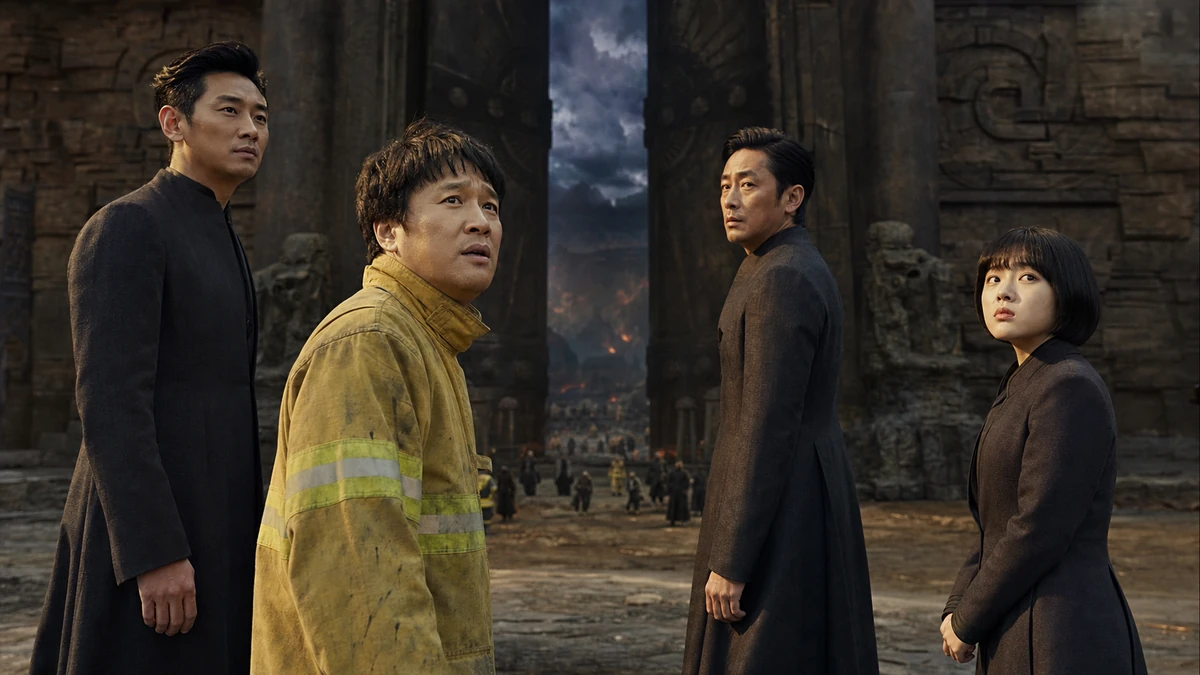
Cha Tae-hyun plays Kim Ja-hong, a firefighter killed while saving a girl from a fire. Two supernatural escorts, Haewonmak and Lee Deok-choon, meet him after his death. At the entrance to the next world, he encounters a third, Gang-lim. Together, the three guides must help him through seven trials over 49 days.
The charges cover murder, indolence, deceit, injustice, betrayal, violence and offenses against family bonds. Rather than treating his last rescue as a definitive character reference, the courts examine episodes from his life through different moral categories. The narrative tension comes from the possibility that an apparently straightforward act may look very different once its context emerges.
The escorts are not disinterested public servants. They have been promised human reincarnation if they successfully help 49 dead people reincarnate within 1,000 years. Ja-hong is their 48th client, and the first person identified as a righteous soul to appear in 19 years. His case could bring them closer to their own escape from supernatural service.
That arrangement gives the film an engine recognizable from American legal dramas: Advocates must defend a client while carrying ambitions of their own. It also makes the guides more than tour operators through an exotic landscape. Their future depends on their ability to explain another person’s past, binding the action sequences and courtroom arguments to the same objective.
Understanding the Beliefs Without Mistaking Fantasy for Doctrine
The film’s vocabulary needs some unpacking, but not a theology degree. Iseung refers to the world of the living; jeoseung is the world after death. The jeoseung chasa are messengers or escorts associated with the afterlife. Here, they guide the dead and serve as their defenders. Yeomra, an underworld judge and ruler, is the authority who has offered the escorts their chance at reincarnation.
For Americans, calling these figures grim reapers provides a rough starting point, but the comparison is incomplete. The familiar hooded figure with a scythe generally personifies death. These characters have a much broader assignment: They accompany, investigate, argue and intervene. Thinking of them as supernatural escorts with legal duties gets closer to their function in this particular story.
The 49-day period also has a cultural resonance beyond an arbitrary fantasy countdown. Forty-nine days is significant in some Buddhist mourning traditions, including those practiced in Korea. The movie draws on a broader cultural vocabulary of death, judgment and rebirth, but its elaborate procedures should not be treated as a documentary account of religious practice.
South Korea is religiously diverse, and no single movie can stand in for what Koreans believe happens after death. The safest and most rewarding approach is to understand these elements first as the rules of a fictional world. As with Greek mythology in an American adventure film, a viewer can follow the relationships and stakes without assuming that the population shares the characters’ cosmology.
What 10 Million Admissions Actually Tells Us
American entertainment coverage typically leads with box office dollars. Korean coverage often gives particular prominence to admissions — the number of tickets sold. In a country of roughly 50 million people at the time of the film’s release, surpassing 10 million admissions signals an unusually broad theatrical reach.
It does not mean that 10 million different people attended, because repeat visits count. Nor can the milestone be converted into a meaningful American revenue figure without information about ticket prices and other market conditions. Its value is as a measure of scale within South Korea’s movie business, not as a direct equivalent to a particular Hollywood opening weekend.
The film received the award recognizing the most-attended Korean film at the 2018 Blue Dragon Film Awards. It also won an audience-selected popularity award at that year’s Chunsa Film Art Awards. Those honors document its connection with mass audiences, although commercial reach and audience voting do not establish unanimous critical approval.
The distinction matters for readers encountering Korean cinema mainly through internationally celebrated directors or award-winning dramas. A domestic blockbuster offers another view of the industry: the entertainment that brings large audiences into theaters through accessible characters, heightened emotions and spectacle. Along With the Gods belongs in that discussion not because every viewer necessarily embraced its choices, but because so many bought tickets to see them.
What This Means for the United States
For the American market, the film is a useful corrective to a narrow understanding of Korean screen entertainment. U.S. viewers who associate Korean movies primarily with dark thrillers, social criticism or prestige filmmaking can find here a different commercial tradition: a broad fantasy adventure that asks audiences to invest as deeply in a mother and her sons as in the next supernatural threat.
One helpful American reference point is Defending Your Life, Albert Brooks’ 1991 comedy about a man whose conduct is examined after death. Another is The Good Place, the NBC comedy that turned the mechanics of moral judgment into a sustained argument about ethics. These are comparisons, not claims of influence. Along With the Gods uses a different cultural framework and a more emphatic mixture of danger, action and family emotion.
For U.S. distributors and other entertainment companies, the analytical lesson is that recognizable genre elements do not require identical storytelling conventions. A courtroom, a deadline and a protagonist with something to lose can provide entry points for viewers unfamiliar with Korean afterlife traditions. Explaining those entry points may be more useful than presenting the movie simply as a cultural curiosity.
The film’s Korean performance, however, does not establish American demand. The available record here supplies no U.S. box office figures, audience demographics, licensing terms or evidence of American corporate involvement. It would be a mistake to turn domestic success into a claim about profits or partnerships across the Pacific.
Its relevance to U.S.-Korea cultural exchange is more grounded: It gives American fans another way to encounter Korean storytelling on its own terms. That exchange becomes richer when audiences can recognize familiar moral questions without expecting every foreign blockbuster to behave like an American franchise movie.
Digital Spectacle Built Around an Argument
Much of Along With the Gods depends on computer-generated imagery. Its principal destinations are realms that cannot simply be found by a location scout, and the different courts and infernal spaces must feel like parts of a world with enforceable rules. The effects therefore carry narrative information as well as visual scale.
This is familiar territory for Americans accustomed to Hollywood fantasy. An invented setting works best when the audience understands not only what it looks like, but also what can happen there and why it threatens the characters. In this film, the supernatural environment gives physical form to judgment. The landscape is part of the prosecution’s power, not merely scenery behind the dialogue.
The technical work received recognition across several Korean awards organizations. Jin Jong-hyun won the film arts award at the 2018 Baeksang Arts Awards and technical honors at the Korean Association of Film Critics Awards and the Blue Dragon Film Awards that year. Those awards support a concrete claim about professional recognition; they do not require assuming that every effect or sequence was universally praised.
Recognition also extended beyond the digital work. Kim Yong-hwa won the Baeksang directing award, while Kim Hyang-gi received the Blue Dragon supporting actress award. Kim Dong-wook earned a supporting actor award at Chunsa. The range matters because it challenges an easy dismissal of the film as a technical demonstration. Its spectacle depends on performers making an imaginary system feel consequential to people with recognizable fears and attachments.
Adapting a Comic by Redistributing Its Work
The move from Joo Ho-min’s comic to the screen involved more than turning drawings into moving images. One important change concerned who would do the explaining and defending. The original includes a character named Jin Gi-han; the film gives Gang-lim the role that character would otherwise perform, combining responsibilities within the supernatural escort team.
That choice connects two narrative functions: guiding Ja-hong through an unfamiliar world and arguing his case inside it. Rather than asking a newcomer to track separate figures for the journey and the legal defense, the adaptation builds those duties into an existing central character.
American audiences know the broader problem from comic book and novel adaptations. A sprawling source can sustain side characters, parallel threads and extended explanations that compete for space in a feature film. Consolidating roles changes the original, but fidelity cannot be assessed solely by counting what survives. The more revealing question is what the change does to the audience’s understanding of motivation and relationships.
Here, the arrangement strengthens the link between movement and advocacy: The person helping the firefighter proceed is also helping interpret his life. Viewers who have never read the comic can follow the core relationship without a separate orientation to its original cast. That is an adaptation strategy worth examining on its own, rather than treating every departure as either a betrayal or an automatic improvement.
The Hardest Questions Are About Work and Family
Ja-hong’s occupation gives the moral inquiry an immediate point of contact with American audiences. Firefighters occupy a familiar place in U.S. public life as people expected to enter danger for others. By introducing him through a fatal rescue, the movie establishes a powerful presumption of selflessness — then tests whether that public identity can explain a whole person.
One proceeding raises his failure to save a fellow firefighter. The juxtaposition is uncomfortable by design: A man who saved a child must still answer questions about someone he could not save. It invites consideration of how responsibility should be assigned under emergency conditions, when hindsight may offer clarity that was unavailable in the moment.
This is not evidence about the actual performance or working conditions of Korea’s fire services. It is an ethical problem dramatized through one fictional worker. The distinction keeps the analysis focused while allowing the question to travel: What does a profession demand, and when does an expectation become an impossible standard?
The family story complicates the record further. Ja-hong’s mother and younger brother, Kim Su-hong, reveal relationships that cannot be reduced to his role as a rescuer. One trial concerns cheollyun, a term associated with fundamental family bonds and obligations. In this context, it asks viewers to consider duties within a family, not simply whether someone violated a rule.
Traditions emphasizing filial responsibility give that question particular cultural weight in Korea, but neither family devotion nor family conflict is uniquely Korean. Americans can recognize the gap between loving a relative and behaving well toward that person. The film’s task is to make that gap visible without allowing a single label — hero, son, brother or defendant — to end the inquiry.
From the Multiplex to the Holiday Living Room
The film’s life beyond theaters provides another perspective on its place in Korean popular culture. On Sept. 26, 2018, it aired as a Chuseok holiday movie through SBS and its regional broadcasting network, including KNN. The reported television rating exceeded 13.6%.
Chuseok is a major Korean holiday associated with family gatherings, ancestral remembrance and harvest traditions. For an American reader, Thanksgiving offers a limited comparison in terms of family travel, shared meals and prominent holiday television programming, though the holidays have different histories and customs.
A film about family obligations arriving in that viewing environment acquires a different setting from its initial theatrical run. The story moves from an outing organized around a large screen to programming available in the household during a major family holiday. That helps explain why the broadcast belongs in an account of the movie’s reach, even without evidence establishing why individual viewers tuned in.
The television rating and theatrical admissions measure different things and should not be added together. What they establish separately is a history of encounters with audiences in more than one format. For American observers following Korean entertainment, that history is worth watching alongside international visibility: how a work succeeds at home, how it circulates afterward and whether its cultural particulars remain legible to new viewers. Along With the Gods offers a durable example of a fantasy whose unfamiliar world opens onto a very familiar demand — to hear the whole story before passing judgment.
Comments
Post a Comment