Image to help understand the article
A family trip, a missing daughter and a body in the trunk
South Korean director Kim Mijo’s new film, The Journey to Gyeongju, opened its first week in theaters with a strong enough showing to land No. 3 at the overall Korean box office and No. 1 among Korean films. On paper, that may sound like a routine release-week result. In practice, it says something more revealing about where Korean cinema is headed in the second half of the decade: audiences are still showing up for local films that can package emotional intimacy, social unease and genre tension into one commercially legible product.
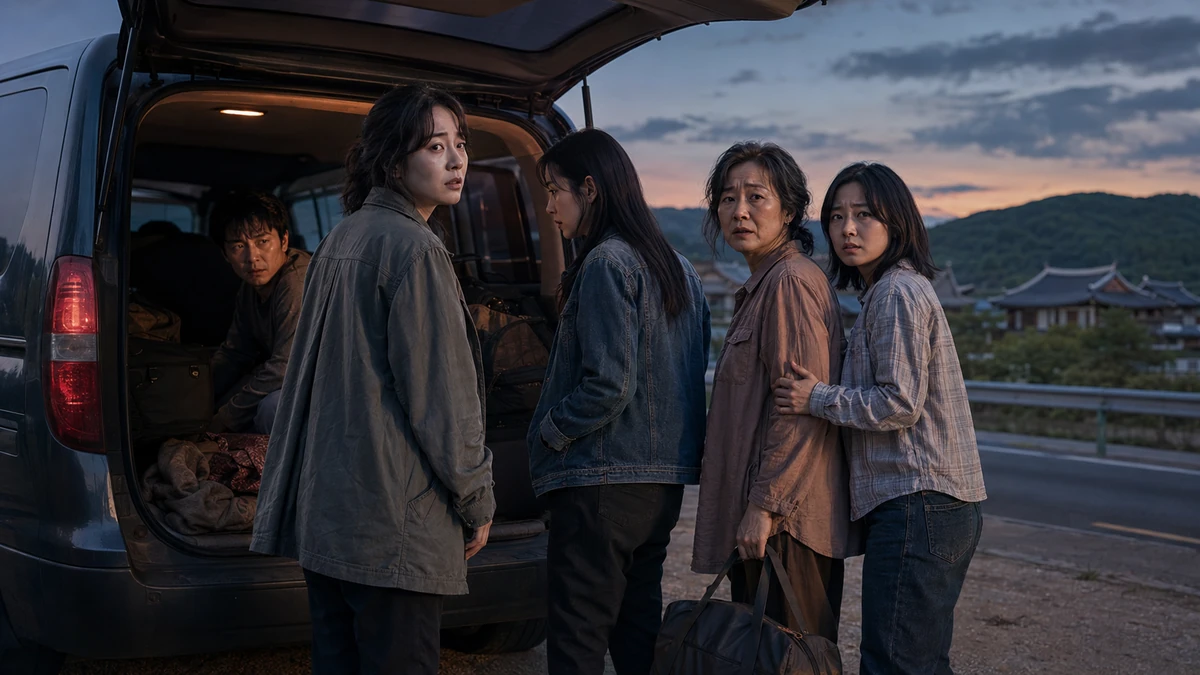
The Journey to Gyeongju, released in South Korea on Aug. 26, is officially classified as a crime film. But the hook is not a police procedural or a standard gangster setup. It begins with a mother and her three daughters setting out on a family trip to the historic city of Gyeongju to mark the birthday of the youngest daughter, who never came home after a school trip eight years earlier. Then comes the destabilizing detail: inside the trunk of the family’s van is an unidentified man.
That collision between the ordinary and the ominous is the movie’s selling point. To an American audience, the closest shorthand might be to imagine a family-drama setup that suddenly swerves into something with the menace of a neo-noir or psychological thriller. The image is intentionally jarring. Matching family T-shirts suggest the kind of sentimental group trip that, in the United States, might evoke a summer highway vacation, a memorial gathering or a reunion pilgrimage. The man in the trunk turns that familiar picture inside out.
The title matters, too, in a way that may not be immediately obvious to non-Korean viewers. “Gyeongju” is both the name of the missing youngest daughter and the destination city. That dual meaning is central to the premise. The family is traveling toward a place that also carries the name of the person whose absence defines them. In English, The Journey to Gyeongju sounds straightforward enough. In Korean, the title carries an added echo, binding grief, geography and memory into a single phrase.
The film’s first-week results, based on Korea’s official box-office tracking system run by the Korean Film Council, show 187,901 admissions between Aug. 24 and Aug. 30, with cumulative admissions at 192,380 and weekly revenue of 1.82 billion won. Those are not blockbuster numbers on the scale of a major franchise tentpole. But for a domestic crime film built around an unsettling family premise rather than an obvious spectacle concept, the opening is meaningful. It places the movie in the upper tier of the week’s theatrical market and, just as importantly, at the top of the Korean-produced field.
Why the setup feels distinctly Korean — and widely legible
Part of what makes the premise intriguing is how specifically Korean it is, even as its emotional mechanics travel well. South Korean films often excel at taking everyday social structures — family, school, the workplace, neighborhood life — and revealing pressure points beneath them. American viewers have seen versions of this dynamic in internationally successful Korean titles that use domestic spaces and familiar rituals as staging grounds for dread, resentment or buried violence.
Here, the family road trip itself is the trapdoor. In Korean culture, as in many others, family outings can carry a powerful sense of obligation as well as affection. Group travel, commemorative birthdays and coordinated clothing can all signal togetherness, but they can also expose fault lines within the family unit. The premise of a trip honoring a daughter who disappeared years ago taps into mourning, ritual and unresolved trauma all at once.
The destination city of Gyeongju adds another layer that American readers may need explained. Gyeongju, often described as a kind of “museum without walls,” is one of South Korea’s most historically significant cities, known for its royal tombs, archaeological sites and deep association with the ancient Silla kingdom. In Korean popular imagination, it is a place of heritage, memory and accumulated time. That makes it an especially loaded setting for a story about loss and a family haunted by a person who never returned.
Even without seeing the film, the official synopsis tells you what kind of tension it wants to create. It withholds explanation. Who is the man in the trunk? Why is he there? Is the family implicated in a crime, covering one up, or entering one? The movie’s marketing appears to lean on that unresolved contradiction rather than spelling out plot twists in advance. That, too, fits a broader Korean genre tradition, one that often trusts viewers to sit with moral ambiguity instead of rushing to provide clean labels for victim, perpetrator and witness.
In the United States, crime films centered on families often split into recognizable categories: mob sagas, suburban thrillers, true-crime adaptations or prestige indies built around a buried secret. Korean cinema frequently blurs those lines. It is comfortable moving between melodrama and menace in the same scene. A family dinner can become a confession chamber; a casual errand can turn into a catastrophe. The Journey to Gyeongju appears to belong to that tradition, where genre is less a strict container than a tension system laid over daily life.
What the opening-week numbers really say about the Korean market
The most important fact in the box-office data is not simply that the film placed third overall. It is that among Korean films, it ranked first for the week. That distinction matters because South Korea’s theatrical market remains highly competitive, with local productions constantly measured against Hollywood imports and other international releases. Finishing as the top Korean title indicates that the film cut through in a crowded environment and found an audience quickly enough to register as more than niche counterprogramming.
Korean box-office reporting is usually framed around admissions rather than just gross revenue, a useful reminder that the local industry still pays close attention to actual audience turnout. By that measure, nearly 188,000 viewers during the opening week is a visible start. It does not, on its own, tell us whether the film will become a breakout success or merely a respectable performer. But it does tell us that the premise, cast and release strategy were strong enough to generate immediate curiosity.
That matters in a post-pandemic, streaming-saturated environment where theatrical attendance is harder to take for granted. The Korean industry, like the American one, has been grappling with fragmentation: tentpoles still matter, but so do films that can persuade moviegoers to leave home for something that feels eventful in a different way. A midrange crime drama with a premium cast and a potent mystery may be one answer to that challenge.
There is also a broader industrial signal here. Korean cinema has spent years building a global reputation on bold genre storytelling, but domestic success still matters enormously. International acclaim can elevate a country’s film brand, yet a healthy local market is what allows directors and production companies to keep making varied work. When a film like The Journey to Gyeongju posts solid opening numbers without relying on superhero-style scale, it suggests that Korean audiences are still willing to support distinctive homegrown stories in theaters.
None of that means the movie is guaranteed to enjoy long legs. First-week rankings are only one snapshot. Without budget details or a break-even point, it is impossible to say how the film stands commercially in a fuller sense. What can be said is narrower and more useful: the movie entered the market with enough force to become part of the national conversation, and its performance offers another data point in the enduring marketability of Korean genre films led by recognizable talent.
The cast and director help explain the early attention
The film arrives with a cast that gives it immediate credibility for Korean audiences. Lee Jung-eun, Gong Hyo-jin, Park So-dam, Lee Yeon and Byun Yo-han are all listed among the principal performers. The official materials do not specify which actor plays which family member, so it would be inaccurate to assign roles beyond what has been formally disclosed. But the lineup alone helps explain why the movie drew notice from the start.
For many international viewers, Park So-dam will be the most instantly recognizable name because of Parasite, the Oscar-winning film that permanently changed the place of Korean cinema in American movie culture. Lee Jung-eun is also familiar to global audiences from her work in Korean film and television, including projects that have circulated widely through streaming. Gong Hyo-jin has long been a major presence in Korean entertainment, especially for domestic audiences who know her from both film and television. Byun Yo-han similarly carries strong industry recognition. Together, the cast gives the project a mix of arthouse prestige and commercial appeal.
Kim Mijo’s filmography is another reason the project stands out. The Korean Film Council lists previous representative works including Hommage, Galmaegi and other titles associated with character-driven storytelling. That background makes The Journey to Gyeongju notable not just as a crime release, but as a crime film shaped by a director with a record of working through memory, identity and interpersonal tension. For American readers, that is worth emphasizing because Korean genre films are often at their best when they are made by directors who treat suspense as a vehicle for deeper social and emotional inquiry rather than as an end in itself.
The running time — 110 minutes — also suggests a film designed to maintain tension without overstaying its premise. And its South Korean age rating, restricted to viewers 15 and older, places it in a space roughly analogous to mainstream teenage-and-up accessibility rather than extreme adult-only provocation. That can matter commercially. It broadens the potential audience while still allowing for mature subject matter.
The production company is Studio High Five, with distribution handled by Lotte Cultureworks and Lotte Entertainment, one of the major players in the Korean film business. For American readers less familiar with the Korean market, that distribution backing is significant. It means the film is not being launched in an ad hoc way; it is entering theaters through an established commercial apparatus with the capacity to position it nationally.
What this means in the United States
For American audiences and companies, the bigger story is not whether The Journey to Gyeongju becomes a major crossover hit. It is what films like this reveal about the durability of South Korea’s screen industries as a source of exportable storytelling. Over the past decade, the United States has moved from treating Korean film and television as niche imports to recognizing them as a regular part of the entertainment conversation. That shift has been driven by streaming, festival circulation, the global success of Korean series and films, and the rise of a U.S. audience that is more comfortable than before with subtitles.
A movie like The Journey to Gyeongju fits squarely into that new landscape. It has a premise that is culturally specific yet easy to pitch internationally: a grieving family goes on a memorial trip while hiding a stranger in the trunk. That kind of setup is legible to American distributors, streamers and festival programmers because it promises suspense while offering emotional and cultural texture. It is the sort of concept that can travel, whether through specialty theatrical release, streaming acquisition or later adaptation conversations.
There is also an industry lesson here for U.S. studios and platforms. Korean producers have become particularly adept at building stories from a simple but destabilizing contradiction — rich family, poor family; school trip, disappearance; family vacation, hidden crime. American executives spend enormous sums looking for “high-concept” material that can be summarized in one sentence while still feeling fresh. Korean cinema has repeatedly shown how to generate that effect without sacrificing tonal complexity.
For U.S.-Korea cultural ties, films like this matter beyond ticket sales. South Korea’s entertainment industries have become a form of soft power with real commercial consequences. American companies license Korean formats, co-produce content, recruit Korean creators and monitor Korean audience trends because the country functions as both a domestic market and an innovation hub. Every successful local release helps reinforce the idea that Korea is not just exporting isolated global phenomena, but sustaining a broader creative ecosystem.
American fans are part of that equation, too. Viewers in the United States who discovered Korean entertainment through globally visible titles are increasingly following actors, directors and companies across projects rather than showing up for only one breakout sensation. If The Journey to Gyeongju reaches the U.S. through festivals, art-house booking or streaming, it will land in a market that is much more prepared for it than it would have been 10 years ago.
That does not mean every Korean box-office performer will translate into an American success story. Cultural specificity can be an asset, but it is not a guarantee of crossover. Some titles travel because of awards momentum; others because of stars; others because the genre hook is irresistible. What matters is that there is now a real pathway. The American market no longer treats Korean film as an occasional discovery. It treats it as a pipeline worth watching.
A wider trend: Korean genre storytelling keeps widening its emotional range
One reason this film is worth attention now is that it appears to sit at the intersection of several longer-running trends in Korean screen storytelling. The first is the continued strength of genre hybridity. Korean filmmakers have long resisted neat categories, and audiences have rewarded that approach. Comedy bleeds into horror; domestic drama slips into suspense; crime stories double as meditations on class, grief or institutional failure. The Journey to Gyeongju seems designed around exactly that kind of tonal friction.
The second trend is the use of women-centered ensembles in narratives that refuse to keep women at the margins of action. Here, the central image is not a lone male antihero or detective but a mother and daughters in motion, carrying an unresolved history and an apparent secret. Even without knowing where the plot goes, that framing distinguishes the film from more conventional crime templates. It suggests a story in which family memory and female relationships are not side ingredients but the engine of suspense.
The third trend is the repurposing of familiar Korean social rituals into sources of dread. In American genre terms, this is somewhat like taking the emotional grammar of Thanksgiving, a family road trip or a memorial service and making the audience ask what is being performed versus what is being concealed. Korean filmmakers have become especially skilled at turning customs associated with duty and togetherness into spaces where guilt, resentment and denial can no longer stay hidden.
That matters because it points to why Korean content continues to resonate globally. It is not simply that the stories are “different.” It is that they often dramatize pressures that audiences everywhere recognize: the family script you are expected to follow, the dead person whose absence organizes the living, the unspoken thing in the car with everyone pretending the trip is normal. Those are culturally grounded images, but they are also universally legible ones.
If the movie sustains word of mouth, it could become another example of how Korean cinema turns conceptual sharpness into commercial curiosity. If it fades quickly, it may still remain noteworthy as a sign of what kinds of films are being positioned for the local theatrical market: not only spectacle and franchise entries, but controlled, star-driven stories that offer mood, mystery and a recognizable emotional anchor.
What to watch next
The next question is whether The Journey to Gyeongju can hold attention beyond its opening frame. In any market, a strong premise can buy a film a first weekend; only audience response determines what happens after. For Korean cinema, where social media chatter, critical reaction and word of mouth can shape a film’s trajectory quickly, the coming weeks will show whether viewers embrace the film as a must-see thriller, a prestige ensemble drama or something in between.
Internationally, the key thing to watch is distribution. Will the movie secure festival attention outside Korea? Will an American streaming platform or specialty distributor see it as a viable acquisition? Will the presence of globally familiar performers help it travel? Those are the practical steps that often determine whether a Korean release remains a domestic talking point or becomes part of a wider global conversation.
For American observers of the Korean Wave, the deeper significance lies in continuity. A film does not need to become the next awards phenomenon to matter. Sometimes the more revealing development is that South Korea continues to produce commercially viable midrange films with strong casts, clear hooks and culturally rooted storytelling. That is the infrastructure beneath the headlines — the day-to-day strength that makes occasional global breakthroughs possible.
In that sense, The Journey to Gyeongju is more than a one-week box-office item. It is a reminder that Korean cinema’s international appeal has never rested on novelty alone. It rests on craft, on confidence in local detail, and on a willingness to treat family life not as a safe space but as a stage where the country’s anxieties can be acted out with unnerving force. For American audiences who have learned to expect something sharper, stranger and more emotionally exacting from Korean storytelling, that may be the most familiar part of all.
Comments
Post a Comment