A Korean Crime Film Turns a Family Trip Into a Box Office Signal — and Offers a Window Into What U.S. Audiences May Want Next
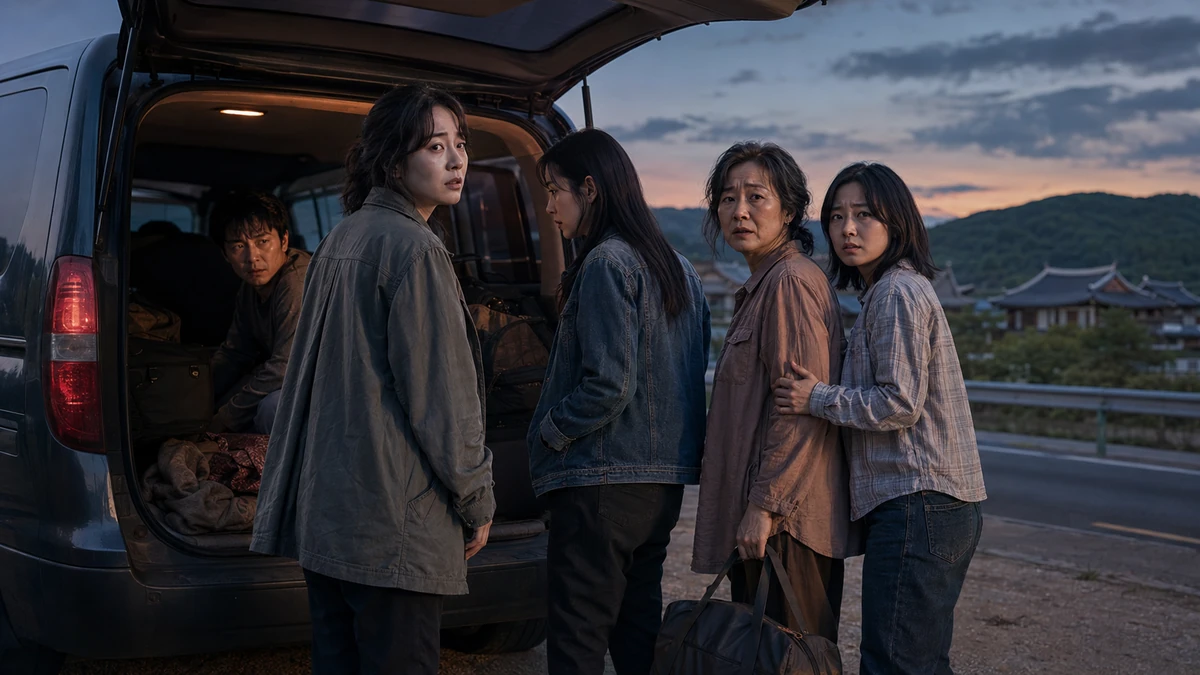
Image to help understand the article
A family road trip, a missing daughter and a body of unresolved grief
South Korean moviegoers have given an early vote of confidence to a crime film built on one of the oldest dramatic tricks in cinema: take something ordinary, even comforting, and place something deeply wrong inside it. In director Kim Mijo’s “The Journey to Gyeongju,” a mother and her three daughters set out on what appears to be a family trip to mark the birthday of the youngest daughter, who never returned from a school excursion eight years earlier. They wear matching shirts, pile into a van and head to Gyeongju, a historic city in southeastern Korea known to many Koreans as a place of memory, heritage and school travel. Then comes the destabilizing image at the center of the film’s pitch: an unfamiliar man is riding in the trunk.
That premise alone helps explain why the movie has drawn attention in its opening frame. According to official Korean Film Council, or KOFIC, box office data cited in the source material, the film ranked No. 3 overall for the week of Aug. 24 to Aug. 30, the week that included its Aug. 26 release, and No. 1 among Korean films. It sold 187,901 tickets during that weekly counting period and reached 192,380 admissions cumulatively, with weekly revenue of 1.82 billion won. In American box office terms, that distinction matters. The film was not the top release in the market overall, but it outperformed every other domestic Korean title in that window, a meaningful sign in a theatrical landscape where local films are often judged not just against one another but against Hollywood imports and franchise-driven competition.
For readers in the United States, the setup may sound like an arthouse cousin to the kind of tonal collision American filmmakers also love: imagine the visual grammar of a family reunion movie crossed with the dread of a kidnapping thriller, or the tension of a Coen brothers roadside crime story stripped of irony and rooted instead in maternal grief. What makes “The Journey to Gyeongju” distinctively Korean is not that the emotions are foreign. It is that the movie appears to draw suspense from highly recognizable social imagery in Korea: the family outing, the commemorative birthday ritual, the matching group shirts, the lingering trauma tied to school-age absence and the loaded significance of Gyeongju as a destination.
The result, at least from the available synopsis, is less a whodunit than a tightly wound contradiction. The film invites audiences to watch two realities occupy the same frame. On one side is the performance of family togetherness. On the other is a crime-story premise the characters have not fully explained. That clash is often where contemporary Korean genre filmmaking has proven especially adept: not merely delivering suspense, but using suspense to expose fractures inside domestic life, social rituals and public appearances.
Why Gyeongju matters, and why the title carries extra weight
American readers may need a bit of cultural translation here, not of language but of meaning. Gyeongju is not just another city name. Often called “the museum without walls,” it was the ancient capital of the Silla kingdom and remains one of South Korea’s most historically resonant destinations, filled with tombs, temples and archaeological sites. For many Koreans, it is a place associated with school trips, family travel and a national sense of continuity. If a U.S. filmmaker set a mystery against a family trip to Williamsburg, Virginia, or perhaps a historically symbolic route through Gettysburg, the place itself would already carry emotional and civic associations beyond geography. Gyeongju functions in a somewhat comparable way, though within Korea’s own historical memory.
There is another layer to the title and synopsis that matters. “Gyeongju” is both the destination and the name of the missing youngest daughter. That overlap is not a minor wordplay flourish. It turns the journey into something doubly haunted. The family is traveling to Gyeongju while also traveling toward Gyeongju, the absent person whose birthday they are marking. For international audiences unfamiliar with Korean naming and place-name conventions, this is one of the key details that clarifies the film’s conceptual design. The destination is also a reminder; the road trip is also a ritual of mourning.
The source material notes that the youngest daughter disappeared after leaving on a school trip eight years earlier and never returned. In Korea, as in the United States, school excursions carry a strong emotional charge because they combine youthful independence, institutional trust and parental worry. Any story built around a child or teenager who vanishes on such a trip touches a deep nerve. That does not make this film a social-issue drama by default, and the publicly available synopsis does not reveal where the crime plot leads. But it does suggest that the movie is drawing on a specific kind of fear: what happens when a routine social ritual becomes the dividing line between before and after for a family.
The matching shirts are another detail that may read differently to Korean and American audiences. In Korea, coordinated family or group shirts on trips are not unusual and can signify both affection and a highly visible kind of togetherness. To U.S. readers, the closest equivalent may be family reunion T-shirts, church retreat shirts or coordinated outfits on a Disney vacation. In other words, the image can feel wholesome, even slightly cheerful or corny. That is exactly why the image of a stranger in the trunk lands so hard. The film’s premise appears to weaponize familiarity.
What the opening-week numbers say about the Korean market
Opening-week rankings do not tell the whole story of a movie’s long-term commercial future, but they do tell us something about positioning. “The Journey to Gyeongju” placed third overall during its opening week while finishing first among Korean films. That means the movie found traction in a crowded field and did so not as an effects-driven tentpole, but as a midlength, 110-minute crime film led by a director and cast with strong recognition among Korean audiences. In South Korea’s exhibition market, where local productions compete in a sophisticated moviegoing culture that can quickly elevate or dismiss new releases, such a result suggests that the film entered the conversation with real force.
American readers should also understand the importance of admissions in the Korean market. Korean film reporting frequently emphasizes ticket buyers, not just gross revenue, and admissions can be especially helpful for understanding a film’s reach across audiences. The source provides both: 187,901 weekly viewers and 1.82 billion won in weekly box office revenue. While those figures are modest by Hollywood blockbuster standards, that is not the right comparison. The more useful lens is relative market performance. The film was the highest-ranked Korean title of the week, which positions it as a domestic standout even if global audiences have not yet heard of it.
That matters because South Korea has one of the world’s most closely watched national cinemas. For more than two decades, Korean filmmakers have shown unusual fluency in blending genre mechanics with social unease, often turning family stories into thrillers or thrillers into commentaries on class, trauma or memory. A film does not need to become a worldwide smash to matter. Sometimes the most important signal is that local audiences are rewarding a form of storytelling they recognize as their own, particularly at a moment when theatrical business in many countries remains under pressure from streaming and franchise concentration.
The distributor, Lotte Entertainment, is also a major name in the Korean industry. In U.S. terms, that does not guarantee a crossover breakout, but it does indicate a film backed by significant domestic infrastructure. The production company is Studio High Five, and the film carries a 15-and-older rating in Korea, broadly indicating material considered suitable for teens and adults under Korean standards. As always, that rating would not automatically translate to an MPAA equivalent in the United States, but it suggests a mainstream adult-oriented release rather than extreme niche fare.
Perhaps the clearest takeaway is that Korean audiences appear willing to turn out for a crime film that is sold not through spectacle but through dissonance: a recognizable family scene that hides danger. That is a valuable market clue in an era when many theatrical businesses, including America’s, are asking what kinds of non-franchise films can still command attention. Korea’s answer, at least in this case, may be that audiences remain interested in smart genre cinema anchored in performance and premise.
The filmmakers and cast point to a familiar Korean strength: prestige talent in commercial genre work
Kim Mijo is not being introduced here as a first-time curiosity but as a filmmaker with an existing body of work. The source cites representative titles from her filmography including “Waterdrop,” “Hommage,” “Seagull,” “Emma and Yisu,” “Hate Family” and “Tongue.” That matters because one of the enduring strengths of the Korean film industry has been its ability to move directors between festival-recognized sensibilities and commercially accessible genre frameworks. In American terms, think of filmmakers who can carry independent credibility into a wider-release thriller without flattening their voice in the process.
The cast likewise helps explain the film’s opening traction. Lee Jung-eun is well known internationally, with many American viewers likely recognizing her from “Parasite” and television roles that traveled abroad through both streaming and festival circuits, even if the source lists different representative credits. Gong Hyo-jin has long been one of Korea’s most recognizable screen performers, particularly admired for roles that combine warmth, intelligence and emotional precision. Park So-dam is another familiar face to global audiences because of “Parasite,” while Lee Yeon and Byun Yo-han add further depth to a lineup that is likely to attract viewers on names alone.
One detail worth handling carefully: the source explicitly says the official information provided does not match each actor to a specific character in the family. That is important from a journalistic standpoint. It means any coverage should avoid guessing who plays the mother, which daughters are played by which actors or how the stranger in the trunk fits into the cast lineup. In a media environment where entertainment reporting often fills gaps with speculation, restraint is part of accuracy.
Even without those role assignments, the casting points to a larger Korean industry pattern that American audiences increasingly recognize. Korean cinema routinely places major actors in films that are neither superhero-scale nor micro-budget niche projects, allowing star power to elevate stories that depend on mood, moral ambiguity and ensemble tension. Hollywood used to do this more often in the studio thriller era of the 1990s and early 2000s. Today, many of those mid-budget adult thrillers struggle to get made for wide theatrical release in the United States. Korean cinema has remained one of the places where that lane still feels alive.
That is one reason Korean films continue to travel so well internationally even when they are culturally specific. The emotional engine is legible, the formal confidence is high and the performers are treated as central attractions rather than interchangeable parts in an intellectual property machine. If “The Journey to Gyeongju” eventually reaches U.S. festivals, arthouse theaters or streaming platforms, American audiences may find it accessible for exactly that reason: not because it has been simplified for export, but because it trusts character and tension more than exposition.
What this means for the United States
For American audiences and companies, the early performance of “The Journey to Gyeongju” matters less as a one-week box office headline than as another reminder of how Korean screen storytelling continues to shape global taste. The United States has already seen the broader Korean wave transform consumer habits across music, television, beauty and food. Film is part of that same ecosystem, but it plays a distinct role. Korean movies, especially crime films and thrillers, have helped teach U.S. viewers to expect sharper tonal turns, denser moral ambiguity and more audacious genre blending than mainstream American studios often provide.
That has commercial implications. U.S. specialty distributors, streamers and exhibitors have become more attentive to Korean titles not simply because of awards prestige after “Parasite,” but because there is a real audience for them. American viewers who embraced “Parasite,” “Decision to Leave,” “Train to Busan” and a range of Korean series on Netflix are not looking only for “foreign films” in the old art-house sense. They are looking for compelling stories, and many now understand that Korea is a reliable source of them. A movie like “The Journey to Gyeongju,” if marketed effectively, could appeal to that audience through its premise alone: family grief, a mysterious man in a trunk and a road trip to a city loaded with memory.
For U.S. companies, the lesson is also strategic. Hollywood has spent years debating the disappearance of the adult-oriented mid-budget thriller from theaters. Korean cinema has not solved every problem of the global film business, but it has preserved more space for exactly that kind of work. American studios, streamers and independent financiers can study not just the stories but the market behavior: audiences will still show up for suspense built around actors, tone and a clear hook if the film feels specific rather than generic.
There is also a U.S.-Korea relationship angle here. Cultural exports have become one of South Korea’s most effective forms of soft power, deepening people-to-people familiarity between the two allies beyond military ties, trade and diplomacy. Every Korean film that finds traction abroad, especially one rooted in unmistakably Korean settings and rituals, broadens what American audiences think they know about Korea. Not all of those films need to be historical epics or globally awarded prestige dramas. Sometimes a crime movie does more to normalize cultural curiosity than a formal diplomatic campaign ever could.
At the same time, this is where caution matters. The source provides no evidence yet of a U.S. release plan, American distribution deal or North American box office outlook. So the U.S. significance here is not that the film is already a crossover hit. It is that the conditions for interest increasingly exist. The American market is more Korean-literate than it was a decade ago, and a film like this enters that environment with advantages its predecessors did not have: better audience familiarity, stronger platform pathways and a wider base of viewers willing to read subtitles if the story is worth it.
A trend, not just a release: Korean cinema keeps turning domestic space into suspense
If there is a larger trend embedded in “The Journey to Gyeongju,” it is this: Korean filmmakers remain unusually skilled at finding menace inside the structures people are supposed to trust most. Families, neighborhoods, schools, apartment buildings, workplaces and local trips all become pressure cookers. The genre label may be crime, but the deeper subject is often social performance. What do people hide in order to keep an ordinary scene intact? What violence or grief sits just outside the frame of respectability? Those are questions Korean film and television have returned to repeatedly, and audiences at home and abroad have kept responding.
That pattern resonates in the United States because American viewers know this storytelling mode too, even if the Korean execution often feels sharper. Some of the best U.S. thrillers and prestige TV dramas also work by revealing that suburbia, family ritual or institutional normalcy can conceal cruelty. The difference is that Korean cinema frequently pushes the contrast further and with less fear of tonal risk. It may begin with a scene that looks almost sitcom-familiar, then shift into dread without warning. The source summary suggests that “The Journey to Gyeongju” is built precisely on that collision.
The choice to withhold later plot details in the synopsis is also revealing. Rather than selling a complicated mystery architecture, the film is being sold on its central contradiction. That is often a sign of confidence. It tells audiences the filmmakers believe the image itself is enough to create curiosity: a family driving to commemorate a missing daughter’s birthday, and a stranger hidden in the trunk. In a crowded media environment, that kind of instantly graspable but emotionally unsettling premise may be one of the few things that still cuts through.
What to watch next will be simple but important. In Korea, the key question is whether the movie shows staying power beyond opening week and whether word of mouth builds around performance, atmosphere or a twist-heavy resolution. Internationally, the next question is whether buyers and programmers see a path for the film in overseas markets. If they do, American viewers may eventually encounter it not as a cultural homework assignment but as something better: a gripping thriller that also happens to teach them, almost incidentally, about the emotional textures of Korean family life, memory and place.
That may be the most durable lesson here. The global Korean wave is not powered only by polished export products designed to travel easily. It is also powered by local stories that trust their own textures. “The Journey to Gyeongju” appears to be one of those films. Its opening-week ranking in Korea suggests that audiences responded to a premise in which mourning, family ritual and criminal tension share the same vehicle. For American readers, the significance lies not just in whether this one title eventually arrives stateside, but in what it says about the continuing vitality of Korean cinema as a source of stories the U.S. market increasingly recognizes it wants.
Comments
Post a Comment