A Korean Snack Maker’s New Cheese Chip Reveals How Fast Food Trends Now Move From Social Buzz to Core Business
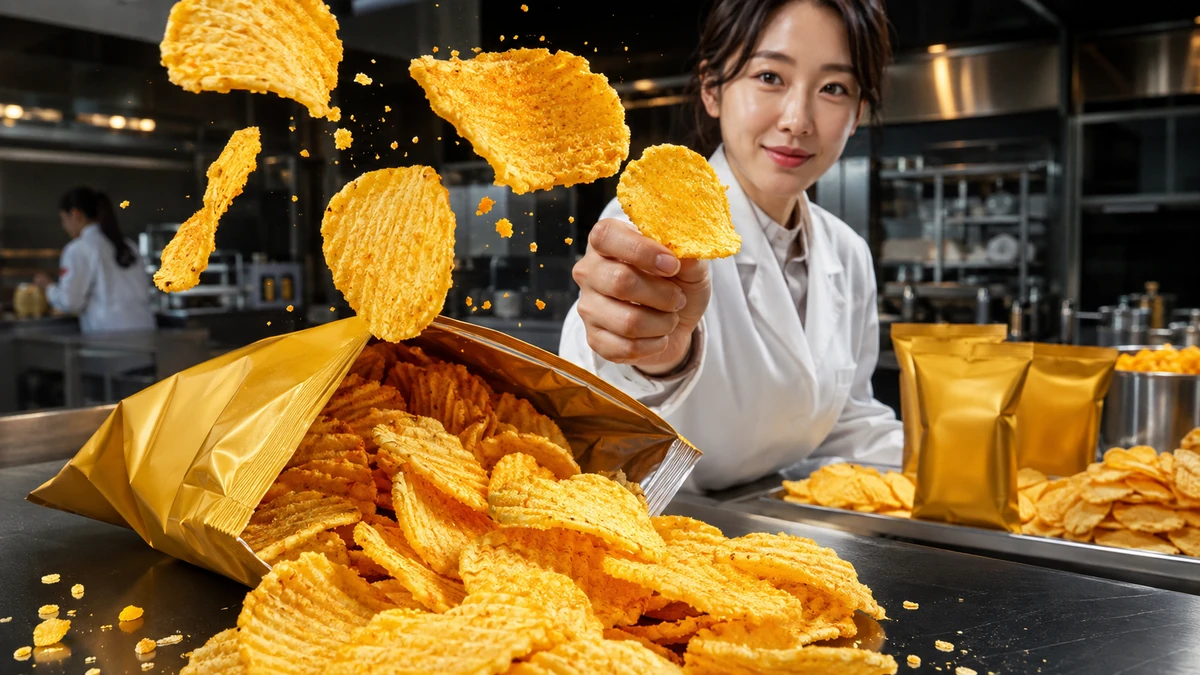
Image to help understand the article
A potato chip launch that says more than it seems
To an American reader, the announcement might sound small: Orion, one of South Korea’s best-known snack companies, is releasing a new potato chip called Poca Chip Hwang Cheese Flavor, a version of its long-running potato snack coated twice in cheese seasoning to create a richer, more intense taste. On the surface, this is the kind of product news that would barely rate a mention outside the food business pages. Companies launch flavored chips all the time. Grocery aisles in the United States are built on that logic, from limited-edition Lay’s contests to seasonal Oreos and hot-sauce-inflected everything.
But in South Korea’s consumer market, this release tells a bigger story about how food companies increasingly test, validate and scale trends at high speed. Orion’s new chip is not simply a new SKU, to borrow the retail term. It is the latest step in a broader strategy built around a single flavor profile — “hwang cheese,” or yellow cheese — that the company has been extending across multiple products after seeing strong reaction to a limited-edition launch earlier this year.
That sequence matters. According to the Korean news summary, Orion first introduced a limited-edition moist chip snack in a yellow cheese flavor in February. The product gained traction on social media and sold out at some retailers, prompting additional small-batch production runs in April and June. Orion then expanded the same flavor identity into other products, including a cookie and another snack brand, before bringing it to Poca Chip, one of its flagship potato chip lines. In other words, the company used a limited release not as a one-off publicity stunt, but as a live market test that helped shape a longer-term portfolio strategy.
That is a pattern American consumers already know, even if the packaging and flavor names are different. What once looked like novelty has become product development. A flavor trend can begin as an internet curiosity, move through scarcity and “sold out” hype, then settle into the permanent shelf set if enough people keep buying. Orion’s yellow cheese expansion is a Korean example of that global playbook — and a sign of how competitive, data-sensitive and responsive the country’s snack industry has become.
It also offers a useful window into Korean consumer culture for readers outside Asia. South Korea’s food market moves quickly, and brand loyalty there often coexists with strong appetite for novelty. Consumers are highly connected online, convenience stores play an outsized role in everyday food discovery, and social media chatter can quickly influence buying behavior. In that environment, a successful flavor can become more than a fad if a company is nimble enough to translate buzz into a durable brand strategy.
What “yellow cheese” means in a Korean snack context
The phrase “hwang cheese,” literally “yellow cheese,” may sound unusual to American ears, because it is not a standard flavor category in the United States. In Korea, however, the term generally signals a bold, familiar, processed-cheese style profile — rich, salty, creamy and visually associated with the bright orange-yellow color Americans might connect with cheddar snack powders, cheese puffs, movie theater nachos or boxed macaroni and cheese. It is less about artisanal terroir than about recognizability and intensity.
That distinction is important. Orion is not pitching an exotic cheese concept. If anything, the company is doing the opposite. It is taking one of the world’s safest flavor pairings — potato and cheese — and trying to make it feel new through technique and product design. The company says the new Poca Chip uses a double cheese coating, the first time it has used that approach in the Poca Chip line, to emphasize the deeper flavor associated with yellow cheese while preserving the familiar identity of a classic potato chip.
That kind of messaging reflects a truth that food marketers everywhere understand: consumers may say they want novelty, but they often buy familiarity with a twist. In the United States, that is the logic behind a spicy ranch chip, a birthday-cake version of a standard dessert, or a premiumized take on a childhood snack. The base stays understandable. The innovation comes from texture, intensity, format or the promise of a stronger sensory hit.
In Korea, where imported Western flavors are often localized and reinterpreted, “cheese” itself has become a flexible cultural shorthand. It can suggest indulgence, youth appeal, comfort food, or a kind of social-media-friendly excess. Korean convenience-store shelves are full of products that turn a familiar global flavor into a sharper, sweeter, more concentrated or more playful experience. From that perspective, yellow cheese works not because it is foreign, but because it has already been made legible to Korean consumers as a versatile snack language.
Orion’s emphasis on the double coating shows how important the “how” has become, not just the “what.” Plenty of chip makers can add cheese seasoning. What they need is a concrete way to explain difference. Double coating is easy to understand, easy to market and easy for shoppers to associate with stronger flavor. It translates a manufacturing choice into a consumer promise: more cheese, more impact, more reason to pick this bag over another.
From limited edition to long-term strategy
The most revealing part of Orion’s move is not the flavor itself, but the route it took to get here. Limited editions have long been a staple of the food industry. They create urgency, generate attention and give consumers a reason to post, sample and compare. But limited-edition products are often treated as disposable theater. They spike interest, then disappear.
What Orion appears to be doing is more disciplined. Rather than leaving the yellow cheese concept as a one-hit curiosity, the company used actual market behavior — social buzz, sellouts at some outlets and repeated small-scale restocking — as evidence that the flavor had broader potential. It then extended that flavor identity across multiple brands and product forms. That is a more sophisticated use of the limited-edition model. It turns attention into research and buzz into portfolio planning.
There is an important business distinction here. A company can repeat a successful product, or it can translate a successful taste profile into a cross-brand asset. Orion seems to be pursuing the latter. By bringing yellow cheese to chips, cookies and other snacks, it is testing whether consumer enthusiasm attaches to one specific product or to the flavor idea itself. If the latter is true, then the company has something more valuable than a hit item. It has a platform.
That strategy resembles what major consumer brands around the world increasingly do when they discover a “winning note” in the market. A popular hot flavor might jump from chips to nuts to instant noodles. A well-performing cookie profile might expand into ice cream, cereals or snack bars. In the beauty industry, one viral ingredient quickly shows up across entire product lines. The principle is the same: once consumers demonstrate they like the signal, brands begin installing that signal across categories.
The Korean article summary also suggests something else worth noting: this expansion unfolded quickly. The limited-edition launch came in February. Additional production followed in April and June. More yellow-cheese products were introduced after that, culminating in the new Poca Chip announcement in early September. That is a compressed timeline, especially by the standards of older consumer-goods cycles, which often moved more slowly from test market to national push.
Fast execution is becoming a competitive advantage in the snack sector. The companies that win are not always the ones with the most radical ideas. Often they are the ones that can read consumer reaction early, determine whether it reflects fleeting curiosity or repeatable demand, and then move before the trend cools. Orion’s latest launch suggests it believes yellow cheese still has room to grow — and that the Poca Chip line is important enough to serve as a serious test of whether the flavor can sustain itself in a mainstream, established brand.
Why South Korea’s snack industry moves so quickly
South Korea offers unusually fertile conditions for this kind of accelerated product development. The country’s consumer market is digitally dense, trend-sensitive and geographically concentrated, making it easier for companies to detect shifts in demand. Social media chatter can spread quickly, but so can physical evidence of interest, such as products selling out at convenience stores, supermarkets or online retail channels. For food companies, that creates a tight feedback loop between attention and action.
Convenience stores are especially important in this ecosystem. In the United States, people may discover snack novelties at Target, Walmart, grocery chains or online influencers’ pages. In Korea, convenience stores are even more central to everyday consumer life and to the testing of new foods. They function not only as retail outlets but as stages for trend formation. Young consumers, office workers and students routinely encounter new products there in highly visible ways, and that speeds the cycle from curiosity to social sharing to purchase.
There is also a cultural dynamic at work. Korean consumers, particularly younger ones, are accustomed to frequent product refreshes across sectors including beauty, beverages, desserts and packaged snacks. The pace of change is part of the appeal. Trying something new is itself a form of participation in a shared culture of discovery. Limited editions become social conversation pieces. A snack is no longer just a snack; it is a small event, an Instagram story, a convenience-store haul, a workplace recommendation or a cue to compare opinions online.
That does not mean every viral item becomes a lasting business success. The summary rightly notes that social media attention alone does not guarantee sustained sales. Food companies still need a reason consumers will come back after the first curiosity purchase. That is where Orion’s stress on flavor intensity and double coating becomes significant. The company appears to understand that if yellow cheese is to become more than a trend tag, the product itself must offer a clear and repeatable difference.
Seen this way, Orion’s rollout is less about inventing a strange new taste than about optimizing the conditions under which a familiar taste becomes re-buyable. That is a subtle but crucial distinction. In a crowded snack market, the real challenge is not to shock consumers. It is to create enough differentiation within familiar territory that people feel the product earns a permanent place in the basket.
What this means for the United States
For American consumers and companies, Orion’s latest move is relevant for reasons that go beyond a single Korean snack. First, it highlights how Korean food brands are becoming more sophisticated in the same way Korean entertainment, beauty and fashion brands already have: they are learning how to turn online enthusiasm into scalable demand. U.S. audiences have spent years watching K-pop labels, streaming platforms and skincare companies build global followings with speed and precision. Korean packaged food may be following a similar path, albeit more quietly.
Second, it underscores the growing importance of the American market as a destination for Korean consumer goods. Korean ramen, frozen foods, sauces and snacks are already more visible in U.S. supermarkets than they were a decade ago. H Mart and other Asian grocery chains helped build that familiarity, but mainstream retailers have increasingly joined in. Products once considered niche now appear at Costco, Trader Joe’s, Whole Foods, Walmart and regional grocery stores. As Korean pop culture has become more mainstream in the United States, curiosity about Korean food has risen with it.
That creates an interesting opening for companies like Orion. A product such as a yellow-cheese potato chip may not sound especially “Korean” to an American shopper in the way kimchi-flavored or gochujang-flavored products might. But that can actually be an advantage. Familiar formats with a distinct brand story often travel well. American shoppers do not need a long cultural tutorial to understand potato chips and cheese. What they need is a reason to believe this version is worth trying, whether because of stronger flavor, Korean brand cachet, novelty value or broader interest in Korean consumer culture.
There are also U.S. industry parallels. American snack companies have long relied on limited-time flavors and fan feedback to shape future offerings. Lay’s “Do Us a Flavor” campaigns and the endless churn of regional, spicy and collaboration-based snack launches show that U.S. companies understand the attention economy. What Korean firms may bring is a more compressed and socially responsive version of the same process — one that could become increasingly influential as Asian brands expand distribution in North America.
For U.S.-Korea economic ties, stories like this sit at the softer edge of trade and cultural exchange. They are not about semiconductors, automakers or defense cooperation, the sectors that dominate bilateral headlines. But food is part of how countries become legible to one another in daily life. When Americans buy Korean snacks in ordinary retail settings, Korea moves from being a source of distant cultural exports to being part of routine consumer experience. That kind of familiarity matters. It strengthens brand ecosystems, opens doors for other Korean products and deepens the lifestyle dimension of the U.S.-Korea relationship.
For American food companies, the lesson is less that they need to copy yellow cheese specifically and more that they should pay attention to how agile Korean competitors are becoming. The future of snack competition may depend not just on manufacturing scale or ad spending, but on how quickly brands can convert digital signals into physical products that feel both new and easy to understand. In that sense, Orion’s chip launch is a small case study in a much bigger global contest over speed, branding and consumer insight.
What to watch next in Korean and global snacks
The key question now is whether Orion’s yellow-cheese push can hold beyond the early phase of excitement. The available facts do not prove that every yellow-cheese product in the company’s lineup is performing equally well. What they do show is a clear progression: one limited-edition product generated enough visible demand to justify repeat production and a wider flavor rollout. The new Poca Chip release is therefore a meaningful test. If consumers embrace the flavor in one of Orion’s flagship snack formats, the company will have stronger evidence that yellow cheese is not just a niche craze but a portable, durable taste identity.
There are several things industry watchers should look for. One is whether Orion keeps the flavor confined to a burst of 2024 launches or begins treating it as a recurring pillar across categories. Another is whether competitors respond with their own intensified cheese concepts or with different flavor-platform strategies built around similarly versatile profiles. In fast-moving snack markets, imitation is often the clearest sign that a trend has moved from novelty to strategic significance.
A second question is whether the product story travels internationally. Some Korean food trends remain highly local, thriving because they fit domestic habits, humor or convenience-store culture. Others cross borders quickly, especially when they rely on flavors and formats that feel broadly familiar. A double-coated cheese potato chip has more export potential than a highly localized novelty flavor because it needs less explanation. It may appeal not only to Korean consumers but also to shoppers in the United States and elsewhere who are open to Asian brands but still gravitate toward recognizable snack categories.
A third issue is whether “social buzz to core lineup” becomes a more formalized operating model across the Korean food sector. The summary presents Orion as an example of rapid commercialization: a company reading consumer reaction, adapting product lines and turning manufacturing features into clear selling points. If more Korean food makers follow that pattern, the result could be a snack industry that behaves more like the digital media environment around it — highly iterative, highly responsive and always looking for the next transferable signal.
That may be the most important takeaway for American readers. This is not just a story about one company adding more cheese powder to a potato chip. It is a story about how modern consumer brands learn. In South Korea, a market often at the leading edge of trend acceleration, companies are refining ways to shorten the distance between online attention and shelf-ready products. Orion’s Poca Chip Hwang Cheese Flavor is a modest example, but it captures a larger shift: successful food innovation today is increasingly about translating familiar cravings into fast, testable and expandable business strategy.
For consumers, that means more choice and more novelty. For companies, it means the old line between marketing stunt and long-term product planning is fading. And for the United States, where Korean culture already shapes music, television, beauty and dining, it is one more sign that Korea’s influence is increasingly arriving through the everyday rituals of shopping and snacking as well.
Comments
Post a Comment