Image to help understand the article
A big-dollar promise, with major details missing
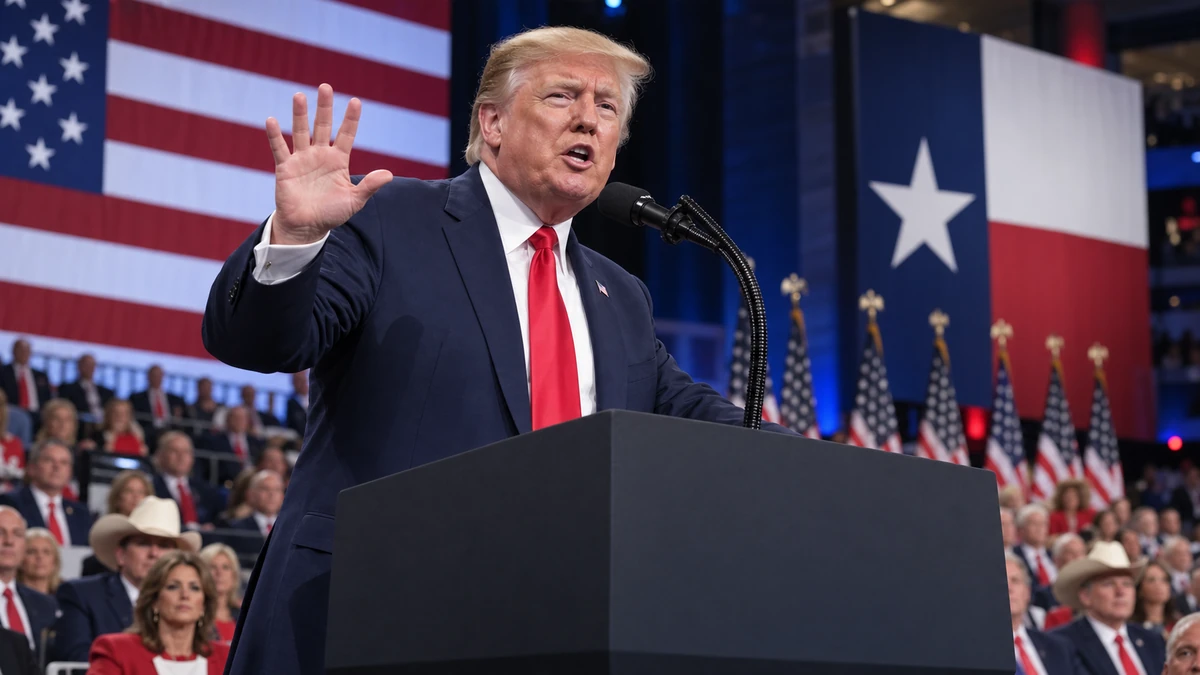
A Korean-language news summary describes President Donald Trump offering Americans a striking election-year bargain: If Republicans win both chambers of Congress in November, every adult U.S. citizen would receive $5,000, with a requirement that the money be spent inside the United States. For households facing high grocery bills, housing costs and debt payments, a payment that size would be hard to ignore. For policymakers, it would raise immediate questions about congressional authority, federal borrowing and whether Washington should encourage additional spending while voters remain worried about prices.
But the reported promise requires an important qualification. The supplied material does not include a full transcript, an official policy document or a complete date for the speech. It places the remarks at a Republican convention in Dallas on the ninth of an unspecified month and identifies Nov. 3 as the midterm election date. Its references to other events also lack sufficient dating to establish a reliable chronology. The central claim therefore remains unverified here. It should not be treated as an enacted benefit, a confirmed payment schedule or money Americans can count on receiving.
What the account does provide is a useful starting point for examining a familiar American political strategy: presenting government policy as a direct, easily understood financial return to voters. The reported proposal also carries consequences beyond the United States, particularly for South Korea, whose automakers, electronics companies and entertainment businesses compete for American consumer spending.
What the Korean account actually describes
According to the summary, Trump made the proposed payment contingent on Republicans winning both the House and Senate. It describes eligibility as covering all adult American citizens, without specifying income limits, and says recipients would have to use the money domestically. It does not explain whether citizens living abroad would qualify, how adulthood would be defined for eligibility purposes or whether the payment would be taxable. Those omissions would matter enormously in turning a campaign statement into a workable program.
The account says Trump compared the payment to a successful company distributing dividends to shareholders. It also describes him urging voters to support Republican congressional candidates as though his own name appeared on the ballot. That appeal reflects the basic political challenge of a midterm election: The president is not running, but the outcome can determine how much of the president's agenda survives the next two years.
The summary also reports a promise to make Trump-associated tax cuts permanent. Neither that description nor the dividend pledge identifies legislative language. Several linked headlines characterize the cash offer as an attempt to buy votes. That is political framing, not a legal finding. A proposed public benefit contingent on legislative control is not, by itself, evidence of an illegal payment to an individual in exchange for a vote.
A campaign pledge is not spending authority
For American readers, the first practical distinction is between promising a payment and having the legal authority to issue it. Congress controls federal appropriations. A president generally cannot create a nationwide, trillion-dollar benefit simply by announcing it at a political gathering. Any assessment of such a plan would need to identify either legislation authorizing the payments or an existing law that clearly permits the proposed use of funds.
Winning both chambers would not automatically settle the matter. Republican lawmakers could disagree about eligibility, borrowing, spending offsets or the wisdom of sending checks to affluent households. Senate procedure could also affect the path to passage. Some budget-related legislation can move through reconciliation, a process that avoids the usual 60-vote threshold for ending debate, but that route carries substantive and procedural limits.
The pledge to make tax cuts permanent needs similar scrutiny. In Washington, permanent typically means that a provision has no scheduled expiration date. It does not mean a future Congress is legally barred from changing it. No ordinary tax statute can guarantee that another elected majority will never revise tax rates or repeal a benefit. Without legislative text, Americans cannot know which provisions the reported promise would cover or how its costs would interact with the cash payments.
The price tag would quickly reach the trillions
A universal payment of $5,000 to adult citizens would be a fiscal undertaking on a very large scale. The arithmetic illustrates the issue without requiring a precise eligibility estimate: Every 100 million recipients would cost $500 billion. A hypothetical program covering 200 million people would require $1 trillion for the payments alone. Those figures are illustrations, not an official estimate of this reported proposal, whose eligible population and administrative expenses have not been established.
The summary identifies no funding source. Financing could theoretically come from additional borrowing, higher revenue, reductions elsewhere in the budget or some combination. Each choice would produce different winners, losers and economic effects. Describing the payment as a dividend does not answer those questions. Unlike a corporation distributing profits to shareholders, the federal government must balance tax collection, spending obligations and borrowing within a legal and political framework.
Inflation would be another central concern, but its direction and magnitude could not responsibly be predicted from the headline amount alone. A large transfer could increase demand for goods and services. Whether that translated into higher prices would depend on economic conditions, supply constraints, monetary policy and how the payments were financed. Families using the money to reduce debt would have a different immediate effect on consumer demand than families spending it all on cars, travel or household goods.
What this would mean for Americans
For U.S. households, the reported eligibility language is at least as important as the amount. Adult citizens are not the same group as adult residents or taxpayers. A citizens-only program could exclude lawful permanent residents and other noncitizens who work and pay taxes in the United States. It could also treat members of the same household differently. A married couple's potential benefit, for example, would depend on the final eligibility rules rather than simply on whether both spouses file a tax return.
The requirement to spend the money domestically would create another set of questions. Ordinary cash deposited into a bank account is interchangeable with money already there. A recipient could use the payment for groceries while directing other funds toward savings or an overseas purchase. A genuinely restricted benefit might instead require a special payment card, merchant rules or another tracking mechanism. Those are possible administrative approaches, not features established by the source.
For American companies, a broad payment could present a potential increase in sales, but businesses would have little basis for planning around it before legislation and implementing rules appeared. Retailers, banks, travel companies and online platforms would need to know what transactions qualified. Consumers face a simpler immediate takeaway: A reported campaign promise is not a receivable. It should not be included in a household budget or used to justify taking on new debt.
America has sent checks before — under different rules
The closest widely understood American comparison is the series of federal pandemic relief payments authorized in 2020 and 2021. Those payments were created through legislation and came with detailed eligibility rules, including income-related limits. Their policy rationale was emergency economic relief during an extraordinary disruption. Whatever the political branding around them, the checks depended on laws and administrative systems, not solely on a presidential declaration.
Alaska's Permanent Fund dividend offers another familiar reference point. It connects an annual payment to eligible residents with the state's resource wealth and a long-established institutional framework. That does not make it a ready-made model for a national $5,000 payment. Rather, it shows what the word dividend can obscure: The funding base, eligibility rules and governing institutions matter more than the label.
The supplied summary also cites child investment accounts and a $1,776 military payment as earlier examples of Trump-associated financial benefits. Their dates and implementation details are not independently established in the supplied material, so they cannot substantiate the new claim. Even if separately confirmed, targeted military benefits and money placed into children's investment accounts would differ fundamentally from immediately spendable cash for every adult citizen. They involve different populations, purposes, timelines and budget demands.
Why South Korean businesses would pay attention
The United States is a crucial consumer market for South Korean companies. Hyundai and Kia sell vehicles to American drivers; Samsung and LG compete in electronics and appliances. Their businesses are not limited to shipping finished products across the Pacific. South Korean companies also operate manufacturing facilities and support employment in the United States, making the distinction between foreign brands and domestic economic activity more complicated than a campaign slogan might suggest.
That distinction is essential to understanding the reported domestic-spending condition. A requirement that a payment be spent in the United States would not necessarily mean that it must purchase an American-made product, much less a product sold by an American-owned company. A South Korean-branded television bought from a U.S. retailer could represent a domestic transaction. Whether it qualified would depend on rules that have not been provided.
If a broad payment eventually became law, South Korean businesses could benefit from stronger U.S. consumer demand. But that possibility should not be confused with a forecast. Households might prioritize rent, medical bills or debt rather than durable goods. Trade restrictions, exchange rates and financing costs could also shape the outcome. For U.S.-Korea commercial ties, the meaningful question would be whether the program favored domestic transactions, domestic production or domestic ownership — three very different standards.
The Korean Wave's American audience is part of the picture
The Korean Wave, often called Hallyu, refers to the international spread of South Korean popular culture, including K-pop, television dramas, film, beauty products and food. For American readers, it is best understood not as a single industry but as an interconnected consumer market. A fan might discover a Korean series on a streaming service, buy a soundtrack, attend a concert and purchase cosmetics promoted by one of its stars.
That market also involves American companies. A K-pop concert in a U.S. arena generates business for venues, ticket sellers, local workers and other service providers as well as the artists and their representatives. Music merchandise sold through an American retailer similarly crosses national lines in ownership, licensing and distribution. A spending rule based only on where the transaction occurred could operate very differently from one based on where the underlying product or intellectual property originated.
There is no evidence in the supplied account that Korean entertainment was a target of the reported proposal or that American fans would spend any benefit on it. The connection is broader and more practical: International culture is already embedded in the U.S. consumer economy. Any attempt to reserve spending for domestic activity would have to confront commercial relationships that do not fit neatly into national categories.
What to watch before treating the promise as policy
The next step is verification, not speculation about arrival dates for checks. A full recording or transcript could establish exactly what was said and whether qualifications were omitted. A complete event date and identification of the gathering could resolve the source's chronology. An official White House statement, campaign document or congressional proposal could then show whether the reported remarks represented a developed policy or a political suggestion.
If a proposal emerged, its most consequential details would include the funding source, income limits, citizenship requirements, treatment of Americans abroad, tax status and enforcement of the domestic-spending condition. An independent budget estimate would help establish its scale. Congressional sponsors and the legislative vehicle would offer a more reliable measure of its prospects than the size of the headline promise.
For Americans and South Koreans alike, the larger issue is how direct-payment politics intersects with a deeply connected economy. A benefit presented as money for American citizens could influence foreign-owned factories in the United States, U.S. retailers selling imported goods and entertainment businesses serving American fans. But those effects begin with a threshold that the supplied summary does not clear: establishing the promise accurately, then determining whether it can become law. Until then, the reported $5,000 dividend is a claim requiring confirmation, not an announced federal benefit.
Comments
Post a Comment