Image to help understand the article
A second journey through the afterlife
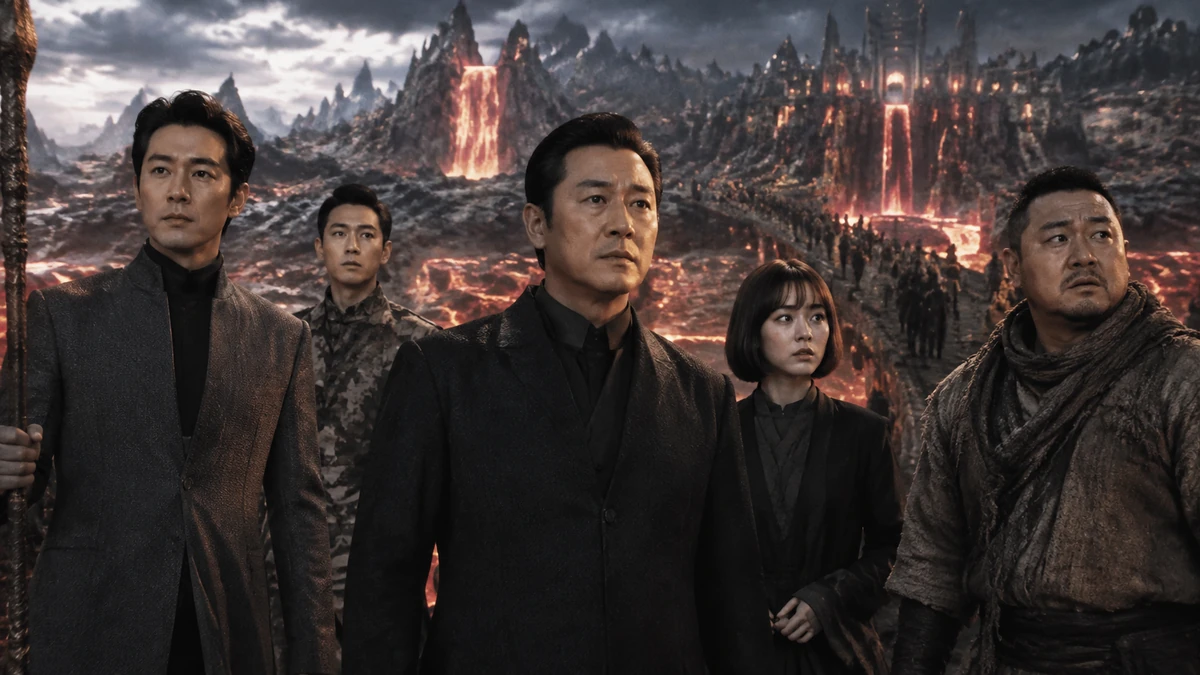
Released in South Korea on Aug. 1, 2018, Along With the Gods: The Last 49 Days is the sequel to director Kim Yong-hwa’s fantasy drama Along With the Gods: The Two Worlds. Based on the webtoon by Joo Ho-min, the film follows three afterlife guardians — Gang-rim, Hae-won-maek and Deok-choon — as they guide a new soul through his final trials.
The film stars Ha Jung-woo as Gang-rim, Ju Ji-hoon as Hae-won-maek, Kim Hyang-gi as Deok-choon, Ma Dong-seok as Seongju-shin and Kim Dong-wook as Kim Soo-hong, with appearances by Do Kyung-soo, Lee Joon-hyuk and Jung Ji-hoon. Produced by Realies Pictures and Dexter Studios and distributed by Lotte Entertainment, the movie runs for 141 minutes and is rated for viewers aged 12 and older.
The story begins when Gang-rim discovers Kim Soo-hong, a soldier who became a vengeful spirit after an unjust death. Instead of allowing him to disappear immediately under the rules of the afterlife, Gang-rim brings him before a final judgment. The three guardians travel through different hells as they attempt to prove Soo-hong’s innocence.
A record-breaking box office performance
According to the Korean Film Council’s box office data, Along With the Gods: The Last 49 Days had drawn 12.26 million viewers by Sept. 16, 2018. The film attracted 1.24 million viewers on its opening day and surpassed 10 million admissions just 14 days after release.
By reaching the 10 million viewer milestone on Aug. 14, the film helped make the Along With the Gods series the first Korean franchise to have both installments exceed 10 million admissions. The film was also later broadcast as a holiday special during the 2019 Chuseok holiday season on SBS and nine regional broadcasters.
A fantasy world built around 49 days of judgment
The movie’s afterlife is based on a fictional system in which souls face judgment over 49 days across seven hells representing crimes such as murder, laziness, lies, injustice, betrayal, violence and violations of family duty. Only souls who pass every trial can receive the chance to be reincarnated.
The story moves between three connected timelines: Kim Soo-hong’s afterlife trial, events in the living world involving an elderly man protected by the guardian spirit Seongju-shin, and the forgotten thousand-year-old history of Hae-won-maek and Deok-choon. Through these threads, the film reveals more about the relationships and pasts of the three guardians.
Praise for visual effects, criticism of its long runtime
Many viewers praised the film’s unexpected twists, expanded depiction of the underworld and the introduction of Seongju-shin as a source of comic relief. Dexter Studios’ visual effects and the way the movie connected its three storylines were also highlighted positively.
Some critics, however, argued that the 141-minute runtime made the opening sections feel slow, as the sequel spent significant time explaining the first film’s aftermath and the guardians’ history. Others criticized the use of computer-generated imagery in scenes they felt did not always serve the story.
A landmark Korean fantasy film worth revisiting
Along With the Gods: The Last 49 Days received recognition for its technical achievements, including awards for visual effects. The film also earned acting honors for Do Kyung-soo and Kim Hyang-gi at the 2018 Busan Ilbo Film Awards, while director Kim Yong-hwa received awards recognizing his work.
For international audiences exploring Korean cinema beyond K-pop and thrillers, the film offers a look at a fantasy universe rooted in Korean ideas of judgment, redemption and family ties. Its rare double 10 million audience achievement and ambitious visual world remain key parts of its legacy.
Comments
Post a Comment