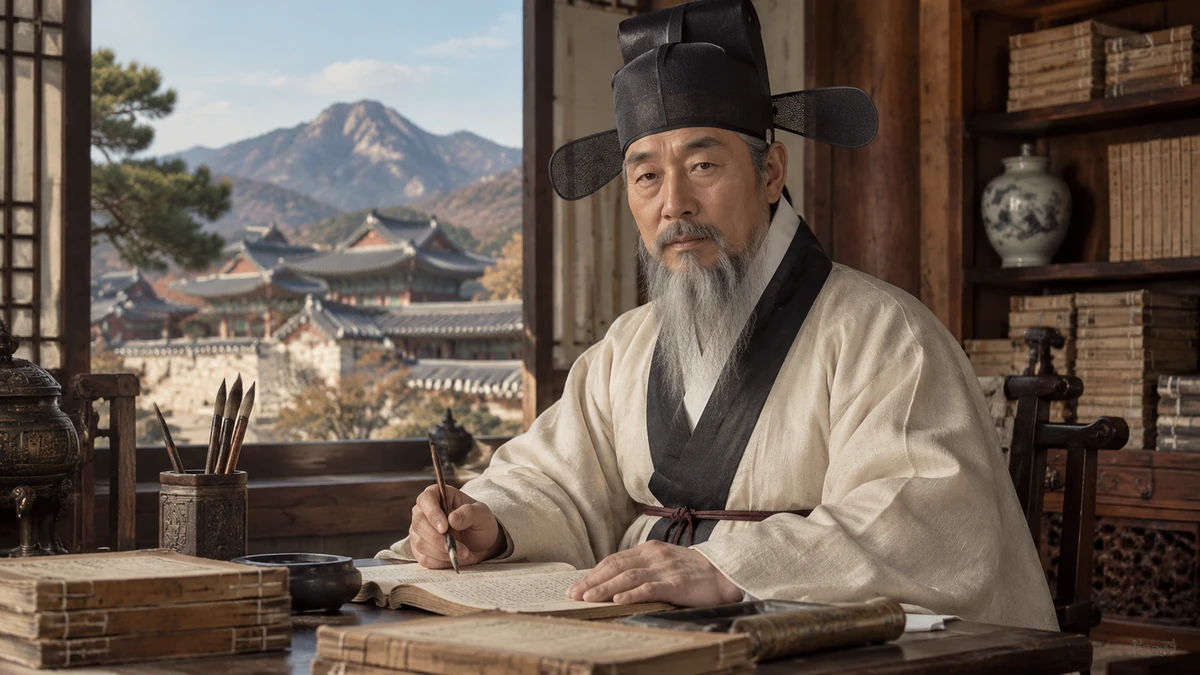
Image to help understand the article
A Forgotten Architect of Korean Historical Thought
Long before modern historians developed universities, archives and professional research methods, scholars in Korea’s Joseon Dynasty were already debating how the past should be recorded and understood. Among the most influential figures in that tradition was An Jeong-bok (1712-1791), a scholar of the late Joseon period whose work helped organize Korea’s historical narrative through careful study and documentation.
For many American readers, An Jeong-bok may not be a familiar name compared with more internationally recognized Korean figures such as King Sejong, creator of Hangul, or Admiral Yi Sun-sin, the naval commander remembered for resisting Japanese invasions. Yet An represents another important part of Korean history: the intellectual tradition of scholars who preserved knowledge, examined society and shaped how later generations viewed the country’s past.
An was a member of the Silhak movement, often translated as “practical learning.” Emerging during the late Joseon era, Silhak scholars argued that academic study should not remain limited to abstract philosophical debates. Instead, they emphasized research into government, agriculture, geography, economics and history as tools for improving society.
A Scholar Shaped by Hardship and Independent Study
An Jeong-bok was born in 1712 in Jecheon, in what is now South Korea’s North Chungcheong Province. He came from a family with a connection to government service, but his family’s political influence had weakened over time. As a member of the Namin faction, a political group within Joseon’s court system, his family faced declining status during periods of intense political competition.
Unlike many scholars who advanced through powerful family networks, An spent much of his life outside the center of government. After moving to Deokgok in Gwangju, Gyeonggi Province, in 1736, he built a private study called Sunam Seosil and devoted himself to research and teaching.
His education was unusually broad. Beginning with Confucian texts as a child, he later studied history, astronomy, geography, medicine, military writings, Buddhism, Daoist thought and literature. His intellectual curiosity reflected a broader Silhak approach: knowledge from different fields could help explain the real conditions of human society.
An’s personal life was also marked by financial difficulties. Historical records describe periods when he struggled economically, including selling farmland and working with servants to produce charcoal in an effort to recover his property. Despite these challenges, he continued writing and researching, building a reputation as a dedicated scholar rather than a wealthy official.
The Influence of Silhak and Mentor Yi Ik
A major turning point in An’s intellectual development came in 1746, when he met Yi Ik, one of the leading thinkers of the Silhak movement. Yi Ik, known by his pen name Seongho, became An’s mentor and influenced his approach to scholarship.
Under Yi Ik’s guidance, An focused on what scholars called “gyeongse chiyong,” the idea that learning should contribute to governing and practical social improvement. Rather than treating history as a simple collection of past events, he viewed historical research as a way to understand political systems, social problems and human behavior.
An later taught students in his hometown and maintained connections with other scholars. His writings covered philosophy, education, government administration and historical analysis. Among his works were texts such as “Chitongdo,” “Dotongdo,” “Hahakjinam” and “Seonghosaseolyuseon,” which reflected his effort to organize knowledge into a systematic framework.
This style of scholarship has parallels with intellectual movements in other countries. In Europe and North America, Enlightenment thinkers similarly emphasized observation, documentation and the practical application of knowledge. While Joseon Korea developed within a different cultural and philosophical environment, Silhak scholars shared an interest in using research to better understand society.
Dongsa Gangmok: Creating a Structured History of Korea
An Jeong-bok’s greatest achievement was “Dongsa Gangmok,” a historical work covering Korean history from the legendary foundation of Gojoseon through the end of the Goryeo Dynasty. The title is often translated as “A Compendium of Korean History,” and the book remains one of the most important historical writings from the late Joseon period.
Writing such a work required years of collecting and reviewing historical sources. An sought to create a more organized understanding of Korea’s past by examining earlier records and arranging historical developments into a coherent structure.
One notable aspect of “Dongsa Gangmok” was An’s approach to Korea’s historical traditions. He emphasized the importance of understanding different kingdoms, including Silla, Goguryeo, Balhae and Goryeo, as parts of Korea’s historical development. His work reflected an effort to examine the country’s past through a broad perspective rather than focusing on only one political tradition.
For American readers, the role of “Dongsa Gangmok” can be compared in a limited way to major national historical projects in other countries. Works such as early American histories written after independence helped shape public understanding of national identity. Similarly, An’s historical writing contributed to later discussions about Korea’s origins, continuity and cultural heritage.
An Jeong-bok’s Role in Government and Education
Although An preferred scholarship over official life, he did eventually accept government positions. He began serving in minor posts in 1749 and later held several administrative roles, including positions connected with royal institutions and government offices.
During the reign of King Yeongjo, An participated in scholarly projects, including work explaining difficult passages from important Confucian texts. Later, he became one of the teachers involved in educating Crown Prince Jeongjo when Jeongjo was still a young royal heir.
After Jeongjo became king in 1776, An served as magistrate of Mokcheon. During his administration, he worked on local reforms involving community agreements, educational activities and public measures. His career demonstrated the connection between his academic interests and practical governance.
In his later years, An returned to his hometown and continued writing. He also produced works criticizing Catholic teachings, which were beginning to spread in Korea during the late Joseon period. His response reflected the concerns of many Confucian scholars of the time about changes in traditional social and philosophical systems.
What An Jeong-bok’s Legacy Means for the United States and Global Korea
Although An Jeong-bok lived nearly three centuries ago, his legacy connects to a broader global interest in Korean history and culture. In the United States, awareness of Korea has expanded dramatically through Korean cinema, television, music, food and technology. The global popularity of Korean culture has increased curiosity about the historical foundations behind modern Korea.
For American audiences interested in Korea, figures like An provide context beyond contemporary entertainment and business headlines. The same country known today for K-pop groups, streaming dramas and advanced technology also has a long tradition of scholarship, record keeping and debate about national identity.
Universities, museums and cultural institutions in the United States that study East Asian history often examine how countries preserve and interpret their past. An’s work offers an example of how historical writing can influence national memory. His “Dongsa Gangmok” shows that history is not only a record of events but also a reflection of how societies understand themselves.
The connection between Korea and the United States today is largely built around modern cooperation in areas such as trade, technology, education and popular culture. As American audiences continue exploring Korean culture, interest is also growing in historical figures who shaped the intellectual traditions behind the country’s modern identity.
A Historical Figure Who Preserved Korea’s Intellectual Heritage
An Jeong-bok did not become famous through military victories or political power. His influence came from books, teaching and decades of research. In an era when historical records were often shaped by court politics and competing viewpoints, he worked to create a structured understanding of Korea’s past.
His life reflects a central idea of the Silhak movement: knowledge should serve society. Through “Dongsa Gangmok” and his other writings, An helped establish a foundation for later generations of historians and scholars.
Today, An Jeong-bok remains an important figure in Korean history because he demonstrated the power of scholarship. His story offers international readers a window into a Korea that existed long before modern headlines — a Korea built not only by kings and warriors, but also by thinkers who preserved the nation’s memory.
Comments
Post a Comment