Image to help understand the article
The alphabet behind a global cultural force
For an American listener moving from a K-pop song to its Korean lyrics, the first encounter with King Sejong’s legacy may come on a phone screen. The compact blocks of letters beneath a music video belong to Hangul, the Korean alphabet whose origins reach back nearly six centuries to a ruler confronting a fundamental problem: His people spoke a language that the dominant written tradition did not adequately serve.
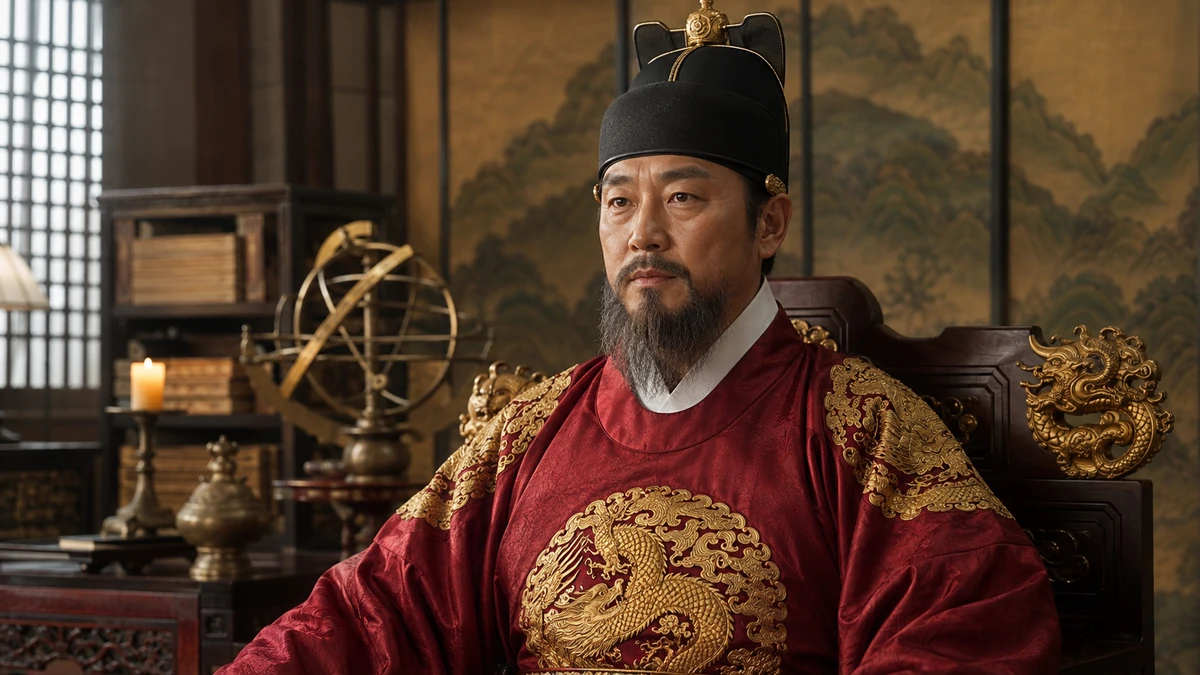
Sejong, who ruled Korea’s Joseon dynasty from 1418 to 1450, is remembered above all for creating an alternative. His new alphabet offered a more accessible way to represent Korean speech, challenging the practical barriers imposed by a writing culture centered on Chinese characters. It was an intervention in communication, but also in government: Useful knowledge could accomplish little if the people who needed it could not read it.
Today, that project has significance far beyond Korea. Korean music, television and film have brought American audiences into sustained contact with the language, while digital platforms circulate Korean writing alongside English. Sejong did not anticipate entertainment exports or smartphone keyboards. But the system he introduced became part of the infrastructure through which Korean culture now reaches the world. Understanding his achievement means looking beyond the familiar portrait of a benevolent king to the relationship among literacy, expertise and power.
A scholarly prince in a hard-edged monarchy
Born in 1397 in what is now central Seoul, Sejong was the third son of the future King Taejong. His personal name was Yi Do, and before taking the throne he was known as Prince Chungnyeong. Joseon, founded in 1392, was still a young dynasty. Its institutions were taking shape, and succession was a matter of political survival, not simply family tradition.
The Korean historical account underlying this profile describes a prince so absorbed in reading that his father once ordered his books hidden out of concern for his health. Such anecdotes help explain Sejong’s enduring image as a scholar-ruler. They also reflect an ideal central to Joseon’s political culture: A monarch was supposed to cultivate judgment through study, not merely inherit authority.
Sejong was not originally the designated successor. His older brother, Prince Yangnyeong, lost his position as crown prince in 1418 after repeated misconduct and calls from officials for his removal. Chungnyeong replaced him and became king later that year when Taejong abdicated. Accounts of the brothers emphasize the younger prince’s criticism of Yangnyeong’s behavior, placing moral discipline at the center of the succession story.
The transfer did not immediately give the new king complete control. Taejong retained influence over military affairs and appointments, and the early reign included a purge that claimed Sejong’s father-in-law, Shim On. That violence matters to the larger portrait. The ruler now celebrated for widening access to knowledge emerged from a monarchy that secured authority through coercion as well as learning.
Why Korea needed a different writing system
To understand the scale of Sejong’s intervention, English-speaking readers first need to separate a language from the system used to write it. Korean existed long before Hangul. Sejong did not invent the language; he created an alphabet that allowed it to be recorded more directly and accessibly.
Before that development, educated Koreans relied heavily on Classical Chinese for formal writing. Chinese characters also appeared in systems adapted to represent Korean. But Chinese and Korean differ substantially in grammar and sound. Mastering the prestigious written tradition required extensive study, creating a formidable barrier for people without the time, resources or social standing to obtain that education.
A rough Western comparison is the historical distance between Latin learning and the everyday speech of much of Europe. The analogy is imperfect: Korea’s linguistic circumstances and writing practices were distinct. Still, it helps convey how a society could possess sophisticated scholarship and government records while leaving much of its population poorly equipped to read official information or put its own concerns into writing.
The supplied Korean account links Sejong’s interest in a new script to the limits of distributing agricultural knowledge among people unable to read it. The broader problem extended beyond farming. Instructions, legal matters and communication with authorities all depended on access to written language. Making that access less difficult could strengthen the state while also giving ordinary people a tool they had lacked.
What Sejong created — and what he did not
Sejong completed a system of 28 letters in 1443 and promulgated it in 1446. It was called Hunminjeongeum, commonly rendered in English as “the correct sounds for the instruction of the people.” The name refers both to the original writing system and to the document introducing it. Hangul is the name by which the alphabet became widely known much later.
Its design makes speech visible in a distinctive way. Several basic consonant shapes schematically reflect the positions or forms of the speech organs used to produce their sounds. The original vowel design drew on symbols associated with heaven, earth and humanity. These features combined attention to pronunciation with the philosophical vocabulary of the period.
Modern Hangul uses 24 basic letters, rather than the original 28, with additional combinations formed from them. Unlike the letters of an English word, which generally run in a continuous line, Korean letters are grouped into syllable blocks. A beginner may initially mistake each block for a single indivisible character. In fact, its components represent consonants and vowels.
That distinction gives learners an approachable starting point, but it should not be confused with effortless fluency. Learning to decode the alphabet is different from acquiring Korean vocabulary, grammar, pronunciation and socially appropriate speech. For American fans, recognizing an artist’s name or sounding out a song title can be an early milestone without meaning they understand the lyrics.
Nor did royal publication produce universal literacy overnight. Chinese characters retained prestige, and the new alphabet encountered opposition among some educated officials. Its social position changed over centuries. The early 20th-century linguist Ju Si-gyeong is associated with the modern name Hangul and efforts to study and promote Korean; he did not transform an unrelated older script into a newly invented alphabet. Modern Korean writing rests on Sejong’s creation, shaped by subsequent standardization and use.
Knowledge as a tool of government
The alphabet was part of a wider governing approach that treated scholarship as a practical resource. In 1420, Sejong established the Jiphyeonjeon, usually translated as the Hall of Worthies, as a court institution for scholarship and policy research. For an American reader, it is more useful to imagine a royal research and advisory body than a modern university or an independent think tank.
Sejong also distributed responsibilities among senior officials rather than relying on a single all-powerful minister. The Korean account describes Hwang Hui handling areas requiring decisive administration, Maeng Sa-seong contributing to education and institutional development, and Yun Hoe working on diplomacy, documents and court scholarship. Kim Jong-seo became important in defense affairs.
Those arrangements were not constitutional checks and balances in the American sense. They operated within royal government, and Sejong retained particular control over military matters and personnel. Nevertheless, the division of duties reveals an interest in matching expertise to responsibilities and limiting the concentration of administrative power in one subordinate.
His reforms also included a land-tax framework that distinguished among land quality and harvest conditions. The underlying challenge remains recognizable: Governments need sufficiently accurate information to distribute burdens and administer policy. Under Sejong, gathering knowledge, organizing officials and improving communication were connected activities, not separate intellectual pursuits.
That practical orientation coexisted with a strongly hierarchical social vision. The court promoted Confucian rituals and texts emphasizing obligations within families and society. Sejong’s government could make selected opportunities available to talented people of lower status without seeking to abolish the status system itself. Accessibility was a significant ambition, but it was not modern political equality.
Science built for local needs
Sejong’s support for astronomy, timekeeping and agricultural measurement followed a similar logic. His court sponsored instruments for observing the heavens, sundials, water clocks and rainfall measurement. These were not simply displays of royal sophistication. Reliable calendars and measurements helped a farming society organize work and helped officials understand the conditions on which food supplies and public revenue depended.
Among the best-known figures associated with that effort is Jang Yeong-sil, a technical specialist whom Sejong supported despite his low social origins. His career illustrates the king’s willingness to recognize useful ability beyond the narrowest elite circles. It does not establish that Joseon had become a meritocracy, but it shows how royal patronage could open space for exceptional expertise.
The court’s astronomical work also complicates any account of Korean achievement as wholly isolated invention. Scholars drew on Chinese and Islamic astronomical traditions. The calendrical compilation known as Chiljeongsan incorporated knowledge from outside Korea while advancing calculations suited to the kingdom’s own needs, including its capital.
For Americans, the relevant comparison is not a claim that Sejong created a medieval version of NASA. It is the more basic proposition that public support for specialized research can produce everyday benefits. His court joined institutions, skilled personnel, equipment and publication in a sustained effort. Like the alphabet, the scientific work made knowledge more useful by adapting it to local circumstances.
What Sejong’s legacy means for the United States
The immediate American connection is cultural rather than diplomatic. A viewer discovering Korean television through Netflix, or a listener following Korean performers on YouTube, encounters a language whose written form has a traceable moment of deliberate design. Hangul provides a path from consuming translated entertainment to engaging with Korean names, titles, posts and eventually more complex texts.
The changing relationship is one of proximity. Korean writing can appear inside the same American digital routines as English: on streaming menus, in recommendation feeds and in online fan conversations. The alphabet is no longer something an interested U.S. learner must encounter only through a textbook. That exposure creates opportunities for curiosity, though the historical source provides no basis for measuring how often casual contact turns into sustained study.
For U.S. media and technology companies, the practical lesson concerns language access. Serving Korean-speaking users requires more than replacing English words with Korean equivalents. Products need to support Korean text entry, display, search and navigation reliably. Entertainment companies also need translations that communicate meaning and social context, including differences in age, status and familiarity that Korean dialogue can express in ways English does not.
A useful American industry comparison is the distinction between distributing a work and making it accessible. Captions, subtitles and multilingual interfaces do not create the underlying film or song, but they influence who can engage with it. Hangul’s historical role was much broader than a localization feature. Still, both examples show that communication systems are consequential infrastructure, not decorative additions to content.
The connection to U.S.-South Korea relations is less direct but still meaningful. The modern alliance did not grow out of Sejong’s reign, and his policies should not be treated as a forecast of today’s partnership. Yet Americans who know South Korea primarily through security headlines, electronics or entertainment gain a fuller understanding by recognizing its long history of institutional and intellectual development. Cultural familiarity can enrich a relationship otherwise discussed largely in strategic or commercial terms.
A celebrated ruler, not an uncomplicated hero
Sejong’s achievements do not erase the moral distance between his world and ours. Joseon participated in a China-centered diplomatic order in which tribute and recognition helped structure relations with the Ming dynasty. Such arrangements involved exchanges and negotiations, but also burdens imposed on vulnerable people.
The Korean account describes women sent from Joseon to the Ming court as tribute, some of whom became imperial consorts and were later killed in burial rites following an emperor’s death. It also describes Sejong’s negotiations to end requirements for tribute in women, gold and silver in exchange for increased deliveries of other goods. These events resist a simple story of enlightened progress: The reign included both participation in an abusive system and efforts to change its demands.
That tension should inform how the alphabet is remembered. Giving people a more accessible writing system was a remarkable act, but it did not make its creator a democratic leader. Royal benevolence and royal power were intertwined. A government could want subjects to understand instructions and express grievances while still expecting obedience within a rigid social order.
What to watch as Korean culture travels
The contemporary question is not whether Hangul alone explains the Korean Wave. It does not. Entertainment companies, creative workers, investment, distribution networks, translators and audiences all contribute to the international circulation of Korean culture. Attributing that success to one 15th-century invention would turn a complex history into a promotional slogan.
What bears watching is whether broad exposure produces deeper linguistic and cultural engagement. Do platforms treat Korean-language information as central to the user experience? Do translations help audiences understand relationships and institutions rather than merely follow a plot? Can an American fan move easily from a romanized artist name to its Korean spelling and reliable information about it? These are practical questions about access, not predictions of inevitable growth.
Sejong’s enduring contribution offers a useful standard for considering them. His alphabet addressed the gap between the language people actually spoke and the tools available to record and understand it. Centuries later, as Korean stories reach American screens and headphones, that underlying issue remains familiar: Culture travels farther when more people have the means to engage with it.
Comments
Post a Comment