Image to help understand the article
The Korean innovation Americans encounter every day
An American listener searching for a K-pop song, a student reading a Korean restaurant menu or a viewer pausing a Korean drama encounters the legacy of a king who died nearly six centuries ago. The compact blocks of Korean lettering on a screen are not decorative symbols or a version of Chinese writing. They are an alphabet, developed under King Sejong to address a fundamental problem: Most of his subjects could speak their language but lacked an accessible way to write it.
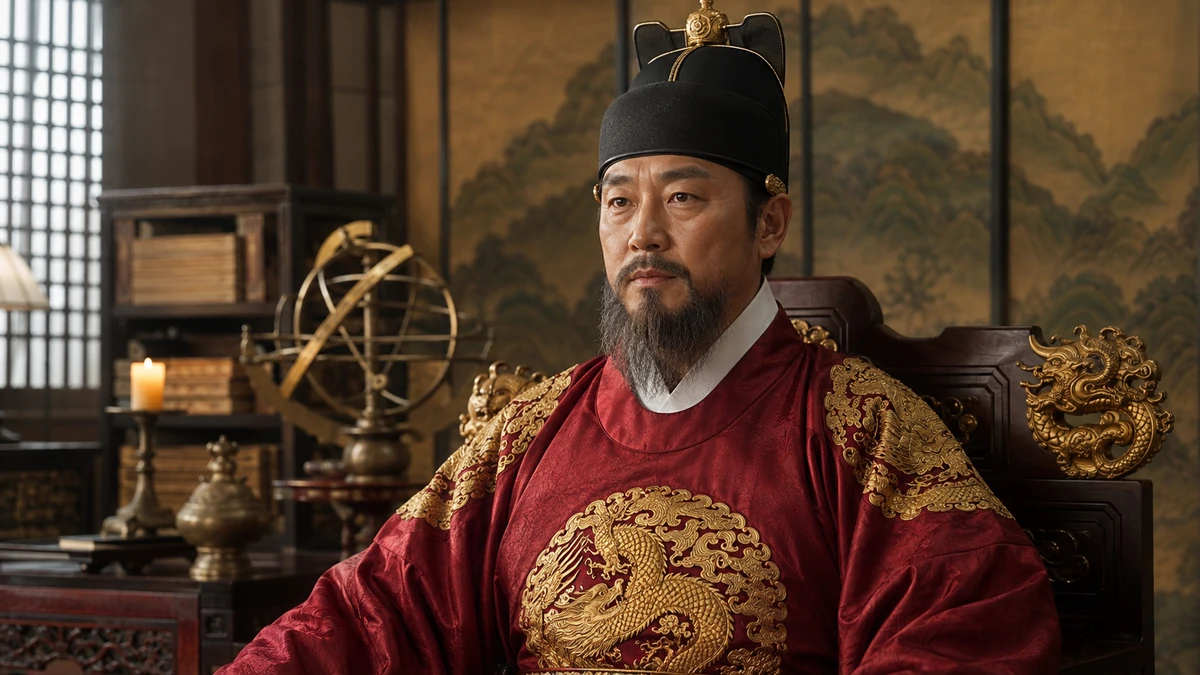
Sejong, who ruled Korea’s Joseon dynasty from 1418 to 1450, is remembered for achievements in government, astronomy, agriculture and technology. His most consequential project was the writing system introduced as Hunminjeongeum, a name commonly translated as “the correct sounds for the instruction of the people.” Today, its modern form is known in South Korea as Hangul.
For Americans, that history provides a useful way to look beyond the exports that often define contemporary Korea: music, television, movies, beauty products and consumer electronics. Long before Korean entertainment companies were trying to reach foreign audiences, Sejong confronted a different communication gap within his own country. The connection is not a straight line from a royal decree to global pop stardom. It is a longer story about who gets access to knowledge, whose language counts and how a society builds the tools to express itself.
A bookish prince in a dangerous royal household
Born in 1397 in what is now Seoul, Sejong was the third son of the future King Taejong. His personal name was Yi Do, and before becoming king he held the title Prince Chungnyeong. Joseon, the dynasty founded in 1392, was still young. His childhood unfolded inside a ruling family occupied with consolidating its authority, not simply observing ceremonial traditions.
Accounts of the prince emphasize an almost compulsive devotion to books. He studied with prominent teachers and reportedly read so intensely that his father ordered his books hidden out of concern for his health. Such stories help explain the scholarly image attached to Sejong, although the portrait of a tireless royal student should not obscure the political circumstances that brought him to power.
The eldest brother, Prince Yangnyeong, had been designated heir. His conduct, however, repeatedly angered Taejong and drew criticism from officials. Chungnyeong also challenged his brother’s behavior. In 1418, Taejong removed Yangnyeong as crown prince and selected Chungnyeong instead. Later that year, he abdicated in his favor.
The transfer did not immediately give the new king complete control. Taejong continued to exercise military and personnel authority, and a purge reached Sejong’s father-in-law, Sim On. Sejong’s eventual reputation as a capable, learned ruler emerged from this unforgiving political setting. He inherited a monarchy in which scholarship could improve government, but family connections could also become lethal liabilities.
Why Korea needed another way to write
To understand Sejong’s alphabet, English-speaking readers need to separate spoken language from writing system. Koreans already had a language. What they lacked was an easily learned script designed specifically to represent it. Educated elites relied heavily on Classical Chinese, the prestigious written medium of scholarship, diplomacy and administration across much of East Asia.
Korean and Chinese are different languages, with different grammatical structures. Earlier methods used Chinese characters to record aspects of Korean, but they required substantial expertise. The obstacle was not that Korean people had nothing to say. It was that the available written tools demanded an education beyond the reach of much of the population.
An imperfect American reference point would be a government conducting its most important written business in Latin while most residents spoke English. That analogy does not capture every feature of the Korean situation, but it conveys the distance between everyday speech and elite literacy. A farmer might possess detailed practical knowledge and still be unable to read an official agricultural text.
That disconnect mattered to Sejong’s governing agenda. Publishing useful information could accomplish only so much if intended readers could not understand the writing. His response addressed the underlying barrier rather than merely producing more books. The new script offered a way to represent Korean speech directly, potentially widening access to both information and self-expression.
An alphabet, not a set of picture symbols
Sejong’s new writing system was completed in 1443 and promulgated in 1446. It originally contained 28 letters. Modern Hangul uses 24 basic letters — 14 consonants and 10 vowels — along with combinations that represent additional sounds. Its distinctive appearance comes from arranging letters into syllable blocks rather than placing every letter in an uninterrupted horizontal sequence, as English generally does.
That distinction is important for American beginners. A Korean block that looks like a single complex symbol is usually assembled from smaller alphabetic components. Learning those components gives a student a way to begin sounding out unfamiliar words. It does not, by itself, supply their meanings or teach Korean grammar, but it removes an obstacle that can initially make the language look less approachable than it is.
The script’s design also reflects systematic attention to speech. Basic consonant shapes represent features of the speech organs involved in producing sounds, while related letters build on those forms. The original vowel design drew on philosophical ideas about heaven, earth and humanity. The result combined close observation of language with the intellectual vocabulary of its time.
Its adoption was not instantaneous. Some elite scholars opposed the innovation, and Classical Chinese retained high status long after Sejong’s reign. The script circulated in royal and private settings and developed through centuries of use. The modern name Hangul became established much later, associated with early 20th-century language reformers including Ju Si-gyeong. Sejong created the foundation; subsequent generations shaped its modern role.
The state behind the celebrated inventor
The alphabet can make Sejong look like a solitary genius, but his broader record also illustrates the importance of institutions. In 1420, he established the Jiphyeonjeon, usually called the Hall of Worthies in English, as a palace center for scholarship and policy research. Its scholars received substantial support. Research was part of governing, not merely an ornament attached to the royal court.
Sejong assigned senior officials different responsibilities according to their strengths. Hwang Hui handled demanding administrative and political work. Maeng Sa-seong contributed to education and institutional reform. Yun Hoe worked on diplomacy, official documents and matters involving scholarship. Kim Jong-seo became an important figure in defense. The arrangement depended on delegation without allowing any one minister to monopolize authority.
A governing procedure routed much routine business through senior state councilors before it reached the king, while military and personnel matters remained under closer royal control. For American readers, the rough comparison is an executive relying on experienced department heads and policy specialists. It was not, however, a constitutional cabinet accountable to voters. The system operated within hereditary monarchy.
Sejong also supported changes in taxation that took account of land quality and harvest conditions. Such policies belong beside the alphabet in assessing his reign. They show a concern with adapting administration to actual circumstances. Yet Joseon remained a hierarchical society, and selecting some talented people across status boundaries did not amount to abolishing those boundaries.
Science as a practical service
Sejong’s court invested in instruments for observing the heavens, measuring time and recording rainfall. These projects can sound remote from modern life until their practical uses come into view. An agricultural state needed dependable calendars. Officials needed ways to track environmental conditions. Reliable timekeeping supported both everyday administration and the rituals through which the monarchy organized public life.
The king backed specialists including Jang Yeong-sil, whose rise despite low social status became one of the best-known examples of Sejong’s willingness to reward technical ability. Court-supported work produced astronomical instruments, sundials and water clocks. Rain gauges added another means of observing conditions central to farming and revenue.
Researchers also drew on knowledge from outside Korea. Work on the astronomical calculations collected in the Chiljeongsan incorporated Chinese and Islamic calendrical traditions. The ambition was not simply to reject foreign learning in the name of independence. It was to adapt available knowledge so that calculations could serve Korea’s own geographic and administrative needs, including observations referenced to its capital.
Americans might recognize a broad parallel with publicly supported weather observation and scientific research: Information becomes more useful when institutions collect it consistently and connect it to decisions. The technologies and political systems are vastly different. Still, the underlying question is recognizable. What should a government measure, and how can that knowledge improve people’s lives?
What Sejong’s legacy means for the United States
For the United States, the most immediate relevance is cultural access. Korean entertainment now reaches Americans through channels that routinely place Hangul alongside English: streaming interfaces, music videos, album packaging, social media posts and subtitles. BTS, Blackpink and Korean television have given audiences reasons to encounter the script even when those audiences have never taken a Korean class.
The change is not that Americans have suddenly become fluent in Korean. Rather, Korean-language material can now reach them without first being entirely remade as an English-language product. Subtitles, digital distribution and fan discussion allow viewers to engage with work that retains its original language. Hangul is part of that visible identity, not merely a technical detail hidden behind translation.
For U.S. companies distributing Korean content, including Netflix and YouTube, this creates practical responsibilities. Titles, names, search functions, captions and promotional material have to work across writing systems. Romanization — representing Korean words with the Latin alphabet — can help an English speaker navigate a catalog, but it cannot preserve every pronunciation distinction or replace accurate translation. Treating Korean text as visual decoration risks losing meaning precisely when audiences are seeking a closer connection.
The comparison with American entertainment is instructive. Hollywood’s international reach has long relied on subtitling, dubbing and local marketing. Korean entertainment’s American presence demonstrates the same need in the other direction: U.S. audiences are also recipients of translated culture. Beyond commerce, understanding Korea’s linguistic history adds depth to a relationship Americans often encounter through military cooperation, trade or headlines about North Korea. It makes Korea more legible as a society with its own intellectual traditions.
A revered ruler, not a modern democrat
Sejong’s achievements warrant attention, but responsible history cannot stop with admiration. His government reinforced Confucian social ethics, including expectations about family hierarchy, loyalty and proper conduct. Texts promoting exemplary behavior were instruments of moral education and state authority. A ruler could want subjects to read useful information while still expecting them to remain within a tightly ordered society.
His foreign relations also operated within unequal structures. Joseon maintained a tributary relationship with Ming China, exchanging missions and goods within a regional order that acknowledged the Chinese emperor’s superior status. This was not equivalent to a modern alliance between legally equal nation-states, nor can it be reduced to a simple story of uninterrupted Korean independence from outside pressure.
Among the harshest features of that relationship were demands for women sent from Joseon to the Ming court. Some became imperial consorts, and some faced death through the practice of burying attendants or consorts with a deceased emperor. Court gestures of consolation and benefits for families did not erase the coercion involved. Sejong’s government eventually obtained relief from demands for women, gold and silver in 1430, while agreeing to supply more of other goods.
These realities complicate the popular image without making the alphabet less significant. Expanding access to writing was a major intervention in a stratified world. Calling it modern democracy would misrepresent both the achievement and its limits. Sejong’s importance lies in what he changed within his historical circumstances, not in how closely he resembles an idealized contemporary leader.
What to watch as Korean culture travels
Hangul’s modern reach rests on developments Sejong could not have anticipated: mass education, modern publishing, computers, smartphones and global entertainment distribution. The script is used in both South Korea and North Korea, despite differences in terminology and language standards. It belongs to a linguistic heritage larger than any single music company, streaming service or diplomatic partnership.
As Korean culture circulates in the United States, a useful question is whether exposure develops into understanding. Learning to recognize a favorite performer’s name is different from learning Korean, but it can be a beginning. For educators, cultural institutions and entertainment distributors, the opportunity is to explain rather than exoticize — to show that unfamiliar lettering has an accessible structure and a specific history.
Another issue is how faithfully digital systems handle Korean. Search tools, automated captions and translation software increasingly mediate what American audiences see. Their performance can shape whether a name is discoverable, a joke makes sense or a historical reference survives the trip into English. Those are contemporary versions of a persistent problem: Information can exist and still fail to reach the people who need it.
Sejong’s answer was to change the means of communication itself. Nearly six centuries later, that remains the most relevant part of his story. The king did not create the Korean Wave. He helped create a tool through which generations of Koreans could record their language — a tool Americans now encounter whenever Korean culture crosses their screens.
Comments
Post a Comment