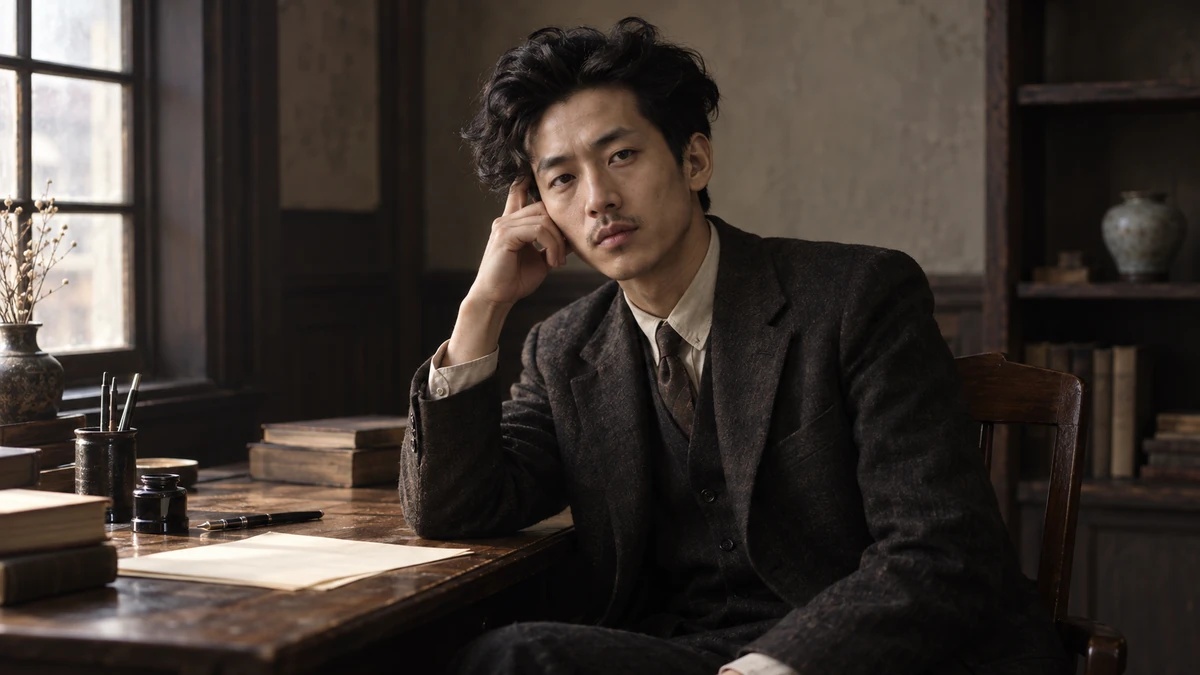
Image to help understand the article
A Korean Writer Who Refused to Be Easy
In 1934, a Korean newspaper gave readers something many of them did not want: poems that refused to behave like poems. Yi Sang’s series, known as “Ogamdo,” disrupted familiar language and expectations so aggressively that complaints helped bring its publication to a halt after 15 installments. What looked to some readers like a failure of communication became an enduring example of literary experimentation.
For Americans whose introduction to Korean culture came through pop music, television dramas or movies, Yi offers a different entry point. His work belongs to a Korea under Japanese colonial rule, decades before the division of the peninsula produced today’s two Korean states. Yet his concerns — estrangement, unstable identity and the difficulty of making sense of modern life — can feel strikingly familiar.
A poet, fiction writer, trained architectural technician and visual artist, Yi challenged the boundaries between disciplines as well as the conventions within them. His best-known works, “Ogamdo” and the short story “The Wings,” help explain why Korean literature should not be understood simply as a companion product to the Korean Wave, the international spread of South Korean entertainment. Its experiments have a much longer history.
That history also complicates the idea that internationally interesting Korean art must be immediately accessible. Yi’s career poses a question American publishers and readers know well: What happens when work that initially alienates an audience eventually becomes essential to a country’s understanding of its literature?
Learning to Build, Wanting to Paint
Yi was born Kim Hae-gyeong on Sept. 23, 1910, in the city now known as Seoul. That same year, Japan formally annexed Korea, beginning colonial rule that lasted until 1945. His entire life unfolded within that political order.
His father, who had worked at a printing office serving the Korean imperial household, lost a finger and later supported himself through a barbershop. Beginning in 1913, the boy grew up in the home of his father’s older brother. His uncle financed his education but expected him to advance the family’s fortunes, imposing a demanding household discipline.
Art offered another direction. At school, he met Ku Bon-ung, who became a painter and a lifelong friend. Yi wanted to paint, and an oil landscape of his was selected for a school exhibition in 1925. The following year, however, he entered the architecture department of a technical school in Seoul. He graduated at the top of his class in 1929.
One account traces his pen name to a plumwood box for art supplies that Ku gave him. The story should be understood as an account of the name’s origin, not an uncontested explanation. What is clear is that the name Yi Sang appeared in his graduation album, before it became attached to some of Korean literature’s most unconventional writing.
His technical education matters because his later work did not treat the page merely as a place to record feelings or tell stories. Mathematical symbols, unusual arrangements and broken grammatical patterns became part of his literary vocabulary. An architectural background offers a useful way to approach those choices: Form itself could carry meaning, rather than simply hold it.
Making Art Inside a Colonial System
After graduation, Yi became an architectural technician in the Japanese colonial administration. He also participated in an architectural association, winning first and third place in a competition to design covers for its journal. His visual art continued alongside that work; a Western-style painting was selected for the 1931 Joseon Art Exhibition.
His literary debut came in 1930 with “December 12,” his only full-length novel. It appeared in nine installments in the Korean-language edition of a magazine used to promote the colonial government’s policies. He subsequently published Japanese-language poems in an architectural journal, before expanding his Korean-language literary activity.
For an American audience, those publication venues require context. They were not simply neutral equivalents of an arts magazine or a professional association’s newsletter. Yi worked within institutions shaped by a foreign government that controlled Korea. His career illustrates how education, employment and opportunities to publish could run through the structures of colonial authority.
That does not make each publication a straightforward declaration of political allegiance. Nor does writing in Japanese erase his place in Korean literary history. It shows the constraints and contradictions facing an artist whose professional life developed under imperial rule. The language and institutional setting of a work are part of its history, not substitutes for reading it.
American readers familiar with modernists such as William Faulkner or Gertrude Stein may recognize the impulse to disrupt conventional narration. But that comparison has limits. Yi was not merely producing a Korean version of an American or European movement. His experiments emerged from a specific colonial society, with its own unequal distributions of power and opportunity.
Coffeehouses, Illness and a Literary Circle
Tuberculosis began narrowing Yi’s options early. Diagnosed in 1931, he experienced worsening symptoms, including coughing up blood. In 1933, amid friction with a new Japanese supervisor, he left his technical position and went to a hot-spring resort in what is now North Korea to recuperate.
There he met Geumhong, who became his partner. The two later lived together and operated Jebi, a coffeehouse in central Seoul. Their relationship and the business both encountered difficulties. Geumhong left in 1935, and the establishment closed that September.
The Korean term for such a coffeehouse is “dabang.” In accounts of this literary world, it is useful to think beyond today’s grab-and-go coffee chain. A dabang could provide a setting for conversation and contact among artists and writers — closer in function to a literary cafe or an informal salon. But being a gathering place did not guarantee that a business would survive.
Yi’s literary connections were growing during these unsettled years. In 1933, he began associating with writers linked to Guinhoe, usually rendered in English as the Group of Nine. Among them were Lee Tae-jun, Jeong Ji-yong, Kim Ki-rim and Park Tae-won. Jeong helped him place Korean-language poems in a magazine.
Those relationships complicate the familiar portrait of the isolated genius. Yi’s writing was singular, but its publication depended on a network of people willing to make room for it. Friends arranged introductions, helped secure jobs and provided access to print. His career demonstrates both the importance of artistic communities and the limits of what they could protect a writer from.
When the Newspaper Audience Pushed Back
Lee Tae-jun helped bring “Ogamdo” to the newspaper Joseon Jungang Ilbo in 1934. The first poem appeared July 24. The 15th appeared Aug. 8, after which the series stopped amid protests over its difficulty.
The title is often rendered as “Crow’s-Eye View,” a disorienting variation on the familiar idea of a bird’s-eye view. It is an apt introduction to a writer whose pages unsettle rather than stabilize the reader. His broader body of work breaks grammar, incorporates mathematical notation and privileges mental movement over a clearly marked narrative route.
The American comparison is not a conventional newspaper poetry column so much as a general-interest publication suddenly asking its regular audience to read an uncompromising experiment. Readers who expected a recognizable scene, a clear emotion or an easily paraphrased message faced something that resisted those expectations.
The episode is sometimes tempting to cast as a simple contest between a visionary and an unenlightened public. A more useful reading recognizes a mismatch among the work, its medium and its audience. A newspaper delivered experimental literature to people who had not necessarily sought it out. The interruption records that collision; it does not, by itself, explain every reader’s objection.
Two years later, “The Wings” attracted critical attention. Its central relationship involves an inert husband and a wife engaged in prostitution, with the narrative placing psychological experience ahead of conventional action. Together, the story and “Ogamdo” established contrasting ways of encountering Yi: through the disruptions of poetic form and through a fictional consciousness that offers no comfortable foothold.
The Danger of Reading Fiction as a Diary
Yi drew on intimate relationships, but the overlap between life and art requires care. In “The Wings,” the wife’s name, Yeonsim, was Geumhong’s real name. Other works also reworked conflicts involving lovers and friends. These connections invite biographical readings without making the fiction a verified transcript of private events.
In a story published in December 1936, Yi described a narrator being beaten by Geumhong and returning after several days to find her gone. Such a passage is evidence of how he represented a relationship in literature. It should not automatically be presented as independently established reporting about another person’s conduct.
Another complicated attachment involved Kwon Sun-ok, whom Yi brought to work at a cafe he acquired after mortgaging his parents’ home. Kwon, a reader of Russian writer Maxim Gorky, compared Yi to British novelist D.H. Lawrence, a resemblance he reportedly welcomed. She eventually married his friend Jeong In-taek, and Yi served as master of ceremonies at their wedding.
For readers accustomed to biographies that organize a male artist’s life around his “muses,” these women deserve more careful treatment. They were people with their own reading, decisions and relationships, not simply raw material for his development. The surviving account is heavily shaped by the writer and the literary world that preserved his story.
What Yi Sang Means for American Readers and Publishers
For the United States, Yi’s significance is primarily cultural, not evidence of a new commercial deal or diplomatic initiative. His biography does not establish current American sales, adaptation plans or demand from entertainment companies. What it does provide is a reason to broaden the framework through which Americans encounter Korean creativity.
The Korean Wave often introduces a country through works designed for large contemporary audiences. Yi offers something different: a difficult historical writer whose reputation rests partly on refusing familiar forms. American fans moving from screen entertainment into literature need not expect the same pacing, emotional cues or immediate rewards.
There is a useful domestic parallel. American literary history makes room for experimental writers whose importance cannot be measured solely by their initial popularity. Faulkner’s fractured chronology or Stein’s unconventional syntax can demand instruction, rereading and patience. Korean literature deserves the same allowance for difficulty, without having to prove that every important work is an easy gateway to the culture.
For American publishers, editors and educators, the practical issue is presentation. An introduction explaining colonial Korea, a translator’s discussion of unusual typography or a note distinguishing fiction from biography can help readers without pretending to solve every ambiguity. The editorial challenge is to provide access while preserving the qualities that make the work unsettling.
Translation is especially consequential when grammar and visual arrangement are part of the artistic experiment. Smoothing an awkward passage may produce more fluent English while weakening the original disturbance. Leaving every disruption unexplained may strand a newcomer. Those are editorial questions, not evidence that any particular American edition has handled them poorly.
At the level of U.S.-Korea cultural ties, the larger value is depth. Engagement that reaches beyond current hits allows Americans to see Korea as a society with internal debates, difficult classics and changing judgments about its artists. What to watch is not simply whether another Korean title attracts attention, but whether readers and cultural institutions make room for the less immediately marketable parts of that history.
A Short Life, a Long Reassessment
In June 1936, Yi married Byeon Dong-rim, an English literature graduate of Ewha Women’s College, despite family objections. They did not legally register the marriage. Later that year, he traveled alone to Japan and joined literary discussions with other Korean writers and artists in Tokyo.
Japanese police arrested him in February 1937 on suspicion related to his political beliefs. After about a month in custody, he was released as his tuberculosis worsened. He entered the hospital affiliated with Tokyo Imperial University, where Byeon came after receiving a telegram that he was critically ill.
Yi died April 17, 1937. He was 26 by the age-counting convention used in the United States. Korean accounts that describe his life as lasting 27 years reflect the traditional Korean system, which counted a newborn as 1 and added a year at the new year.
In a later essay, Byeon recalled his desire for melon near the end of his life. She went to buy it, but when she returned and prepared it, he could not swallow it. Her account leaves an intimate image of a dying man, far removed from the defiant formal invention associated with his name.
His friend Park Tae-won later interpreted Yi’s neglect of his own health in stark, self-destructive terms. That was a grieving friend’s judgment, not a medical finding or a basis for recasting his death as suicide. Tuberculosis was the illness that ended his life.
Recognition continued long afterward. A fiction prize bearing his name was established in 1977, followed by a poetry prize in 2008. His birth centennial in 2010 brought renewed attention to both work published during his lifetime and material recovered after his death.
The distance between the interrupted newspaper series and that lasting recognition is central to his legacy. Yi did not leave a model of effortless cultural communication. He left work that asks readers to reconsider what literature can do — and a reminder, valuable on either side of the Pacific, that an audience’s first verdict need not be its last.
Comments
Post a Comment