Image to help understand the article
A Korean Television Legend Beyond the K-Pop Spotlight
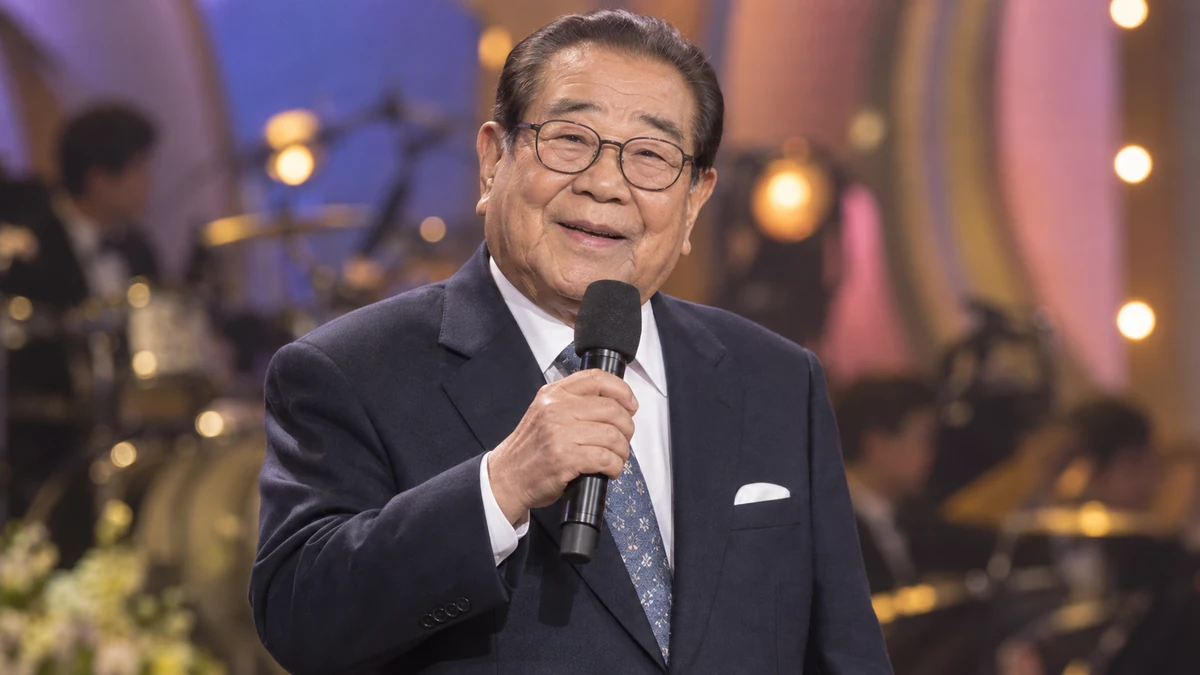
For Americans who discovered South Korean entertainment through BTS, Blackpink or streaming dramas, Song Hae represents a different introduction: a traveling television stage where ordinary people, rather than meticulously trained stars, became the main attraction. As the longtime host of KBS’ “National Singing Contest,” he built his reputation by helping contestants turn a few minutes at a microphone into a moment of public recognition.
Song died June 8, 2022, at his Seoul home at age 95, shortly after Guinness World Records recognized him as the oldest TV music talent show host. But that distinction captures only the final chapter of a career that connected singing, comedy and broadcasting with some of the most consequential experiences in modern Korean history: war, displacement, authoritarian rule and the separation of families across a heavily fortified border.
His story also has a direct American thread. A U.S. evacuation ship carried him south during the Korean War. Decades later, the program that made him a household name took its stage to Los Angeles and New York. His life offers a way to understand U.S.-Korean connections beyond military alliances and entertainment exports: through the people, memories and cultural traditions that traveled between them.
A Name Born From War and Separation
Song was born Song Bok-hee on April 27, 1927, in Jaeryong, in what is now North Korea. His artistic ambitions preceded the division that would define his adult life. In 1949, he entered the vocal music department of an arts school in Haeju and began performing. The Korean War, which broke out in June 1950, interrupted that path.
Trying to avoid conscription into the North Korean army, he hid in the mountains. After his third departure, he could not return home and boarded a U.S. evacuation vessel heading south. His mother’s warning to be careful became their final exchange. Looking out at the sea during that journey helped inspire the stage name Song Hae, with “Hae” referring to the sea.
For American readers, the Korean War is often encountered through military histories, veterans’ accounts or the long cultural afterlife of “M*A*S*H.” Song’s experience brings another perspective into focus: a young civilian whose escape became a permanent separation from home. The ship offered safety, but it also carried him toward a future in which he would never reunite with his mother.
After reaching Busan, he served as a communications soldier in the South Korean military. When the armistice was signed July 27, 1953, his assignment included transmitting its message in Morse code. The agreement stopped the fighting without producing a peace treaty, leaving the peninsula divided and displaced families facing an uncertain future.
From Traveling Performer to Broadcast Fixture
Song’s postwar career began far from the modern machinery of K-pop agencies, international fan platforms and global concert tours. After leaving military service, he joined a traveling musical theater troupe and formally debuted as a singer in 1955. A small film role followed in 1963. By the late 1960s, comedy programs and broadcast hosting had become central to his work.
An approximate American reference point is the generation of entertainers who moved among touring variety shows, radio, movies and early television. The comparison is not exact, but it helps explain why describing Song only as a singing-contest host understates his range. He belonged to a performance culture in which singing, comic timing and the ability to hold a live audience’s attention were closely connected skills.
His career also passed through a politically imposed transformation of Korean broadcasting. He worked at TBC before it was forcibly closed in the 1980 media consolidation under South Korea’s authoritarian government. His television work shifted to KBS 2TV. An early-morning traffic program he began hosting in 1975 continued through the institutional changes and remained part of his career until 1989.
That history distinguishes his longevity from a simple story of personal endurance. Song maintained a public presence as the institutions around him changed. His eventual identity as a reassuring television fixture rested on decades of adaptation, not on spending his entire career in one unchanged job.
A Singing Contest That Made Room for Ordinary Lives
Song first hosted “National Singing Contest” on May 8, 1988. The Korean title, “Jeonguk Norae Jarang,” describes a nationwide showcase of singing ability. Its traveling public broadcasts brought amateur performers before television audiences, with Song serving as the link between the individual contestant and the larger crowd.
For Americans, the format can be approached as a combination of a county-fair talent show and a nationally televised variety program. That is a more useful starting point than assuming it was simply an earlier Korean version of “American Idol.” The significance of Song’s role lay not only in presenting musical performances but also in giving participants room to be recognizable people, with personalities and lives beyond the song.
His arrival followed a devastating personal loss. In March 1987, his only son died at 23 in a hit-and-run traffic crash. Producer Ahn In-ki encouraged the grieving broadcaster to join him on the road, offering the traveling program as a way to get moving again. Song accepted after considering the proposal.
His tenure was not uninterrupted. He was replaced during a spring 1994 programming change, but viewer complaints and falling ratings followed. He returned about six months later, in October. That episode provides a concrete measure of his importance: the program’s appeal was tied not simply to its concept but to the familiar person welcoming contestants onto its stage.
What His Career Means for American Audiences and Companies
The program’s appearances in Los Angeles and New York establish a tangible connection to the United States. Its international itinerary also included Tokyo, Beijing, London and Paraguay. Those trips show that Korean entertainment was crossing borders through a community-oriented broadcast format, not only through the superstar-driven exports that now dominate American coverage.
For Korean American audiences, such a program can offer an entry point into the entertainment familiar to parents and grandparents. For viewers without Korean family ties, it opens a different window on the country: one centered on amateur participation, older performers and local gatherings rather than celebrity training and polished choreography. These are possibilities suggested by the format, not evidence that every overseas viewer experienced it the same way.
There is also a useful comparison with American television personalities such as Dick Clark and Bob Barker. Their programs were different from Song’s, but their careers illustrate how a host can become an institution through repeated encounters with audiences over decades. Familiarity itself becomes part of the program’s value. Song’s return after his 1994 replacement makes that dynamic particularly visible.
For U.S. broadcasters, streaming services and entertainment companies interested in Korea, the lesson is analytical rather than a demonstrated business opportunity: Korean popular culture encompasses more than the genres most visible in American marketing. Song’s career invites consideration of older audiences, variety entertainment and cultural memory alongside youth-oriented fandom. His biography, however, supplies no U.S. audience totals, licensing figures or revenue data that would justify claiming an untapped commercial boom.
The larger bilateral point is equally important. Americans encounter Korea as a security partner and a source of globally successful entertainment. Song’s journey links those categories without collapsing them: the refugee carried aboard an American vessel later became an entertainer whose stage reached American cities.
A Visit to Pyongyang, but Not a Return Home
Song’s most personally consequential trip was not to an overseas entertainment market. It was to Pyongyang in 2003, where he co-hosted a singing special with North Korean television announcer Jon Song Hui. His history of fleeing south complicated the process of obtaining permission to stay, underscoring how politically sensitive an entertainer’s biography could remain half a century after the war.
The broadcast offered a temporary shared stage across the peninsula’s division. When the closing chorus performed a song whose title means “Let’s Meet Again,” Song cried. The emotional weight came from more than the symbolism of the event: his hometown and his mother belonged to the world from which he had been separated.
At a dinner after the performance, he raised the subject of Jaeryong. A North Korean official told him that so much time had passed that the people he sought were no longer there. Song later recalled understanding from that exchange that he would not see his mother again. He repeatedly expressed a wish to hold “National Singing Contest” in his hometown, but that ambition was never realized.
For Americans accustomed to reading North Korea coverage through nuclear negotiations and military threats, this episode adds a necessary human dimension. Cultural contact could create an extraordinary encounter, but it could not undo decades of separation. The Pyongyang program should not be mistaken for evidence that entertainment had resolved the political obstacles governing Song’s life.
The Singer Behind the Host
Even after becoming best known as an emcee, Song continued to sing. He performed older Korean popular music on the television program “Gayo Stage” and held solo concerts past the age of 80. In 2015, he released a song that incorporated the story of his separation from his mother. A full-length album followed in 2018.
For an American audience, this repertoire can be understood partly through the role of standards and older country songs: music that carries memories of earlier performers, family gatherings and particular periods in national life. That comparison describes a social function, not a claim that the musical styles are interchangeable. Song’s singing belonged to a Korean tradition with its own history and emotional vocabulary.
His continuing work as a singer matters because it changes how his hosting can be understood. He was not simply a broadcaster placed in front of amateur musicians. He had spent his own life onstage and continued recording and performing deep into old age. The contest was one expression of that identity, rather than a departure from it.
He also established lasting ties to Dalseong, the hometown of his wife, Seok Ok-i. The couple met during his military service and married the following year. Dalseong named him an honorary resident in 2011 and a promotional ambassador in 2012. Until declining health prevented it, he hosted the area’s annual azalea festival. His wife died in January 2018.
A Record That Could Not Capture the Whole Career
Song continued participating in outdoor recordings into his 90s. When the spread of COVID-19 halted on-site recording in 2020, the program continued through studio specials. The disruption exposed a central feature of the show: gathering people in a physical place was not incidental to its identity. The encounter among host, contestants and local spectators was part of what television carried into viewers’ homes.
On May 23, 2022, Guinness World Records recognized the 95-year-old as the oldest TV music talent show host. That same month, he told the production team that worsening health made it difficult to continue. His final television appearance was May 15, and he died June 8.
The record provided an easily understood international headline, but age alone does not explain why he mattered. His working life extended from postwar touring entertainment through radio, comedy, outdoor television and pandemic-era studio broadcasts. Longevity was the result visible at the end of that progression; the substance was his continuing relationship with performers and audiences.
His funeral tributes emphasized that relationship. Fellow comedian Eom Young-su remembered a host who made older people feel young and contestants feel like stars. Other colleagues recalled the everyday places associated with him, including the restaurants he frequented. Those remembrances situated him in ordinary social life as much as in the formal history of broadcasting.
What to Watch Beyond the Global Hit Machine
Official recognition followed Song throughout his later career and after his death. He received several grades of South Korea’s Order of Cultural Merit, culminating in the highest, the Geumgwan, awarded posthumously on the day he died. In 2023, he was included among 50 figures honored for their contributions to KBS. Despite eligibility for burial in a national cemetery, he was buried beside his wife in Dalseong, in accordance with his wishes.
For English-speaking audiences, his legacy broadens the question of what counts as an important Korean entertainment story. International success is often measured through chart positions, streaming rankings and ticket sales. Song’s career points to another measure: whether a performer can create a durable space in which ordinary people recognize themselves and feel welcome.
As American interest in Korean culture extends beyond its most internationally visible stars, one question worth watching is whether broadcasters, distributors and cultural institutions make more room for this longer history. Older variety programs and the careers behind them can illuminate experiences that a current hit alone cannot explain. That is a matter of cultural understanding, whether or not it produces a large new market.
Song’s life resists a tidy success story. Television gave him a national platform and carried him abroad, but it could not restore his lost family or deliver the hometown performance he wanted. What he did build was a public stage sustained across generations. For Americans looking beyond the Korean Wave’s newest successes, that stage offers a view of the history, grief and everyday pleasure beneath the global spectacle.
Comments
Post a Comment