Before the Korean Wave Went Global, “Haeundae” Built a Blockbuster Around One City’s Worst Nightmare
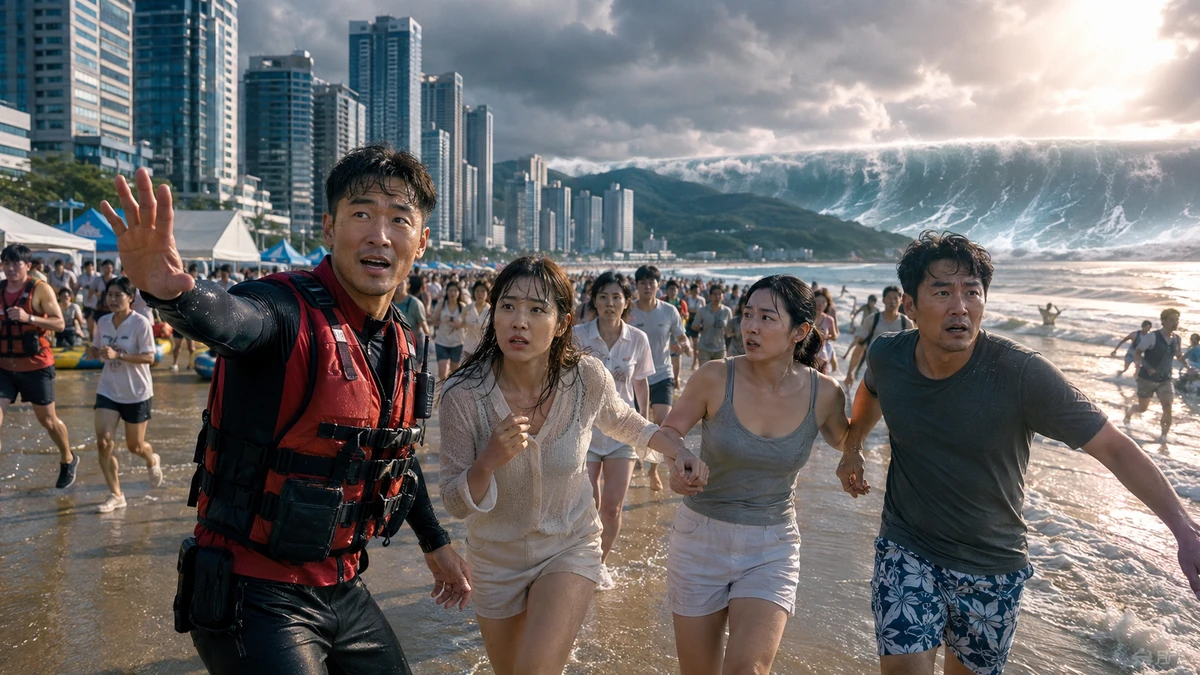
Image to help understand the article
A Disaster Movie Rooted in Everyday Busan
A wall of water racing toward a crowded beach is the kind of image audiences associate with Hollywood spectacle. But the central achievement of “Haeundae,” director Yoon Je-kyoon’s 2009 disaster film, was not simply putting a Korean city in the path of a computer-generated tsunami. It was making the people in that city matter before the wave arrived.
The film takes its name from Haeundae, Busan’s best-known beach district and one of South Korea’s most recognizable summer destinations. For Americans, its cultural role might be understood as part Miami Beach, part Santa Monica and part hometown boardwalk: a heavily visited stretch of coast that is also a working neighborhood, a commercial center and a source of local identity. During peak vacation season, the beach can become a densely packed sea of umbrellas and visitors. That familiar summer scene gives the movie’s threat its force. The disaster is not approaching an anonymous coastline. It is bearing down on a place where people work, raise children, argue with relatives and carry memories they cannot escape.
At the center are Choi Man-sik, a lifelong resident played by Sol Kyung-gu, and Kang Yeon-hee, played by Ha Ji-won. Man-sik loves Yeon-hee but has been unable to speak honestly because he carries guilt over the death of her father during the 2004 Indian Ocean tsunami. As he prepares to propose, geologist Kim Hwi, played by Park Joong-hoon, detects warning signs near the waters around Tsushima and the Korean Peninsula. Government disaster officials reject his concerns, insisting that a tsunami striking Korea is not supported by the geological and statistical evidence. The sea, of course, does not wait for the bureaucracy to reach a consensus.
The Real Disaster That Inspired the Film
Yoon’s idea grew out of the 2004 Indian Ocean earthquake and tsunami, one of the defining natural disasters of the early 21st century. Yoon, who is from Busan, was in Haeundae when the catastrophe unfolded across South and Southeast Asia. Watching the devastation, he began with a direct and frightening question: What would happen if a tsunami struck Haeundae when the beach was filled with summer vacationers?
That question allowed Yoon to bring an international trauma into a place he understood personally. Yet “Haeundae” does not treat Busan as a generic stand-in for any coastal city. To tourists, the district may represent a weekend trip or a summer holiday. To the film’s characters, it represents livelihood, family history, romance, embarrassment and regret. The geography matters because the relationships have grown out of it.
The story’s scientific countdown follows a familiar disaster-movie structure. An expert spots a pattern. Officials doubt him. Warning signs intensify. By the time the danger becomes undeniable, evacuation time has nearly vanished. In the film, the collapse of Tsushima generates a massive tsunami that races toward Busan at roughly 500 mph, leaving the people along the coast only about 10 minutes. The speed and compression turn private emotions into immediate choices: whom to call, whom to protect, what apology can no longer be postponed and what sacrifice might be required.
American viewers will recognize elements found in movies such as “Deep Impact” and “The Day After Tomorrow,” including the ignored scientist and the collision between institutional confidence and physical evidence. But “Haeundae” shifts much of its attention away from national leaders and command centers. Its emotional field is the neighborhood. The people at risk are not primarily presidents, generals or celebrity scientists. They are seafood workers, parents, children, former spouses, young lovers and maritime rescuers.
Why 10 Million Admissions Mattered in Korea
“Haeundae” became what South Koreans call a “10 million audience film,” meaning it surpassed 10 million admissions at the domestic box office. The phrase carries a significance that can be lost in a simple translation. Korean box-office performance is commonly discussed in admissions rather than dollars, and crossing the 10 million threshold has long functioned as a cultural milestone. It suggests that a movie has reached beyond dedicated film fans and become a national event — something discussed across generations, workplaces and social circles.
That achievement was especially important for a locally produced disaster movie. Before audiences bought tickets, the production had to answer a basic industrial question: Could South Korea mount a large-scale effects picture capable of competing with the visual expectations established by Hollywood? The reported production budget was 16 billion won, a major commitment for the Korean industry but, according to accounts of the production, less than one-tenth of the budgets associated with Hollywood disaster spectacles.
The film took five years to develop, including about a year of screenplay work. Filming began in August 2008, with production moving between South Korea and the United States before the movie opened July 22, 2009. Those details underline the scale of the gamble. The filmmakers were not only staging destruction; they were attempting to integrate effects work, location identity and a large ensemble within financial limits far tighter than those of a major U.S. studio tentpole.
The commercial result demonstrated that Korean audiences would support a domestic spectacle when it spoke in a recognizable emotional and cultural register. That lesson would become increasingly relevant as Korean film and television expanded overseas. Technical ambition did not require erasing local character. In the case of “Haeundae,” specificity helped create mass appeal.
A Korean Genre Hybrid, Not a Hollywood Copy
Yoon has described his goal as making a disaster film with Korean humor and drama — a movie with what Koreans often call “the smell of people.” The expression does not refer literally to scent. It describes warmth, human messiness and the sense that characters belong to a lived-in community rather than a mechanical plot. That philosophy explains why the tsunami does not arrive immediately. The movie first spends time on awkward romance, family obligations, unresolved guilt, divorce, neighborhood friction and broad comedy.
To some American viewers accustomed to tighter tonal separation, the shifts can feel unusual. A Hollywood disaster film may include jokes or romance, but it often signals clearly when the serious part has begun. Popular Korean cinema is frequently more comfortable placing comedy, melodrama, action and tragedy side by side. The humor does not necessarily diminish the disaster. Instead, it establishes ordinary life so that its destruction carries greater emotional weight.
The ensemble reinforces that strategy. Kim Hwi’s scientific warning is intertwined with his relationship to his former wife, Lee Yoo-jin, played by Uhm Jung-hwa, and their daughter, Ji-min, played by Kim Yoo-jung. Elsewhere, maritime rescue worker Choi Hyung-sik, played by Lee Min-ki, and his romantic interest, Kim Hee-mi, played by Kang Ye-won, bring the emergency response into the story at a personal level. Kim In-kwon appears as Oh Dong-choon, while Song Jae-ho, Kim Ji-young and Cheon Bo-geun play members of Man-sik’s extended family.
The result is less a story about one hero saving a city than a portrait of a community facing the same impossible clock. The approach resembles an ensemble network drama, with separate relationships gradually drawn together by a shared crisis. The wave provides the spectacle, but the accumulation of emotional debts gives the movie its structure.
What the Film Meant for the United States
For the American market, “Haeundae” offers an early example of the formula that would later help Korean popular culture win international audiences: adopt a globally familiar genre, preserve a distinctly Korean emotional rhythm and use local detail as an advantage rather than an obstacle. U.S. viewers do not need prior knowledge of Busan to understand the fear of a crowded vacation destination suddenly becoming a disaster zone. But the movie also invites them into a community whose relationships, humor and regional loyalties are unmistakably Korean.
The production itself had a direct American connection through its visual-effects work and filming in both countries. The filmmakers recruited Hans Ulrich, whose credits included major Hollywood effects pictures such as “Deep Impact,” “The Perfect Storm,” “The Day After Tomorrow” and “Lemony Snicket’s A Series of Unfortunate Events,” as well as work beginning with “Star Wars: Episode VI — Return of the Jedi.” His involvement represented more than imported prestige. It reflected a practical exchange between the Korean and U.S. industries: Hollywood technical experience was applied to a Korean story operating at a fraction of typical American blockbuster spending.
For American studios and producers, the film’s success offered a useful business lesson. Spectacle alone does not guarantee cultural reach, and a smaller industry does not necessarily need to imitate Hollywood on Hollywood’s terms. “Haeundae” sold scale through place and character. That model is now familiar to U.S. audiences who have embraced Korean productions that mix genres more freely than many American studio releases. The later global attention surrounding Korean film and streaming television did not emerge from nowhere; it was built on domestic hits that proved local filmmakers could manage ambitious concepts while retaining a national voice.
The film also provides an instructive comparison with U.S. disaster movies, which often place federal institutions, military operations or national symbolism at the center. “Haeundae” is more municipal and intimate. Its crisis is experienced through a beach district and the people attached to it. For American companies evaluating Korean material — whether for distribution, licensing, remake discussions or streaming acquisition — that difference is not a barrier to translation across markets. It is part of the product’s identity.
Busan’s Baseball Culture Adds Local Texture
The movie’s Busan identity extends beyond beaches and dialect-inflected characters. Members of the Lotte Giants, the city’s professional baseball team, appear as themselves, including Lee Dae-ho and Jang Won-jun. Baseball broadcaster Heo Koo-youn, announcer Han Myung-jae and then-Giants manager Jerry Royster also make cameo appearances.
For an American audience, the effect is comparable to setting a movie in Boston and including Red Sox personalities, or filming in Chicago and drawing on the Cubs as part of the city’s emotional landscape. The cameos help establish that the characters live in a specific sports town, not a digitally constructed coastal backdrop. Royster’s appearance adds another U.S.-Korea connection: an American baseball figure was part of the local Giants culture represented on screen.
Baseball has a deep following in South Korea, and team loyalty is strongly tied to regional identity. In Busan, the Giants are woven into civic pride and popular memory. By inserting recognizable baseball figures into the film, Yoon grounds the coming catastrophe in ordinary entertainment and familiar routines. Viewers are reminded of the world that exists before the emergency — games, broadcasts, celebrities and neighborhood conversations.
This detail also illustrates why “Haeundae” traveled beyond the generic premise of “a tsunami hits a city.” Many countries can produce images of collapsing buildings and flooded streets. Fewer can make those images feel attached to a community the audience recognizes. The film’s landmarks, residents and sports references give the destruction social meaning.
Technical Ambition and Industry Recognition
The movie’s effects were central to its marketing and to the doubts surrounding the project. Creating a convincing tsunami is difficult even with enormous resources. Water must move with believable weight while interacting with buildings, vehicles, debris and crowds. The challenge becomes greater when a production must control costs and combine international expertise with domestic shooting.
“Haeundae” received substantial recognition during the 2009-10 awards cycle. At the Blue Dragon Film Awards, Hans Ulrich and other members of the computer-graphics team received the technical award, while the movie was honored for drawing the largest audience among Korean films. Yoon received a planning award at the Grand Bell Awards. At the Buil Film Awards, Yoon and Kim Hwi won for screenplay, Kim In-kwon received supporting actor honors and Yoon was named best director. Cinematographer Kim Young-ho was recognized by the Korean Association of Film Critics, and Yoon and JK Film received producer honors from the Director’s Cut Awards. At the Baeksang Arts Awards, Lee Min-ki won the film prize for best new actor, while Yoon received the film division’s grand prize.
South Korea’s awards organizations do not map neatly onto the Oscars, Golden Globes or critics groups familiar to Americans, but together these honors indicate the breadth of the movie’s industry impact. Its acting, writing, cinematography, production planning and effects all entered the conversation. The film was not treated solely as a commercial curiosity. Its success was recognized as a production achievement that expanded expectations for what a Korean mainstream movie could attempt.
Success Also Exposed the Piracy Problem
As “Haeundae” continued playing in theaters and passed 10 million admissions, an illegal copy circulated online. Distributor CJ Entertainment moved to remove unauthorized files and said it would pursue legal action against parties that profited from the leak. The episode cast a shadow over the theatrical triumph and highlighted a problem that was becoming increasingly urgent for film industries worldwide.
The American entertainment business was confronting the same disruption during that era. Faster broadband, peer-to-peer file sharing and unauthorized streaming were weakening the traditional separation between theatrical release and home viewing. A hit could generate enormous attention while simultaneously becoming a prime target for illegal distribution. For a Korean production that had invested heavily in effects and depended on ticket sales, piracy was not an abstract debate about technology. It threatened the economic model required to make similarly ambitious films.
The incident now reads as an early warning about the challenges that would accompany the international growth of Korean content. Wider demand creates opportunities for studios, platforms and rights holders, but it also increases the value of unauthorized copies. As Korean entertainment developed larger audiences in the United States and elsewhere, questions of timely access, legitimate distribution, subtitles and rights enforcement became part of the same global marketplace.
A Milestone With Lessons Beyond Its Release Year
Seen today, “Haeundae” matters less as a prediction of a specific disaster than as evidence of an industry in transition. Korean filmmakers were testing whether they could build a homegrown event movie around effects-heavy spectacle without surrendering the storytelling traits that domestic audiences expected. The answer, measured in more than 10 million admissions, was yes.
The film’s most durable choice was to make the disaster secondary until it could no longer be ignored. Before the wave, there is guilt between a man and the woman he loves, distance between former spouses, responsibility toward children and the daily disorder of a crowded neighborhood. The rejected scientific warning supplies suspense, but the relationships supply consequence. When the characters are given only minutes to act, the crisis forces them to reveal what their ordinary conversations had concealed.
For U.S. audiences, that combination helps explain the broader appeal of Korean genre storytelling. The cultural details may be highly specific, but the emotional machinery is accessible: people procrastinate, institutions dismiss inconvenient warnings, families fracture and emergencies expose priorities. “Haeundae” wrapped those ideas in the language of a blockbuster while keeping Busan, rather than an imitation of an American city, at the center.
What followed in Korean cinema and television would bring greater international visibility, deeper relationships with American distributors and platforms, and more frequent collaboration across borders. “Haeundae” belongs to the period that showed such expansion was commercially plausible. It demonstrated that a Korean movie could absorb Hollywood expertise, operate under very different budget conditions and still draw a mass audience by being more local, not less. The tsunami was the selling point. The neighborhood was the reason it mattered.
Comments
Post a Comment