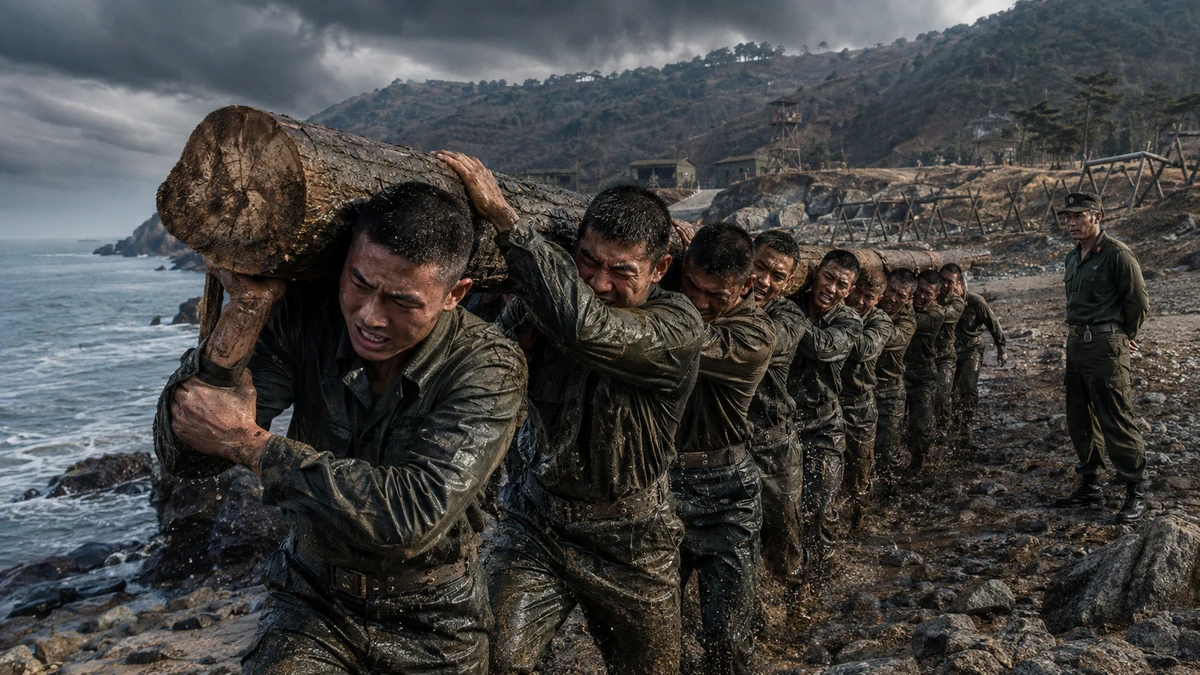
Image to help understand the article
The film that created South Korea’s 10 million admissions club
Long before “Parasite” won the Academy Award for best picture and Korean dramas became fixtures on American streaming services, a grim military thriller demonstrated the power of South Korea’s domestic film industry. Director Kang Woo-suk’s “Silmido,” released in South Korea on Dec. 24, 2003, became the first movie in the country’s history to sell more than 10 million tickets. Its final nationwide attendance was reported at 11.08 million admissions, establishing a benchmark that remains central to the way Koreans discuss blockbuster success.
In the United States, movie performance is usually expressed in box-office dollars. South Korea also tracks revenue, but admissions carry unusual cultural weight. A film that crosses 10 million tickets is treated as a national phenomenon — the kind of release seen by families, office workers, students and older viewers who may rarely agree on entertainment. The label “10 million movie” became a recognizable category after “Silmido,” identifying films whose reach extended well beyond devoted moviegoers.
The scale of that achievement is only part of the story. “Silmido” did not reach its audience with escapist fantasy, romantic comedy or a reassuring patriotic tale. Based on Baek Dong-ho’s novel of the same name, it dramatized Unit 684, a secret South Korean commando force created during one of the most dangerous periods of the Cold War on the Korean Peninsula. The unit’s mission was tied to a plan to assassinate North Korean leader Kim Il Sung. When government policy changed, the men trained for the operation were left trapped between state secrecy and their own survival.
By placing that episode at the center of an expensive, accessible action drama, the film changed the relationship between Korean commercial cinema and the country’s unresolved modern history. It suggested that an audience of blockbuster size would engage with a story about institutional betrayal, hidden violence and people excluded from the official record. That combination — mass-market filmmaking joined to political memory — would become an important feature of South Korea’s film culture.
A covert unit born from an attempted assassination
The historical chain of events began on Jan. 21, 1968, when 31 members of a North Korean commando unit infiltrated South Korea with the aim of assassinating President Park Chung-hee. The attack, commonly known as the Blue House raid, brought the armed infiltrators close to South Korea’s presidential compound in Seoul. It intensified fears that the division of the peninsula could erupt into another full-scale war less than two decades after the Korean War.
For American audiences, the episode belongs to the same broader Cold War landscape as the Cuban missile crisis, clandestine CIA operations and the war in Vietnam. But Korea’s situation was — and remains — distinct. The Korean War ended in 1953 with an armistice rather than a peace treaty. North and South Korea therefore remained technically at war, separated by the heavily fortified Demilitarized Zone. South Korea was also governed at the time by Park, an authoritarian leader whose government emphasized anti-communism and national security while restricting political freedoms.
Following the North Korean raid, South Korea prepared a retaliatory mission targeting Kim. Under orders associated with Korean Central Intelligence Agency Director Kim Hyong-uk, Unit 684 was established and sent to Silmido, a small island off the country’s west coast. The isolation of the island was essential to both the mission and the movie: It functioned as a training ground, a prison and a place where the state could conceal people whose existence was not meant to become public.
In the film’s version of events, 31 social outcasts, including death-row prisoners and men serving life sentences, are recruited into the unit. They are offered a stark bargain. If they endure the training, complete the assassination mission and prove their loyalty, they can escape the stigma of their pasts and begin new lives. Freedom is not presented as a right but as a reward controlled by the same state that has removed them from society.
The men undergo relentless physical punishment, combat preparation and psychological conditioning. Their suffering initially appears to have a clear purpose: They are being transformed into a force capable of infiltrating North Korea. But after they reach combat readiness, the mission is repeatedly postponed. As Seoul begins pursuing a less confrontational relationship with Pyongyang, the assassination plan becomes politically inconvenient. A strategic shift that can be described in government language as diplomacy leaves the unit’s members facing a terrifying question: What happens to secret soldiers when the state no longer needs their secret?
A blockbuster built around a group, not a superhero
“Silmido” uses the scale of a military action movie, but its central character is effectively the unit itself. Sol Kyung-gu, one of South Korea’s leading actors, plays Kang In-chan, the leader of the third squad. Ahn Sung-ki portrays training commander Choi Jae-hyun, while Huh Joon-ho plays instructor Sgt. Jo Dong-il. Jung Jae-young appears as first squad leader Han Sang-pil. The supporting ensemble includes Lim Won-hee, Kang Sung-jin, Kang Shin-il and Lee Jung-heon.
That ensemble structure separates the film from the familiar Hollywood model in which an extraordinary individual overcomes a corrupt system. The men in “Silmido” are shaped, disciplined and eventually destabilized as a collective. Their conflicts with the instructors matter, but the trainers are not portrayed only as sadistic villains. Choi, in particular, is caught between military duty and a personal sense of honor toward the men placed under his command. The drama comes from different levels of responsibility inside the same doomed institution.
Ahn’s casting carried additional resonance in South Korea because of his real-life military officer experience. His character embodies the tension between obeying orders and acknowledging the humanity of people the government has reduced to assets. That tension gives the film a moral dimension beyond the mechanics of a covert mission. The question is not simply whether the commandos will reach North Korea. It is whether anyone inside the system can protect them once their assigned purpose disappears.
The production assembled many of the resources associated with a major studio spectacle. Kim Hee-jae wrote the screenplay, Kim Sung-bok handled cinematography and Ko Im-pyo edited the film. Cho Young-wuk and Han Jae-kwon contributed music, while specialists oversaw production design, underwater photography, visual effects, prosthetic makeup, large sets and action choreography. Production support also involved personnel in Malta and New Zealand. The result gave a suppressed historical episode the physical scale and momentum of a war movie.
The first portion of the film is dominated by repetition: drills, punishments, tests of endurance and the hardening of men into combatants. The isolated landscape amplifies the sense that ordinary law no longer applies. Once the operation is canceled, those same elements acquire a different meaning. Training that was framed as preparation for sacrifice becomes evidence that the men have been used. Discipline turns into containment, and loyalty becomes impossible to separate from coercion.
When policy changes but people cannot go home
The most enduring theme in “Silmido” is the contradiction between total loyalty and official nonexistence. The government demands that the trainees give their bodies and identities to a national mission. Yet the secrecy surrounding the operation means the state cannot fully recognize them as soldiers or citizens. Once the geopolitical calculation changes, they cannot simply receive discharge papers, return to their families and explain where they have been.
This is where the movie moves beyond a specific inter-Korean crisis. Its political argument is understandable in any country that has conducted classified operations: Governments can change strategy more quickly than they can repair the lives affected by the old one. A canceled operation may look like restraint or progress from the perspective of national policy. For the people already recruited, trained and compromised, cancellation can create a new form of danger.
The film arrived at a time when South Korean popular culture was becoming more willing to revisit authoritarian rule, state violence and the human cost of national division. For decades, anti-communist ideology had strongly influenced how North Korea and security issues could be represented in public. “Silmido” did not erase that history, but it shifted attention away from a simple North-versus-South framework. Its deepest conflict is between individuals and the South Korean state that recruited them.
The movie’s enormous audience helped return the real Silmido incident to public conversation. Interest expanded beyond Unit 684 to other covert groups trained for operations in North Korea. Silmido itself was developed as a tourist destination, showing how popular entertainment could reshape not only public memory but also the physical meaning of a place. An island associated with secrecy became a location people sought out because a commercial film had made it nationally recognizable.
That transformation illustrates the power of screen tourism, now familiar to international fans who visit South Korean locations featured in television dramas and K-pop videos. In this case, however, the destination was not sold primarily through romance or visual beauty. It was linked to an unresolved tragedy. Visiting the site could be an act of curiosity, historical engagement or movie fandom, and sometimes all three at once.
The risks of turning disputed history into entertainment
The film’s cultural impact did not settle the history it dramatized. Instead, its popularity raised the stakes of questions about accuracy. “Silmido” depicts the unit as being composed largely of condemned prisoners and violent criminals. Relatives of the trainees disputed that portrayal, saying ordinary civilians were among those recruited after intelligence agents made deceptive promises of high pay. Accounts indicated that the real members included people such as a circus performer and day laborers.
Forty-seven relatives of eight trainees filed a defamation complaint against the director and production company. Courts at both the trial and appeals levels found them not guilty. The legal outcome did not eliminate the broader ethical problem: For millions of viewers, the feature film became the most vivid — and perhaps the only — version of the incident they knew.
American cinema has confronted similar disputes. Films including “JFK,” “Zero Dark Thirty” and other fact-based political dramas have been praised for bringing difficult subjects to mass audiences while being criticized for compressing events, inventing dialogue or giving contested claims the authority of images. Viewers understand in theory that a movie is not a court record. In practice, a compelling performance and carefully staged scene can become more memorable than later corrections.
“Silmido” also drew criticism over its use of the North Korean revolutionary song commonly translated as “Song of the Red Flag.” A complaint alleged violations of South Korea’s National Security Act, a Cold War-era law that has been used against material deemed supportive of North Korea. When the film later aired on terrestrial television, those portions were muted. To Americans accustomed to broad First Amendment protections, the idea that the inclusion of a song in a drama could create a national security controversy may appear unusual. In South Korea, however, cultural expression involving North Korean symbols has long existed within a more restrictive legal and political environment.
A scene involving sexual violence brought another major criticism. The film received a dishonorable award from a women moviegoers’ organization accusing it of justifying sexual violence. That objection remains significant when reassessing the work. A film can be historically influential and technically accomplished while still relying on depictions that audiences and critics find exploitative or harmful.
At the same time, reactions from people connected to the unit were not uniform. Kim Bang-il, identified as the real-life model for the platoon leader played by Huh, praised the film for removing what he considered fictional elements from the original novel and presenting events realistically. Those conflicting responses demonstrate why historical dramas must be evaluated as interpretations rather than definitive records.
What “Silmido” means for the United States
For American audiences, “Silmido” offers context for understanding how the Korean Wave developed before it became a familiar part of U.S. entertainment. The global rise of Korean film did not begin with Hollywood awards or streaming algorithms. It was supported by a domestic industry capable of making technically ambitious movies, attracting enormous national audiences and turning Korean history into commercial spectacle.
That matters to American distributors and studios because Korean success cannot be understood only as an export trend. Movies and series that travel well are often built first on intense local engagement. “Silmido” was deeply specific to South Korea: its national division, authoritarian past, military culture and contested memory. Yet its emotional structure — disposable operatives confronting a government that has abandoned them — is legible to viewers raised on American conspiracy thrillers, Vietnam War films and stories about intelligence agencies operating beyond public oversight.
The film also provides a useful counterpoint to the South Korea most Americans encounter through K-pop, romantic dramas, beauty products and consumer technology. The modern U.S.-South Korea relationship is grounded not just in trade and cultural exchange but in a military alliance shaped by the Korean War and the continuing confrontation with North Korea. “Silmido” dramatizes an unstable chapter within that security relationship, when fears of infiltration and assassination made extreme covert action appear possible.
American viewers should not treat the film as a complete history lesson. They can, however, use it as an entry point into questions that remain relevant to both democracies: How should classified operations be investigated? What obligations do governments have to people recruited for missions they cannot publicly acknowledge? Who controls the narrative when official records are incomplete, restricted or politically sensitive?
For U.S. entertainment companies, “Silmido” also carries a creative lesson. Korean films that gain lasting importance frequently combine familiar genres with conflicts rooted in local history. The action filmmaking makes the story accessible; the national specificity gives it weight. Attempts to reproduce Korean success by copying visual style alone risk missing that foundation. The strongest cross-border projects preserve the political, social and emotional conditions that made the original story matter.
A milestone that deserves a complicated legacy
“Silmido” received substantial recognition during the 2004 awards season in South Korea. Kang received honors including a special jury award at the Chunsa Film Art Awards, the film earned a bronze cinematography prize at the Golden Cinematography Awards, and it collected awards for adapted screenplay, planning and Huh’s supporting performance at the Grand Bell Awards. Kang received the top film honor at the Baeksang Arts Awards and won best director at the Blue Dragon Film Awards, where Jung was named best supporting actor and the movie was recognized as the year’s best film.
Its reach continued on television. A 2005 Lunar New Year broadcast on MBC recorded a 30% audience rating in several major regional measurements. Lunar New Year is one of Korea’s most important family holidays, comparable in social scale — though not in tradition — to a major American holiday weekend. A holiday broadcast placed the violent, politically uncomfortable drama in homes across the country, extending its role in public memory beyond its theatrical run.
More than two decades after its release, “Silmido” remains worth revisiting for reasons that exceed its box-office record. It proved that a Korean historical blockbuster could draw a mass audience without offering an uncomplicated celebration of the nation. It turned a covert operation into a public argument about responsibility. It also demonstrated the danger of allowing dramatization to define people whose real backgrounds and choices remain disputed.
The most productive way to view the film now is to hold its achievements and failures together. Its ensemble performances, large-scale production and institutional critique helped redefine what a South Korean commercial movie could attempt. Its disputed portrayal of the trainees and its handling of sexual violence require scrutiny rather than nostalgia. Its success opened space for hidden history, but commercial visibility did not guarantee historical justice.
That tension is precisely why “Silmido” endures. It is both an industry landmark and an example of how national memory is manufactured. Before Korean cinema became a global awards force, this film showed that millions of viewers would buy tickets to confront a past their country had struggled to acknowledge. For Americans discovering the wider history behind the Korean Wave, “Silmido” is not merely an early blockbuster. It is evidence that South Korea’s cultural rise was built, in part, by filmmakers willing to turn unresolved history into mass entertainment — and by audiences willing to debate what they saw afterward.
Comments
Post a Comment