Image to help understand the article
A Korean breakthrough beyond the blockbuster story
For Americans who discovered South Korean cinema through the Oscar-winning “Parasite,” Yang Ik-june’s “Breathless” offers a demanding route into an earlier chapter of the country’s international film story. Released in South Korea on April 16, 2009, the independent drama follows a violent hired enforcer and a high school student whose unlikely connection brings their family wounds into focus. Its world is abrasive, its central character difficult to embrace. But its international reception demonstrated that a Korean film did not need glamorous stars or reassuring characters to reach audiences far from home.
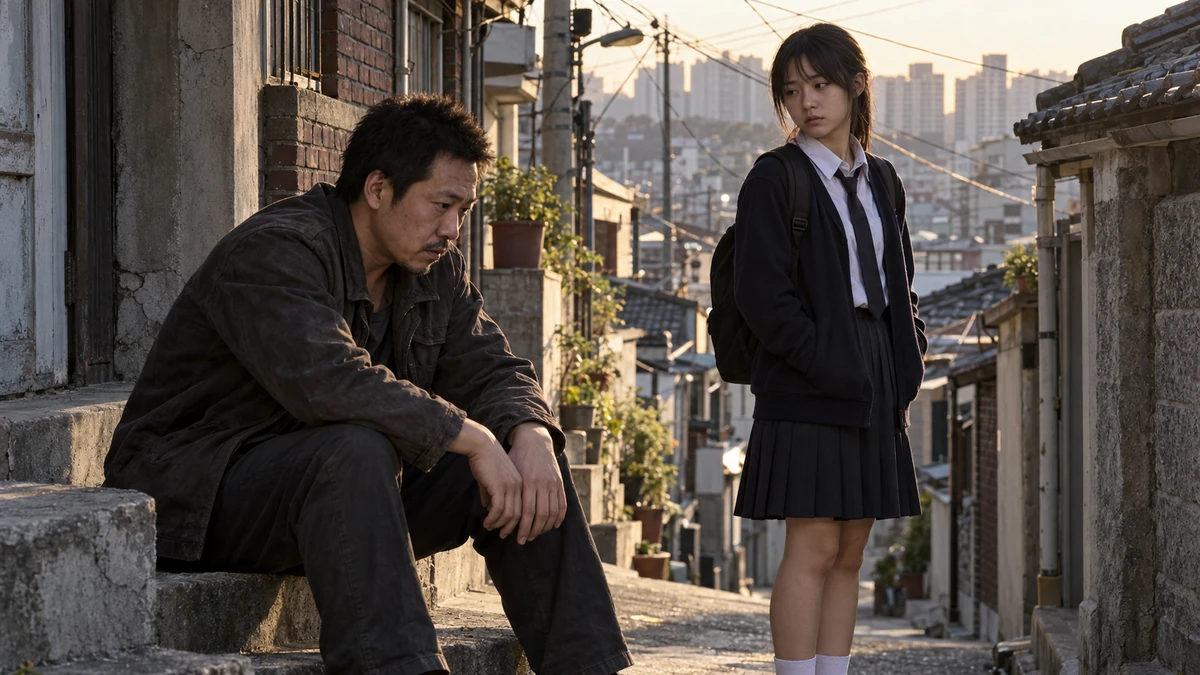
Yang wrote and directed the film and played its lead, Sang-hoon. Kim Kkot-bi stars opposite him as Yeon-hee, a teenager who refuses to be intimidated by a man accustomed to frightening people. Their encounters form the center of a story about violence, emotional inheritance and the difficulty of becoming close to someone when family life has taught you to expect harm.
Revisiting “Breathless” is not simply an exercise in tracing the precursors to today’s Korean entertainment boom. It also challenges the way that boom is often described. South Korean culture’s international reach has never been only a story of big companies, elaborate productions and mass-market hits. This film’s passage through European, Latin American and Canadian festivals reveals another route: a small production finding recognition because its troubling, locally grounded story could travel.
The man behind the violence
Sang-hoon works as a hired thug, using force against others with little restraint. His aggression is not confined to a clearly marked criminal adversary; it is an everyday way of dealing with people. When a chance confrontation puts him in Yeon-hee’s path, her refusal to fear him disrupts that familiar pattern. As the two grow closer, a sense of shared experience emerges beneath their differences in age and circumstance.
The character invites a distinction that matters in any drama about abuse: explaining violence is not the same as excusing it. Sang-hoon carries grief and damage from his family, but those wounds coexist with the harm he inflicts. The film’s premise asks viewers to hold both facts in mind rather than choose between seeing him as a perpetrator or as someone shaped by suffering.
His father’s release from prison after 15 years brings the family’s past back into the present. That development gives concrete form to an otherwise abstract idea: childhood does not stay neatly in childhood. A person may leave the household where injury began without escaping the habits and expectations formed there.
For American viewers, the useful point of reference is not an exotic criminal underworld but the familiar subject of intergenerational trauma. American independent dramas have also explored how damage inside a household becomes anger outside it. “Breathless” approaches that territory through Korean characters and circumstances, not through a claim that violence is a uniquely Korean condition.
Family obligation, without the comforting promise
Family relationships are essential to understanding the film, but they require some care in interpretation. Respect for parents and elders has long held an important place in Korean social life, informed in part by Confucian traditions. Those expectations are neither uniform nor uncontested. They provide cultural context, not a single rule explaining how every Korean household works.
Against that background, a story about a father who returns from prison can carry more than the prospect of an uncomfortable reunion. It raises questions about obligation: What does someone owe a parent who has caused pain? Does a family connection impose duties when the relationship itself has been destructive? And can emotional distance be an act of survival rather than a failure of loyalty?
Those questions are readily legible in the United States, where arguments about forgiveness, estrangement and responsibility also shape family life. The cultural expectations may differ, but American audiences do not need a detailed knowledge of Korean customs to understand the contradiction of wanting closeness while fearing what it costs.
“Breathless” places sorrow caused by family at the starting point of a story about human attachment. Sang-hoon and Yeon-hee’s connection matters because it develops outside their existing family relationships. It offers a way to examine whether recognition from another person can interrupt an established pattern of hostility. That is a more unsettled proposition than the comforting notion that family affection will inevitably repair what family members have broken.
A festival route that crossed several borders
The film’s international standing began taking shape before its South Korean theatrical release. In February 2009, “Breathless” received a VPRO Tiger Award at the International Film Festival Rotterdam in the Netherlands. The Tiger competition is associated with emerging filmmakers, making the recognition especially relevant to a production whose writer-director also carried the lead performance.
In March, the film won the grand prize and the international critics’ prize at France’s Deauville Asian Film Festival. That month also brought an audience award at the Florence Korea Film Fest in Italy. An audience award at the Buenos Aires International Festival of Independent Cinema followed in April, the same month the film opened in South Korea.
The awards continued through the year: a grand prize at the Barcelona Asian Film Festival in May, then a NETPAC Award at the Karlovy Vary International Film Festival in the Czech Republic and a best film award at Montreal’s Fantasia International Film Festival in July. NETPAC, the Network for the Promotion of Asian Cinema, recognizes work from the region. The Montreal result placed the film’s award-winning reception in North America as well as Europe and South America.
This itinerary matters because international success is too often treated as a single breakthrough moment. Here, recognition accumulated across different institutions and audiences. Jury prizes, critics’ honors and audience awards are not interchangeable measures, but together they indicate that the film resonated in more than one kind of setting. They do not, on their own, establish large commercial returns or widespread household recognition.
Performances that traveled with the film
Yang’s multiple roles are central to the film’s identity. Writing, directing and starring put him in charge of both the construction of Sang-hoon and the physical performance through which viewers encounter him. For Americans, that arrangement belongs to a recognizable independent-film tradition, with actor-filmmakers taking on overlapping responsibilities to realize a personal project. It is not proof that the story is autobiographical, and it should not be read as such without further evidence.
Kim’s Yeon-hee is equally important to the premise. Her refusal to shrink from Sang-hoon gives their initial confrontation its force and makes possible the relationship that follows. Treating her merely as an instrument of his emotional development would overlook how much the story depends on two damaged people recognizing something in each other.
Both performances received international recognition. At Spain’s Las Palmas de Gran Canaria International Film Festival in March 2009, Yang won best actor and Kim won best actress. Yang later received a best actor award at Fantasia in Montreal. Those honors complemented the film’s broader festival success, showing that its reception was not limited to praise for its subject matter or its direction.
Recognition followed in South Korea. Kim received the best new actress award at the 2009 Grand Bell Awards. At that year’s Blue Dragon Film Awards, Yang and Kim won the new actor and new actress honors, respectively. The Grand Bell and Blue Dragon awards are prominent institutions in South Korean cinema; for readers unfamiliar with the names, their significance here is that domestic recognition accompanied, rather than disappeared behind, the overseas response.
What this means for American audiences and companies
The strongest American connection is a question of discovery. “Parasite” became the first non-English-language film to win the Academy Award for best picture in 2020, giving South Korean cinema an extraordinary platform in the United States. “Breathless,” made more than a decade earlier, helps put that milestone in perspective. International engagement with Korean filmmaking was already developing through festivals and specialized audiences before the Oscar breakthrough.
That does not make “Breathless” a documented American commercial success. The awards record described here includes a Canadian festival, not evidence of a major U.S. theatrical run. Montreal is part of the North American cultural landscape, but recognition there should not be confused with American ticket sales. Nor does the available information establish current U.S. streaming availability, an American rights holder or plans for a new release.
For U.S. distributors, programmers and streaming services, the film nevertheless illustrates an important distinction: Korean cinema is a national film culture, not a genre. A viewer drawn to Korean thrillers or glossy television romances may encounter something markedly different in a harsh independent drama. Marketing everything under a single Korean-content label can make discovery easier while obscuring the differences that make individual works worth seeking out.
The closest American industry comparison is the festival-to-art-house pathway associated with independent filmmaking. Sundance is a familiar U.S. reference point for that model, though “Breathless” followed the international circuit detailed here. Festival recognition can help a difficult work become visible without making it a blockbuster. For American audiences willing to explore beyond the most heavily promoted titles, that distinction opens up a richer understanding of Korea than any one global hit can provide.
The limits of measuring success
The film’s domestic attendance offers a useful reminder to keep acclaim and commercial scale separate. According to the Korean Film Council’s KOBIS box-office figures cited in the Korean account, “Breathless” had accumulated 72,545 admissions as of April 26, 2009. That is a dated snapshot shortly after its theatrical opening, not a final lifetime total. It also counts admissions rather than revenue, so it should not be presented as the equivalent of a U.S. dollar box-office figure.
Production records identify it as a 2008 South Korean drama, produced by Mole Film and distributed domestically by Jinjin Pictures. The 2008 production date and 2009 release date describe different stages in its history, not conflicting accounts. The film runs 130 minutes and received South Korea’s youth-restricted classification. That rating is a practical warning for prospective viewers, but it is not a Motion Picture Association rating and should not be casually relabeled as an American R or NC-17.
The overseas record extended beyond its initial festival year. In 2010, the Japanese film publication Kinema Junpo placed it first in its foreign-film top 10, and Yang received its foreign-film director award. That recognition adds a regional dimension to a story otherwise dominated by European festival names: the film also found critical distinction in neighboring Japan.
The figures and honors answer different questions. Admissions tell us something about theatrical reach at a specified time. Awards document particular judgments. Neither alone can measure the film’s lasting emotional effect, and neither justifies inventing a larger audience than the evidence supports.
Revisiting a less polished image of the Korean Wave
Even the film’s titles offer a lesson in how a work crosses borders. Its Korean title, “Ddongpari,” refers to a fly associated with excrement — a deliberately coarse image quite different from the English “Breathless.” The Japanese release title, “Iki mo Dekinai,” conveys being unable to breathe. English-speaking viewers should also distinguish Yang’s film from Jean-Luc Godard’s “Breathless,” the French New Wave landmark with which it shares an English title.
The broader cultural context is the Korean Wave, or hallyu, the term used for the international spread of South Korean popular culture. For many Americans, that phrase now brings to mind K-pop, streaming dramas and internationally successful films. “Breathless” complicates the picture by directing attention to an independent work built around people whose lives offer little glamour or escape.
Its importance in a retrospective is not that it predicted every later success or directly caused Korean cinema’s expansion in the United States. The evidence supports a narrower and more useful conclusion: a Korean independent drama about violence and family pain received repeated recognition across national boundaries, including awards chosen by audiences. Its local setting was not an obstacle that had to be removed for others to respond.
What to watch next, from an American perspective, is whether interest in Korean entertainment encourages deeper access to this kind of back catalog, not simply more promotion for the next major release. New screenings, verified distribution announcements and clearly identified streaming editions would provide concrete evidence of that access. Until then, “Breathless” stands as a reminder that understanding Korean cinema means looking beyond its biggest exports — and making room for films that leave viewers unsettled rather than reassured.
Comments
Post a Comment