Image to help understand the article
A Korean Film That Complicates the Breakthrough Story
For Americans who discovered Song Kang-ho through “Parasite,” “Broker” offers a different encounter with an actor whose appeal rests partly on making compromised people difficult to dismiss. This time, he plays a debt-ridden laundry owner who takes a baby from a place intended to provide protection — and offers an explanation that sounds more compassionate than his conduct warrants.
The performance earned Song the best actor award at the 2022 Cannes Film Festival. But the enduring interest of “Broker” lies beyond that distinction. Written and directed by Japanese filmmaker Hirokazu Kore-eda, the South Korean drama brings together a Korean cast and a director long associated with searching examinations of family life. It is both a Korean film and an example of how porous national filmmaking boundaries can become.
That combination matters for American audiences trying to see beyond the handful of Korean titles that become cultural phenomena. The Korean Wave — often called Hallyu, a term describing the international spread of South Korean popular culture — encompasses much more than K-pop, streaming thrillers and blockbuster success stories. “Broker” belongs to its quieter reaches: a morally unsettled drama whose international accessibility does not depend on making its characters easy to admire.
Revisiting the film also raises a question for the American entertainment business. After a breakthrough such as “Parasite,” does the market make room for a broader range of Korean storytelling, or simply search for another version of the same hit? “Broker” is a useful test case precisely because it offers recognition without repetition.
A Road Trip Built on Conflicting Motives
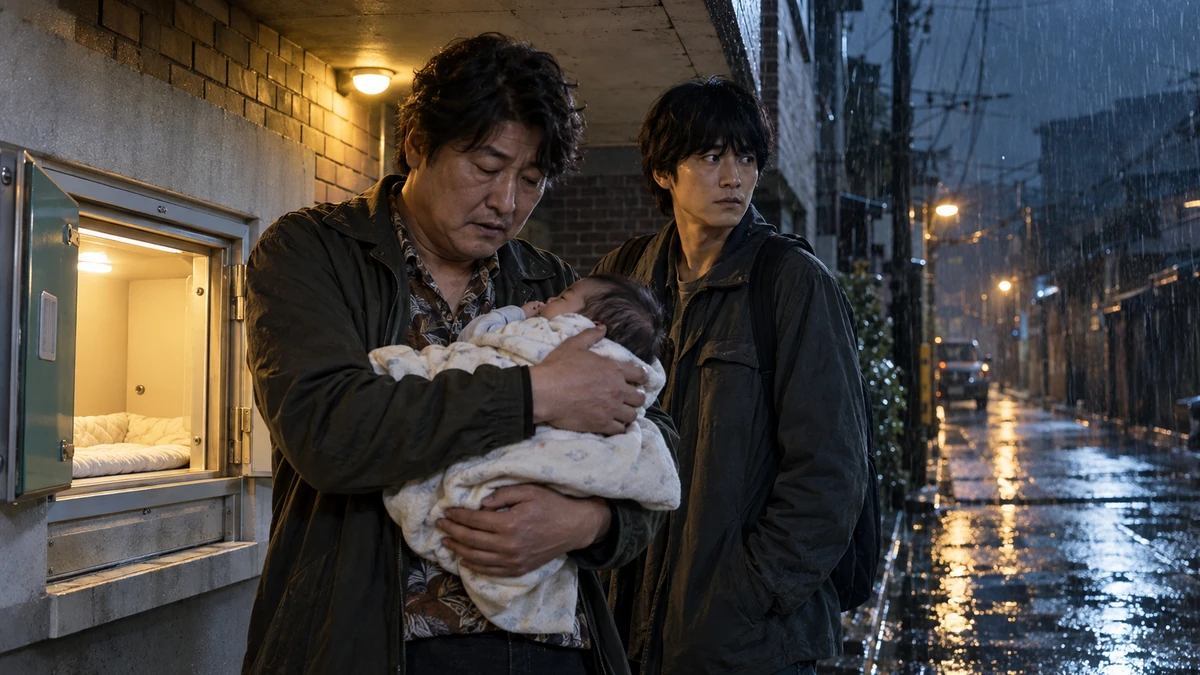
The story begins at a baby box, a facility where an infant can be left anonymously for others to care for. On a rainy night, Sang-hyun, played by Song, and Dong-soo, played by Gang Dong-won, secretly take an infant named Woo-sung. Sang-hyun runs a laundry but struggles with debt. Dong-soo grew up in institutional care and now works at the baby box facility.
Their plan changes when the child’s mother, So-young, returns the next day. Played by Lee Ji-eun, the singer and actress known professionally as IU, she discovers that her baby is missing and threatens to call the police. The men admit taking him, arguing that they intended to find suitable parents who would raise him well.
That claim is not the film’s moral verdict. It is the justification offered by two people who have removed a child without his mother’s permission. The distance between their language of care and the reality of their actions gives the premise its tension. Financial hardship and personal experience may help explain a character, but they do not automatically excuse him.
So-young nevertheless joins the search for new parents. Meanwhile, two detectives, Ahn Su-jin and Lee Eun-joo, played by Bae Doona and Lee Joo-young, follow the group. They want to catch the suspects in the act and conclude an investigation that has lasted six months. What looks like one journey is therefore several overlapping pursuits: a mother’s involvement in her child’s future, the men’s unauthorized arrangement and the officers’ effort to establish a crime.
What American Viewers Should Know About the Baby Box
The baby box is the film’s most immediate cultural explanation point, but it should not be treated as an exotic curiosity or a shorthand for Korean parenting. Within the story, it is a particular place designed to receive infants anonymously. The drama begins when that protective purpose is subverted.
Americans may recognize a broad parallel with safe haven laws, which provide legal routes for surrendering newborns under specified conditions. Some American communities also have designated infant surrender devices. The comparison can help viewers understand the basic idea, but it should not erase differences: U.S. rules vary by state, and the existence of a surrender location does not authorize private individuals to take a baby and arrange a placement themselves.
Nor is “Broker” a guide to Korean adoption law or child welfare practice. Its setup cannot establish how common any particular experience is, what every facility does or what options are available to every parent. Those are reporting questions requiring evidence beyond a fictional narrative. The film instead concentrates attention on people whose immediate choices become entangled around one infant.
That distinction is especially important when a movie travels internationally. Audiences often ask foreign-language films to serve simultaneously as entertainment and social explanation. “Broker” can prompt curiosity about support for parents, institutional care and the protection of children without being made to represent an entire country. Its most accessible question is also its least culturally exclusive: Who gets to decide what acting in a child’s interests actually means?
Song Kang-ho’s Cannes Award, in Perspective
“Broker” screened at Cannes on May 26, 2022, in the festival’s main competition, where it was eligible for the Palme d’Or, the top prize. Song won best actor, and the film received the Prize of the Ecumenical Jury. It opened in South Korean theaters on June 8 that year.
The distinctions matter. “Broker” did not win the Palme d’Or. The ecumenical award is a separate honor associated with a jury that considers films through a humanistic and spiritual lens, not another name for the festival’s top competitive prize. For American readers more accustomed to the Oscars, Cannes has its own award structure; selection for its principal competition and winning its highest honor are different achievements.
Song’s recognition nonetheless provides a clear link to Korean cinema’s expanded American visibility. He was a central performer in Bong Joon Ho’s “Parasite,” which became the first non-English-language film to win the Academy Award for best picture. His Cannes acting prize for “Broker” put an individual performance in the spotlight, rather than treating him only as a familiar face from a celebrated ensemble.
There is a useful complication in that familiarity. Viewers who arrive because they admire Song may be inclined to trust his character. Yet Sang-hyun’s predicament and his charm cannot settle the ethical questions surrounding what he does. The award is a reason to pay attention to the performance, not an instruction to endorse the person being portrayed.
A Japanese Director Working Inside Korean Cinema
“Broker” was Kore-eda’s first Korean film, not his first engagement with the unstable boundaries of family. His Japanese drama “Shoplifters,” which won the Palme d’Or in 2018, also examined a household whose emotional bonds could not be separated neatly from questions of wrongdoing. That earlier work supplies a more useful reference point than assuming “Broker” must resemble another Korean export simply because its dialogue is Korean.
For American viewers, the distinction helps separate a national industry from a single genre. Hollywood is rarely expected to produce only one kind of story after one movie succeeds. Korean cinema deserves the same latitude. A film can share performers and an international audience with “Parasite” while belonging to a different director’s artistic concerns.
Kore-eda’s involvement also makes “Broker” a concrete example of creative exchange between Japan and South Korea, two countries whose relationship carries the weight of Japan’s colonial rule of the Korean Peninsula and continuing disputes over historical memory. A film cannot resolve those issues, and its existence should not be presented as evidence that they have disappeared. It does show that cultural collaboration can occur without fitting neatly into national branding.
The American industry has long relied on filmmakers working outside their birth countries and languages. “Broker” invites the same recognition for Asian cinema: Its categories are not sealed containers. Here, a Japanese writer-director works with Korean stars on a Korean-language story, complicating the idea that international cinema reaches Americans only as a series of separate national products.
What “Broker” Means for the United States
The American connection is more than theoretical. Neon, the U.S. distributor that released “Parasite,” also brought “Broker” to American audiences. That places the film within an identifiable commercial pathway: An American company acquires an international title and tries to connect festival recognition, recognizable performers and audience interest in subtitled cinema.
But shared distribution is not proof of shared commercial potential. “Parasite” became a rare crossover event. “Broker” asks a different kind of investment from viewers, offering a child-centered moral drama rather than promising another variation on Bong’s class thriller. For U.S. distributors, the challenge is to make that difference legible instead of relying on Korean cinema as a catchall marketing label.
The cast creates several possible entry points. Song brings recognition from “Parasite.” IU gives listeners who know her music a reason to explore her acting. Bae is familiar to some American viewers through English-language and international projects, including “Cloud Atlas” and “Sense8.” Those connections can introduce audiences to the film, but they do not establish how many music fans buy movie tickets or how many streaming viewers follow an actor into theatrical releases.
There is a domestic comparison in the way American independent films reach audiences through a mix of festivals, established actors and carefully targeted releases. Films such as “The Florida Project” and “Shoplifters,” though different in setting and storytelling, have offered U.S. viewers portraits of precarious households without the machinery of a conventional blockbuster. “Broker” belongs in that broader viewing conversation, not only on a shelf labeled Korean entertainment.
For Americans, the potential benefit is a wider definition of cultural exchange with South Korea. The relationship is generally discussed through security, trade and technology, while entertainment is often measured by chart rankings and record audiences. A film like “Broker” offers something less easily counted: sustained attention to characters whose circumstances may be unfamiliar but whose arguments about responsibility are not. That is an opportunity for understanding, not evidence of a measurable diplomatic effect.
IU and the Different Audiences Within the Korean Wave
Lee Ji-eun’s presence illustrates why the Korean Wave is better understood as overlapping audiences than as one unified fan base. As IU, she has a major musical identity. As So-young, she occupies a role whose importance comes from the character’s decisions, not from a performance of pop celebrity.
American entertainment has its own long history of singers pursuing screen careers, so the transition itself requires little explanation. What matters here is the distinction between recognition and characterization. So-young is not simply the mother who left her child. She returns, demands answers and becomes part of the journey to determine his future. Reducing her to her first action would erase the contradictions on which the story depends.
Her return also unsettles the men’s account of themselves. Their explanation might sound cleaner if the mother remained absent. Once she is present and able to challenge it, their claim to be helping must coexist with the objections of the person whose child they took. The premise gives her more significance than that of an absent figure used to justify someone else’s choices.
For American fans approaching the film through IU, that makes “Broker” a chance to move from following a celebrity to considering an ensemble drama. The broader crossover opportunity is not merely that a music audience might discover movies. It is that fans can encounter work that asks something different of a performer they already know.
Empathy Is Not the Same as Permission
The detectives are essential to that distinction. Without an investigative perspective, a story about a group traveling together could encourage viewers to treat growing familiarity as its own form of absolution. Su-jin and Eun-joo keep another question in view: What happened, and how can those responsible be held accountable?
The structure gives American audiences a recognizable tension without requiring detailed knowledge of Korean institutions. Crime dramas regularly ask viewers to understand people whose actions they would reject in ordinary life. “Broker” places that tension beside the vulnerability of an infant, making the language of good intentions particularly difficult to accept at face value.
Sang-hyun’s debts and Dong-soo’s childhood in care are therefore relevant but not conclusive. So-young’s participation does not instantly make the group trustworthy. And the officers’ pursuit means that private explanations remain subject to scrutiny beyond the people offering them. Each position changes how the journey can be understood.
That is the strongest reason to return to “Broker” after the festival headlines have faded. Its international significance is not simply that a Korean film won awards or that a Japanese director crossed a border. For U.S. audiences and the companies serving them, it demonstrates the value of looking past breakthrough narratives toward a more varied film culture. The next thing to watch is whether that curiosity extends beyond familiar stars and celebrated exceptions — and gives quieter, less easily categorized films room to be seen.
Comments
Post a Comment