Image to help understand the article
Taking Korean Music Off the Screen
For a music streaming service, getting someone to press play is only the beginning. The harder task is giving that listener a reason to return — and perhaps eventually to buy a concert ticket, explore another artist or become part of a fan community.
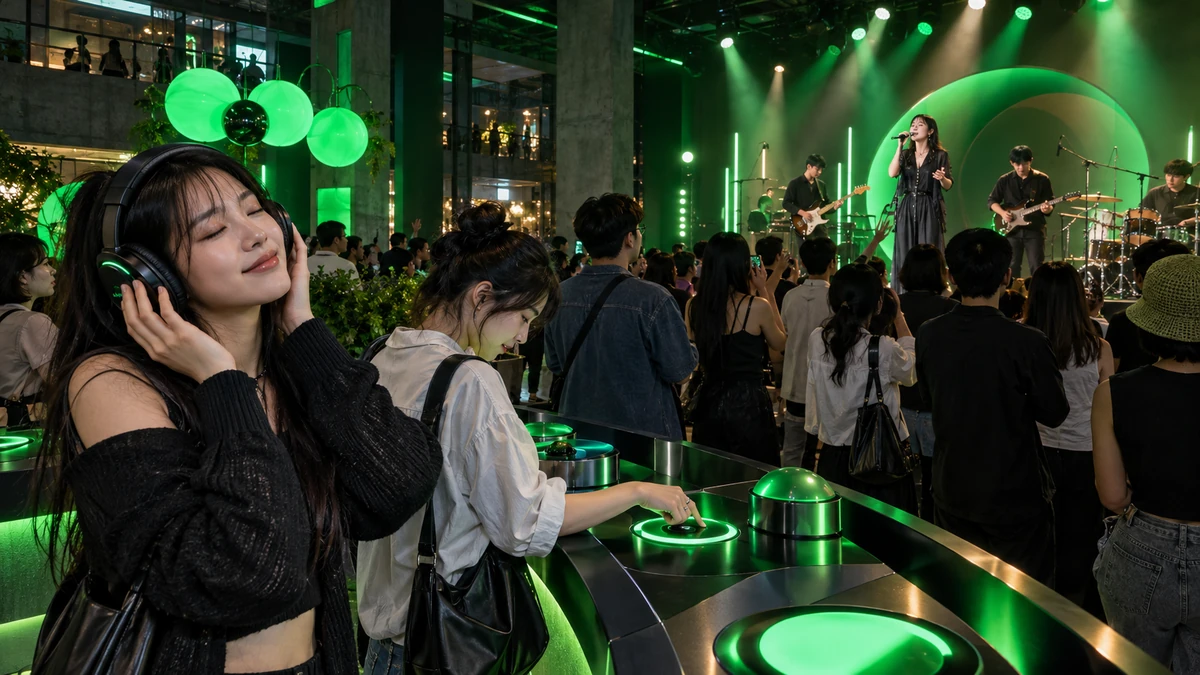
That challenge sits behind Spotify House Seoul, a four-day program of live performances and interactive experiences scheduled for the 10th through the 13th at Anderson C, an event space in Seoul’s Seongdong district. Spotify, the world’s largest music streaming platform, is taking its relationship with Korean listeners beyond the app and into a physical gathering place.
The event also offers a window into a broader question for the music industry: As Korean artists reach listeners around the world, can the companies distributing their music help turn casual discovery into lasting interest? For American audiences, that could eventually mean a wider view of Korean music — one that includes independent acts, rock bands and experimental rappers alongside globally recognized pop groups.
The announced program does not establish that such a transformation is underway. Nor does it demonstrate that a live event will produce more streams or new paying subscribers. What it does show is how Spotify is presenting its ambitions in Korea: not simply as a service selling access to songs, but as a participant in the culture surrounding them.
Why Korea Matters Beyond Its Domestic Market
Speaking in Seoul on the 9th, Gautam Talwar, Spotify’s general manager for the Asia-Pacific region, described South Korea as a center of new culture and creative content whose influence extends well beyond its borders. He said the company would continue investing and collaborating to introduce Korean creativity to the world, strengthen its position in the country and support the music industry’s growth.
Those statements outlined a direction, not a specific financial commitment. The account of his remarks included no investment amount or newly signed agreement. That distinction matters for American readers accustomed to entertainment announcements in which broad expressions of enthusiasm can sound like concrete expansion plans.
Still, the reasoning is significant. Korea is both a consumer market and a source of music, visual styles and fan practices that travel internationally. For a global platform, understanding what Korean listeners want can therefore have implications beyond its domestic subscription business.
This is part of the larger phenomenon often called the Korean Wave, or hallyu: the international spread of South Korean popular culture, including music, television and film. K-pop is its most visible musical component, but it is not a complete description of the country’s music industry. Treating every Korean musician as a K-pop act would be roughly as useful as treating every American performer as a mainstream pop star.
Spotify’s Seoul event can be understood against that backdrop. A company that distributes music globally is looking more closely at the local experiences surrounding its creation and consumption. Whether that attention translates into durable opportunities for artists remains an open question.
A Big Discovery Number, With Important Limits
Talwar offered a striking measure of discovery: According to his remarks, plays associated with users encountering Korean artists’ music for the first time exceeded 2 billion on Spotify in the preceding year.
That is a count of plays, not a count of people. It should not be read as a claim that 2 billion individual listeners discovered Korean music. The distinction is fundamental in a business where large streaming numbers can quickly become shorthand for cultural reach.
The summary of the announcement does not provide enough methodological detail to determine precisely how Spotify defined those first encounters, identified the relevant listeners or counted their plays. The figure is therefore best treated as a company-reported indicator of discovery activity, not a census of new fans.
Even with those limitations, the emphasis is revealing. Streaming success is often discussed through repeated listening: the fans who return to a favorite song or help sustain an album’s popularity. Discovery asks a different question. How often does a person cross the threshold from unfamiliarity into listening?
For an American audience, the difference resembles hearing a new artist once on the radio versus following that artist for years. The first encounter matters, but it does not predict the second. Spotify’s figure does not establish how many listeners returned, explored an artist’s catalog or developed an interest in attending a show.
That is where a live experience could serve a different purpose from a playlist. A stream makes a song accessible. A performance can give it context, personality and a social setting. But the Seoul announcement provides no evidence yet that connecting those experiences will change listeners’ behavior.
The Story Extends Beyond Idol Pop
In discussing Korean music’s appeal, Talwar cited BTS, aespa, RIIZE and CORTIS, while also pointing to interest in Korean rock and hip-hop. The combination is a reminder that the most recognizable names can be an introduction to a much larger musical landscape.
Many internationally prominent Korean pop groups operate within the idol system, in which entertainment companies develop performers and coordinate music, choreography, visual presentation and promotion. For Americans, familiar comparisons include the management and marketing surrounding boy bands and girl groups, though the Korean system has its own institutions and traditions. It does not encompass every artist making music in Korea.
Spotify’s genre figures suggest reasons to look beyond that system. According to Talwar, worldwide streams of Korean indie music rose 68% in the preceding year compared with the year before. Separately, streams of Korean rock among Spotify users in Korea increased 58% in the current year compared with the previous year.
Those figures describe different things. The indie statistic is global; the rock statistic is domestic. They also cover different reporting periods. It would be inaccurate to conclude that Korean rock listening worldwide increased 58%, or that American listening to either category grew at either rate.
Neither percentage reveals the underlying volume. A smaller category can grow rapidly without approaching the audience of an established mainstream genre. And the figures alone do not show whether listeners arrived through idol groups, recommendations, friends or some other route.
What they support is a narrower but still useful conclusion: Spotify is reporting increased listening across more than one part of Korea’s music scene. For curious listeners abroad, that makes genre a useful starting point. An American rock fan need not first become a devotee of choreographed pop to find something compelling in Korean music.
One Album Shows How Loose the Boundaries Can Be
A release described in the Korean coverage offers an example of that variety. Rapper Kim Ximya released his second full-length album, “Dogma,” on the 9th, foregrounding electronic sounds and elements of pop across 10 tracks. Members of Sound Supply Service produced the entire album.
Its third track, “T-H-I-R-S-T-Y,” devotes substantial space to sound rather than rapping. That detail points toward an artist working across stylistic boundaries rather than staying within the most obvious expectations of his billing as a rapper.
American listeners are familiar with artists whose records move between hip-hop, electronic music and pop. The same openness is useful when approaching Korean releases. A musician’s nationality identifies a cultural and industrial context; it does not tell a listener what every track will sound like.
There is no basis in the supplied account to connect “Dogma” directly to Spotify’s genre growth figures. Nor does the account identify Kim Ximya as a performer at Spotify House Seoul. The album is relevant as an illustration of musical range, not as evidence that the event or the platform caused a creative trend.
That distinction helps keep the larger story grounded. Korean music’s breadth exists independently of a streaming company’s marketing campaign. The question for platforms is how effectively they make that breadth visible to people who may know only a handful of names.
What This Means for the United States
For the United States, the immediate significance is less about a four-day event in Seoul than about the relationship between global distribution and American listening habits. Spotify is a Swedish company, but its service is part of the American music market. How it presents Korean artists can affect what U.S. listeners encounter, even when the underlying promotional activity takes place overseas.
The announcement does not include U.S.-specific audience figures, an American edition of the event, new U.S. partnerships or a touring plan. It therefore cannot establish that American demand is growing at the rates Spotify reported for global Korean indie listening or domestic Korean rock listening.
What it does offer is a business question relevant to American labels, promoters, venues and competing streaming services: How can interest in a small number of internationally famous artists develop into an audience for a wider scene? If listeners become attached to individual songs but never learn about the musicians behind them, discovery may remain shallow. Performances, interviews and other forms of context can offer additional ways in.
The offline strategy has recognizable American parallels. Brand-backed showcases around music festivals and industry gatherings such as South by Southwest have long put performances inside broader promotional experiences. These comparisons help explain the format; they do not mean Spotify House Seoul shares the same programming, scale or business results.
American fan behavior offers another reference point. Fans of Taylor Swift, Beyoncé and other major performers build communities around more than recordings, exchanging concert advice, interpreting visual details and organizing social experiences. Korean fandom is not identical, but its emphasis on participation should not seem foreign to U.S. audiences.
In the U.S.-South Korea relationship, music provides a channel of cultural contact separate from diplomacy, defense and trade. A listener discovering a Korean band is not evidence of a geopolitical shift. Still, repeated encounters with artists working in another language can broaden how Americans understand a country too often viewed only through security headlines or a few entertainment successes.
Why Fan Culture Is Part of the Product
Talwar described Korean fans as organized and passionate, consuming music through multiple formats, including music videos. He said those practices can inspire the company’s offline events.
That observation reflects an important feature of contemporary fandom: For many listeners, the song is one part of a larger experience. Video, live performance, visual presentation and interaction with other fans can all shape an artist’s appeal.
In Korean idol fandom, organized fan communities are often known collectively by names associated with particular acts. These communities can give fans a sense of shared identity and a structure for exchanging information or supporting releases. Participation varies widely, however, and no description of highly active fans should be mistaken for a description of every Korean listener.
The American analogy is not simply a fan club mailing list. It is closer to a networked community that follows releases, performances and visual storytelling together. Digital distribution makes that community easier to sustain across borders, while physical events give some of its members a place to meet.
For Spotify, combining live music with interactive programming is consistent with an effort to serve those broader interests. But details matter. The supplied account does not identify a performance lineup or explain how individual activities will operate. It does not establish that any of the artists cited by Talwar will appear, or that attendees will have access to artist meet-and-greets.
It also says nothing about who will attend. Established fans, casual listeners and people drawn primarily by the event itself could respond differently. Without attendance research or follow-up data, claims about building a new audience would be premature.
What to Watch After the Event
The useful test of Spotify’s approach will come after the performances end. One question is whether the company provides more concrete information about the investments and collaborations Talwar described. Another is whether future reporting distinguishes between attracting attention and sustaining it.
For artists, repeat listening, continued engagement with a catalog and opportunities to perform may tell a fuller story than a single discovery metric. For audiences, the question is whether recommendations and promotional programs expose them to unfamiliar sounds rather than repeatedly directing them toward names they already recognize.
American industry observers should also look for geographic detail. Global growth does not automatically mean U.S. growth, and rising listening in Korea does not establish overseas demand. Country-level figures, clear definitions and comparable reporting periods would make it easier to assess where audiences are actually developing.
Spotify House Seoul is best understood as an example of a platform expanding the setting in which music is experienced. The app remains a point of access, but the company is also making room for performance and participation.
That is not yet a proven formula for Korean music’s next international breakthrough. It is a useful indication of where the competition for listeners is heading: beyond making songs available, toward helping people find reasons to care about them. For Americans willing to venture beyond familiar K-pop names, the potential reward is straightforward — a larger, more varied world of music than any single label can convey.
Comments
Post a Comment