
Image to help understand the article
A Korean medical classic tells a larger story about power, knowledge and who gets remembered
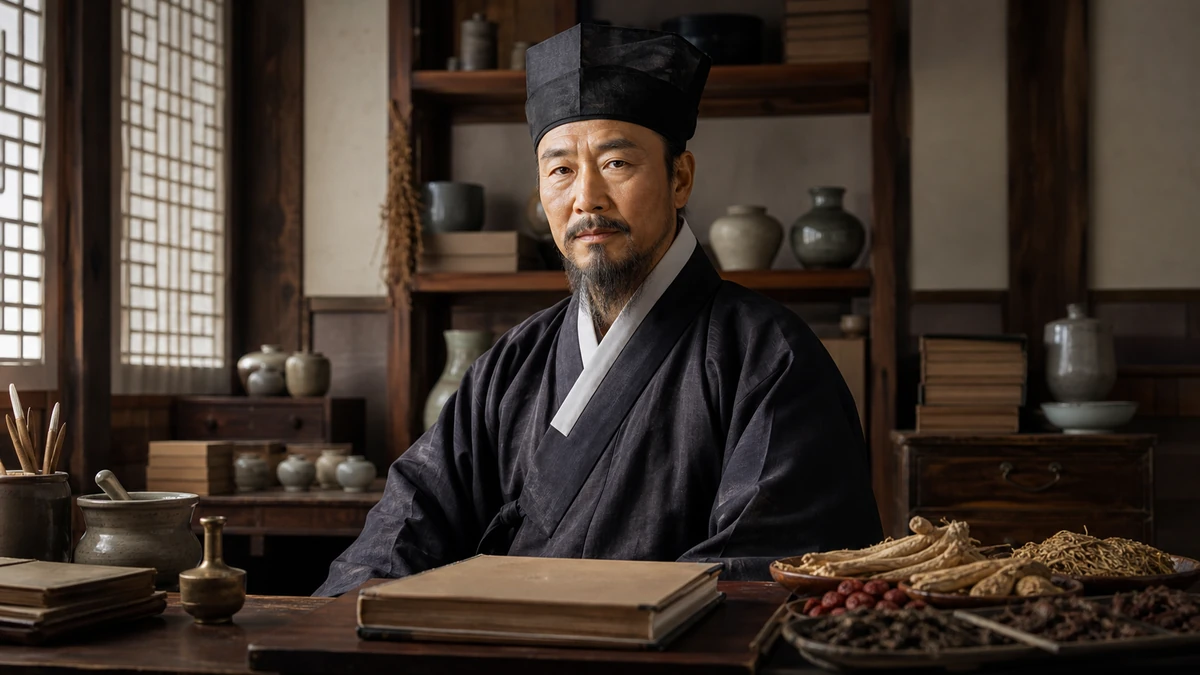
In South Korea, Heo Jun occupies a place somewhere between a revered physician, a national scholar and a pop-culture icon. For many Americans, the closest analogy might be a historical figure who is both academically important and broadly familiar through television — a person like Benjamin Franklin if he were remembered less for politics and more for practical science and public health. Heo, a royal physician who lived from 1539 to 1615 during Korea’s Joseon Dynasty, is best known as the compiler of Dongui Bogam, a sweeping medical encyclopedia that systematized Korean and East Asian medical knowledge at a moment of national crisis.
But the latest Korean discussion around Heo is not simply a celebration of a famous old book. It is also a reminder of how history is made: through competing records, new interpretations and the slow, often messy work of verifying facts. Korean scholars have increasingly settled on 1539 as Heo’s birth year after revisiting period documents, even though older reference works and some archival materials pointed to other dates. That may sound like a narrow academic dispute. In fact, it opens a wider window into how modern South Korea revisits its past — and how a single historical figure can illuminate debates about social mobility, professional expertise, state power and national identity.
For American readers, Heo’s story resonates well beyond the question of whether one court physician was born in 1537, 1539 or 1546. It speaks to a familiar contemporary concern: who gets authority in a crisis, how institutions reward specialists and how later generations separate legend from documented fact. At a time when Korean culture reaches American audiences through K-pop, streaming dramas, beauty products and food, the renewed attention to Heo also shows that the Korean Wave is no longer only about entertainment. It increasingly includes history, scholarship and traditional knowledge systems that South Korea presents as part of its broader cultural influence.
That matters because Dongui Bogam is not just an old medical text in a museum case. It has become one of the best-known symbols of Korean intellectual heritage, especially in discussions of traditional medicine. Understanding Heo means understanding how Korea remembers scientific authority — and why that memory continues to travel globally.
Why scholars care about a birth year dispute
To outsiders, the argument over Heo Jun’s birth year may look trivial. It is not. Historians treat such questions as tests of method, especially when a figure has acquired national prestige and layers of folklore. In Heo’s case, older accounts widely circulated dates such as 1543 or 1546. More recently, however, scholars have pointed to writings by the Joseon literary figure Choe Rip that described Heo as his same-age friend, as well as other records tied to the sexagenary calendar system used in East Asia, to support 1539 as the most credible date. Since the early 2000s, that interpretation has become the mainstream view.
At the same time, not every surviving record lines up neatly. A 1605 roster related to the royal medical office, preserved by the Heo Jun Museum in Seoul, reportedly lists a birth year corresponding to 1537. Yet the same source also gives an age at death that does not fit that date cleanly. This is the kind of contradiction historians confront constantly, whether they are studying early America, imperial China or Joseon Korea: documents were copied by hand, calendars worked differently than modern ones and even official records could contain errors.
For an American audience, the broader point is recognizable. Historical memory is often shaped first by reputation and only later refined by archival scrutiny. The United States has gone through similar re-evaluations with founders, inventors and Civil War figures whose biographies were polished over time before being re-examined through letters, ledgers and government records. Korea is doing something comparable with Heo. Rather than weakening his legacy, the debate strengthens it by grounding it in evidence instead of myth.
That may be especially important because Heo has long been popularized through novels, folk retellings and television dramas, some of which dramatized his rise in ways not fully supported by historical records. The current emphasis in Korean scholarship pushes back against easy storytelling. It says, in effect, that national icons are most meaningful when they can withstand documentary scrutiny. In an era of misinformation and contested narratives, that message travels well beyond Korea.
A doctor who rose through skill, not the standard path
One of the most striking elements of Heo Jun’s biography is how he appears to have advanced. Later dramatizations often suggest that he rose by passing the state medical examination, the conventional route into official service. Yet the surviving exam rosters do not include his name. Instead, records indicate that he entered the royal medical service in 1569 through recommendation by senior officials, including Hong Dam and Yu Hui-chun, and then proved himself through treatment.
That distinction matters. Joseon Korea was a deeply hierarchical Confucian state in which family background, formal credentials and bureaucratic rank all carried enormous weight. To rise without the expected exam record, and then to rise quickly, suggests that Heo’s clinical reputation was hard to ignore. He reportedly treated the wife of the high-ranking official Yu Hui-chun and later treated Yu himself, building credibility in the capital among elite circles. By the early 1570s, records show him holding increasingly senior posts in the royal medical office.
For American readers, the pattern may call to mind a recurring tension in U.S. institutions: credentials versus demonstrated performance. Whether in medicine, technology or government, Americans are familiar with debates over whether formal gatekeeping overlooks talent or whether exceptions to the rules undermine professional standards. Heo’s career suggests both dynamics at once. His ascent reflected extraordinary confidence in his medical skill. It also provoked resistance from officials who objected when a physician received promotions they considered too elevated for someone in his professional category.
Those clashes are especially revealing. On several occasions, watchdog bodies in the Joseon government challenged his promotion, arguing that even significant medical service did not justify conferring rank beyond accepted limits for an official physician. The king, Seonjo, repeatedly overruled them. That tells us two things. First, Heo had become indispensable at court. Second, technical expertise could unsettle rigid status systems, especially when a specialist gained direct favor from the ruler.
In modern terms, Heo was not just a successful doctor. He was an expert whose value became undeniable inside a tradition-bound bureaucracy. That dynamic feels contemporary. Governments still discover, especially in emergencies, that the people who actually know how to solve practical problems do not always fit comfortably inside existing hierarchies.
War, crisis and the making of a national medical text
Heo Jun’s career cannot be separated from war. In 1592, Japan invaded the Korean Peninsula in what is known in Korea as the Imjin War, a devastating conflict that shattered cities, displaced populations and disrupted state institutions. King Seonjo fled the capital and retreated north, eventually reaching Uiju near the border with Ming China. Heo accompanied the royal court, caring for the king during one of the most traumatic episodes in Korean history.
That service mattered politically, but it also mattered intellectually. After the war, the Joseon court faced a problem that Americans might recognize from the aftermath of natural disasters, pandemics or wars: knowledge had been scattered, systems had broken down and the state needed to rebuild practical capacity. Seonjo ordered a new medical compilation project to gather and reorganize medical knowledge. Heo worked with other physicians at first, but when renewed conflict disrupted the effort, the king eventually ordered him to continue the project with broad responsibility and access to hundreds of volumes from the royal collection.
The result was Dongui Bogam, completed in 1610 after roughly 15 years of work. The title is often rendered in English as something like “Mirror of Eastern Medicine,” though its importance lies less in any literal translation than in what the book attempted to do: organize a vast body of clinical knowledge into a usable system. It was not merely a list of remedies. It was an effort to classify the body, disease, treatments and medicinal materials in a coherent way, drawing on accumulated East Asian medical traditions while reflecting Korean experience and state priorities.
Americans can think of it as a landmark reference work produced under pressure, something analogous in cultural weight — though not in identical content — to a foundational legal digest, scientific compendium or national pharmacopoeia. It turned medical practice into state-backed knowledge infrastructure. In a court-centered world, that was no small achievement.
There is also a less romantic side to the story, and it is one reason Heo remains historically compelling. He was not compiling the book from a peaceful scholar’s retreat. He worked while navigating political contention, institutional disruption and later personal disgrace. The text’s authority, in other words, did not emerge from ideal conditions. It emerged because a war-torn state needed order and because one physician had earned enough trust to be tasked with creating it.
Exile, blame and the cost of serving power
If Heo’s rise reflected the rewards of expertise, his downfall showed its risks. Court physicians in premodern states occupied a dangerous position. Their success could bring royal favor, titles and influence. Their failure — or even a ruler’s death from causes beyond anyone’s control — could bring punishment.
That is what happened after King Seonjo died suddenly in 1608. Although the king had previously defended Heo against critics who said his medicine was ineffective or mistaken, the political climate changed immediately after the monarch’s death. Heo was dismissed from office and sent into a form of exile outside the capital. The new king, Gwanghaegun, reportedly sought to bring him back sooner, but opposition from powerful officials delayed that effort.
This part of the story is especially revealing for modern readers because it cuts against the heroic simplicity of later legend. Expertise did not insulate Heo from politics; it made him more vulnerable to it. He had become so closely associated with royal health that he also became an obvious target when the king died. In that sense, his fate resembles that of public experts in many societies who are celebrated during a crisis and scapegoated afterward.
And yet exile did not stop his work. He continued compiling Dongui Bogam during banishment and kept writing until he was released in late 1609. The text was completed the following year. That detail helps explain why Heo’s reputation endures so strongly in Korea. His legacy rests not only on technical accomplishment but on persistence under political pressure. In national memory, he becomes more than a physician. He becomes a model of professional dedication tested by instability, war and official suspicion.
For a U.S. audience, there is another familiar theme here: the uneasy relationship between science and power. Physicians, epidemiologists and public health officials often need state support to do consequential work, but dependence on political authority can quickly turn into exposure. Heo’s life illustrates that dynamic in an early modern Korean setting with striking clarity.
What this means in the United States
The American relevance of Heo Jun’s story lies less in premodern court politics than in the expanding reach of Korean cultural and intellectual exports. For years, the Korean Wave in the United States was shorthand for K-pop concerts, Oscar-winning films, Netflix dramas, Korean skin care and restaurant culture. Increasingly, however, American engagement with Korea is widening to include museums, historical scholarship, wellness conversations and interest in traditional knowledge systems.
That does not mean Dongui Bogam is about to become a mainstream household title in the U.S. in the way a hit K-drama might. But it does mean that the frame through which Americans encounter Korea is changing. South Korea is not only selling contemporary entertainment; it is also exporting a civilizational narrative — a story about deep historical traditions in medicine, philosophy, print culture and statecraft. Figures like Heo help support that broader national image.
There are several ways this matters for the American market and U.S.-Korea ties. First, cultural institutions in the United States have become more interested in presenting Asian histories with greater nuance, especially as Korean studies programs, museum partnerships and translation projects expand. A figure like Heo offers curators, educators and publishers an accessible entry point into Korean history because he sits at the intersection of medicine, war, class and authorship. That is the kind of story that can travel well across borders.
Second, American consumers have shown sustained interest in wellness and alternative or complementary health traditions, from acupuncture to herbal medicine to mindfulness practices imported and adapted from Asia. That does not erase important scientific and regulatory distinctions, and it should not invite romanticized claims. But it does create a receptive audience for historical discussions of how non-Western medical traditions were organized and legitimized. Heo’s work can therefore be read, in the U.S., not as a clinical guide for modern treatment but as evidence of a sophisticated historical system of knowledge production.
Third, the U.S.-Korea alliance increasingly extends beyond security and semiconductors into culture, education and soft power. South Korea’s global profile has grown partly because its government, companies and civil society have become adept at linking contemporary branding with historical depth. Just as the United States often projects influence through Hollywood, Ivy League archives, Smithsonian exhibitions and narratives of innovation, South Korea projects influence through a combination of entertainment success and curated national heritage. Heo Jun fits into that strategy naturally.
There is also a domestic American comparison worth noting. In the United States, public fascination with historical medicine often swings between two extremes: either dismissing older systems as superstition or celebrating them uncritically as hidden wisdom. A more useful approach is to see texts like Dongui Bogam as historical achievements in classification, observation and state organization, while recognizing that premodern medicine operated under very different scientific assumptions than modern biomedicine. That kind of balanced reading is likely to matter more as American readers encounter Korean history in classrooms, documentaries and cultural programming.
Beyond one famous doctor, a broader Korean trend
The renewed attention to Heo Jun also reflects a larger development in South Korea: the effort to revisit canonical figures with a more archival, less mythic lens while still preserving their cultural prestige. This is a mature phase of national storytelling. Countries often begin by elevating heroic figures, then later return to them with sharper questions about documentary evidence, institutional context and social complexity.
South Korea is now well positioned to do that because its cultural confidence is stronger than it was a generation ago. A country that once felt pressure mainly to prove its modern economic success can now devote more energy to explaining its historical continuity and internal debates. That shift is visible not just in scholarship but in museums, television period dramas, educational content and public history projects.
Heo Jun is especially useful in this regard because he connects several themes at once. He represents traditional medicine, but also bureaucratic struggle. He embodies scholarly achievement, but also political vulnerability. He is rooted in a premodern dynasty, yet his posthumous image has been reshaped by contemporary media and national branding. And because some accounts place his birthplace in an area that is now north of the Demilitarized Zone, his biography even carries a faint reminder of how Korea’s modern division overlays a much older shared history.
That layered quality makes him more than a heritage figure. He becomes a case study in how Korea presents itself to the world: as modern and technologically advanced, but also historically rich; globally connected, but grounded in distinct institutions and texts; proud of national icons, but increasingly willing to test legends against records.
For American readers, that is perhaps the most important takeaway. The significance of Heo Jun is not limited to what he wrote in the early 1600s. It lies in why South Korea keeps returning to him now. The answer is that he helps the country explain a larger story about knowledge under pressure, expertise in a hierarchy and cultural confidence in a global age.
What to watch next
Stories like this rarely stay confined to the academy. As Korean culture continues to draw broader English-speaking audiences, more historical figures once familiar mainly inside Korea are likely to be repackaged for international readers, viewers and museumgoers. Some will come through streaming dramas. Others will come through translations, exhibitions and educational partnerships. Heo Jun is an especially strong candidate for this kind of renewed global visibility because his life naturally bridges popular storytelling and scholarly seriousness.
What bears watching is how that visibility is handled. Will Heo be marketed abroad primarily as a wise traditional healer, which risks flattening the difficult politics of his life? Or will he be presented as something more interesting: a physician-administrator who rose through demonstrated skill, worked through war, clashed with status norms, took the blame when power shifted and produced a landmark text under extraordinary conditions?
The second version is less tidy, but it is also more historically credible and more relevant to modern audiences. In that version, Heo’s significance is not just that he compiled a famous medical encyclopedia. It is that his life captures a perennial problem in human societies, from Joseon Korea to contemporary America: how institutions value expertise, how crises reorder authority and how posterity decides what kind of truth it wants from its heroes.
That is why a centuries-old debate over records still matters. It is not merely about correcting a birth year in a biographical note. It is about understanding how a nation builds trust in its past — and how that past becomes part of its global presence today.


0 Comments