Image to help understand the article
Twelve Ships Against 330
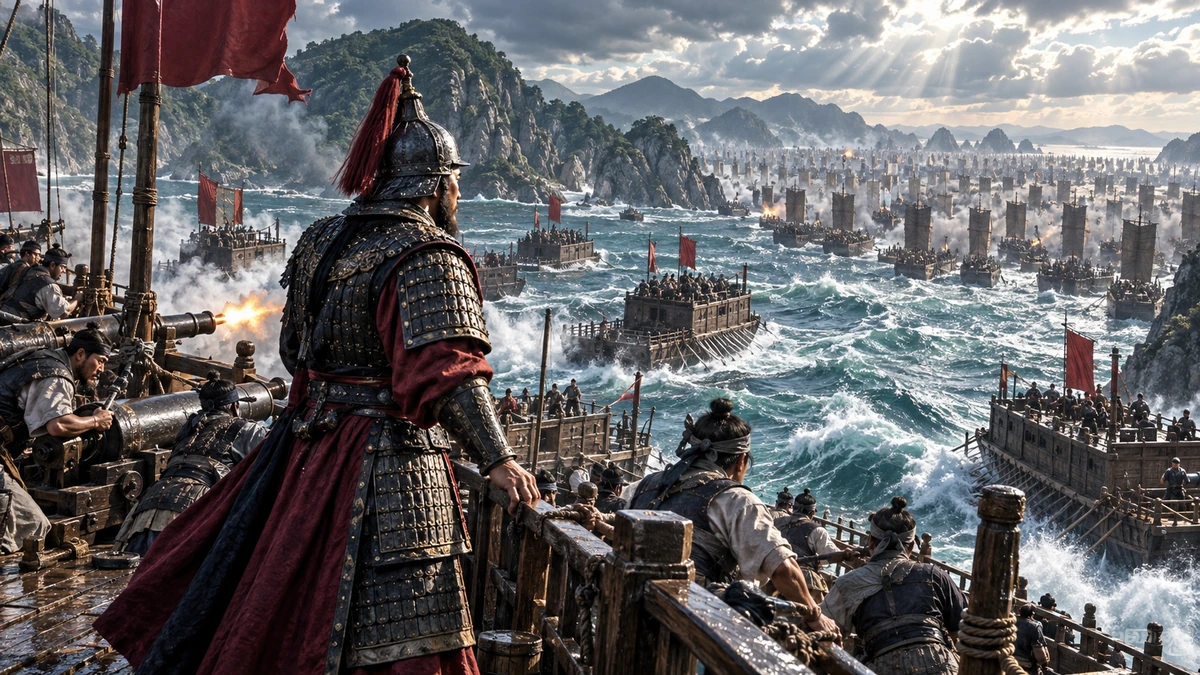
Released in South Korea on July 30, 2014, director Kim Han-min’s historical action film “The Admiral: Roaring Currents” dramatizes one of the country’s most celebrated naval battles. Set in 1597 during Japan’s renewed invasion of Korea, the film follows Adm. Yi Sun-sin after he is reinstated as commander of the Joseon dynasty’s naval forces.
Yi inherits a shattered fleet and frightened troops after a devastating defeat. With only 12 ships remaining, he prepares to confront 330 Japanese vessels approaching the narrow waters of Myeongnyang. Rather than rushing into combat, the 128-minute film first focuses on how Yi confronts fear among his sailors and civilians while devising a response to overwhelming odds.
Choi Min-sik stars as Yi, with Ryu Seung-ryong playing Japanese commander Kurushima and Cho Jin-woong appearing as Wakizaka. The supporting cast includes Kim Myung-gon, Jin Goo, Lee Jung-hyun, Kwon Yul and No Min-woo. Produced by Big Stone Pictures and distributed by CJ ENM, the film carries a South Korean rating restricting it to viewers 15 and older.
A Record-Setting Blockbuster
“The Admiral” reached 10 million admissions just 12 days after its release, becoming the 12th film overall — and the ninth Korean production — to cross that closely watched benchmark. South Korea commonly measures theatrical success by admissions rather than the dollar grosses emphasized in the American movie industry.
By its 18th day, the film had drawn more than 13.98 million viewers, surpassing the 13.33 million admissions recorded by “Avatar” to become South Korea’s highest-attended movie at the time. According to the Korean Film Council’s KOBIS box-office system, its cumulative audience had reached 17,597,914 by Sept. 28, 2014. Along the way, it set a string of speed records, reaching 2 million admissions in three days, 4 million in five, 6 million in seven and 9 million in 11.
The film also collected major domestic honors. It won best film, art direction and cinematography at the Buil Film Awards, followed by best film, best actor for Choi, planning and technical awards at the Grand Bell Awards. Kim received the Blue Dragon Film Award for best director, while the movie was recognized as the year’s most-watched Korean film. Choi later received the top film honor at the Baeksang Arts Awards.
A Battle Built Around Fear
The centerpiece is a naval battle lasting roughly an hour. Before the fighting begins, the film establishes Yi’s private anguish, unrest within the Korean fleet, efforts to build a turtle ship and preparations in the Japanese camp. The battle combines cannon fire, hand-to-hand fighting, collisions between Korean and Japanese vessels and the powerful currents of the Myeongnyang Strait.
Critics praised the sustained tension of the combat and Choi’s commanding performance, while some argued that the film did not fully develop the conflicts between Yi and his officers or explain why soldiers came to trust him. Others noted that the supporting characters were less memorable than the central portrayal.
The movie presents soldiers and ordinary civilians as participants in the struggle rather than treating victory solely as the product of Yi’s strategy. Its solemn emphasis on loyalty, duty to the people and filial devotion produced both emotional praise and criticism that its lessons were delivered too forcefully.
Success and Scrutiny
The extraordinary turnout also shifted attention away from the film itself. Choi expressed frustration that discussion had become dominated by audience totals and said he wanted more consideration of the work on its own terms.
Its distribution prompted a separate debate over market power. Reports said the film occupied 1,500 to 1,600 of South Korea’s 2,584 movie screens, fueling criticism that one blockbuster had crowded competing releases out of theaters. The controversy placed the film at the center of a broader argument over whether record admissions reflected audience demand, dominant distribution or both.
Comments
Post a Comment