Image to help understand the article
Palace entertainment turns dangerous
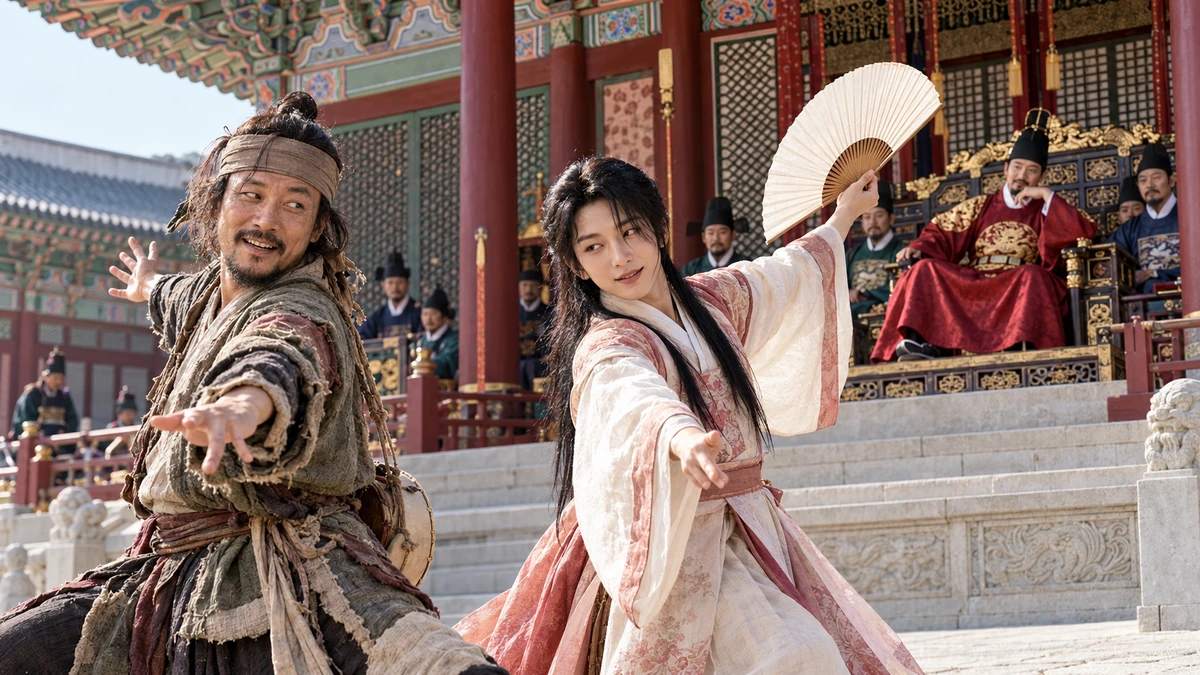
Lee Joon-ik’s historical drama “King and the Clown” opened in South Korea on Dec. 29, 2005, and became the third Korean film to surpass 10 million admissions — a major box-office benchmark in the country’s theatrical market. The 119-minute film is rated for viewers 15 and older.
Set during the reign of Yeonsangun, a ruler of Korea’s Joseon dynasty, the film follows two traveling performers, Jang-saeng and Gong-gil. After arriving in the capital, then known as Hanyang, they gain attention with a satirical show targeting the king and his consort, Jang Nok-su. The performers are arrested for insulting the monarch, but Gong-gil’s quick thinking makes Yeonsangun laugh, earning the troupe a place inside the palace.
Their performances soon move beyond comedy, indirectly confronting official corruption and the court’s deadly treatment of the king’s mother, deposed Queen Yun. As Yeonsangun develops a particular attachment to Gong-gil, Jang Nok-su grows jealous and senior officials seek to remove the performers.
A stage adaptation rooted in royal records
Kam Woo-sung stars as Jang-saeng, with Lee Joon-gi as Gong-gil, Jung Jin-young as Yeonsangun and Kang Sung-yeon as Jang Nok-su. The supporting cast includes Yoo Hae-jin as the clown Yuk-gap and Jang Hang-sun as the royal eunuch Kim Cheo-sun.
The film was adapted from Kim Tae-woong’s play “Yi,” first staged in 2000. Gong-gil appears briefly in the “Annals of the Joseon Dynasty,” the official historical record of the monarchy, as a performer favored by the king. Jang-saeng is fictional. The play’s title comes from a Joseon-era term used by a king for a close and favored subject.
Box-office and awards success
According to the Korean Film Council’s KOBIS box-office system, “King and the Clown” had drawn 10,489,308 admissions by March 26, 2006. South Korea also selected it as the country’s submission for the Academy Award for best foreign-language film that year.
At the 2006 Grand Bell Awards, one of South Korea’s major film honors, it won best picture and best director for Lee. Kam received best actor, Yoo won best supporting actor and Lee Joon-gi was named best new actor. The film also won awards for Choi Seok-hwan’s screenplay and Ji Gil-woong’s cinematography.
Traditional performance and queer themes
The film placed Korean traditional performance at the center of a story that also explored affection and jealousy surrounding Gong-gil, a male performer. Its success helped draw wider attention to Korean films addressing homosexuality and sexual minorities.
The production also faced a plagiarism claim over the line, “I am here, and you are there,” which was alleged to have been taken from the play “Kiss.” A request for an injunction to halt screenings was rejected by both the trial and appellate courts.
Comments
Post a Comment