Image to help understand the article
A King and His Double
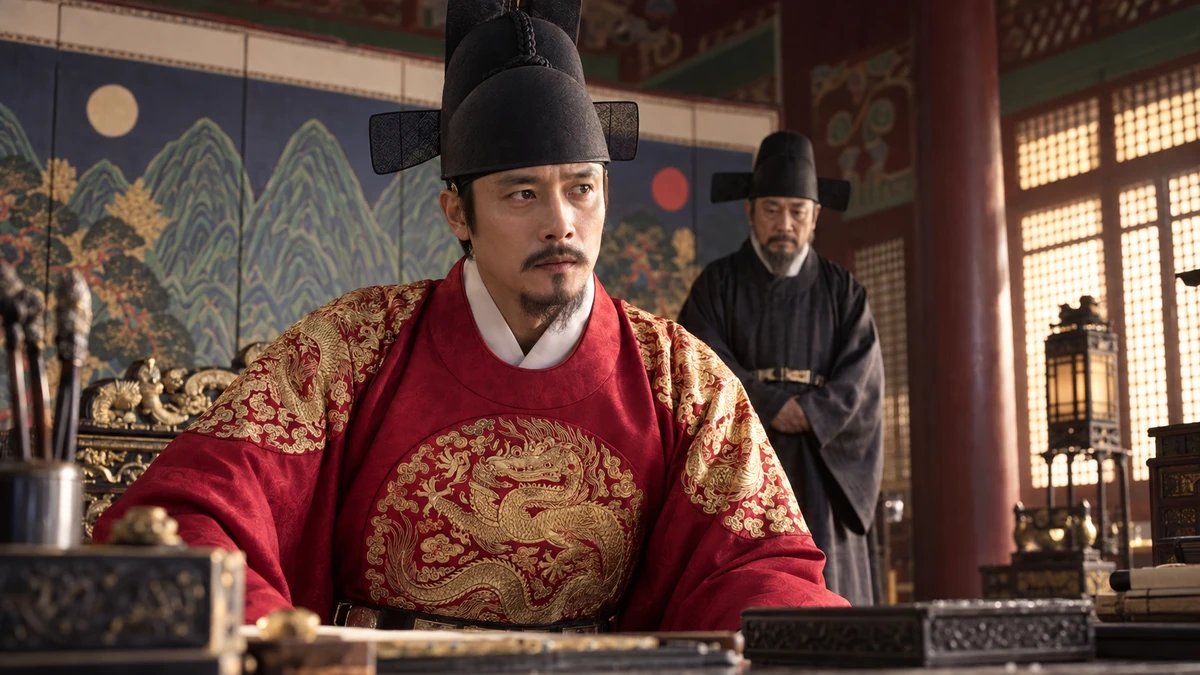
Released in South Korea on Sept. 13, 2012, director Choo Chang-min’s historical drama “Masquerade” places an ordinary performer at the center of a dangerous royal court. The 131-minute film stars Lee Byung-hun in two roles: King Gwanghae, the embattled ruler of Korea’s Joseon Dynasty, and Ha-sun, a jester who looks exactly like him.
Set during the eighth year of Gwanghae’s reign, the story begins as political factionalism and threats against the king’s life intensify. Gwanghae orders his chief royal secretary, Heo Gyun, to find a substitute. Heo discovers Ha-sun performing comedy and tricks at an entertainment house and brings him into the palace to imitate the monarch. When Gwanghae loses consciousness, Ha-sun must occupy the throne while the king receives treatment.
Ryu Seung-ryong plays Heo Gyun, while Han Hyo-joo portrays the queen. The cast also includes Jang Gwang, Kim In-kwon, Shim Eun-kyung, Kim Myung-gon and Park Ji-a. Realies Pictures and CJ ENM produced the film, with CJ ENM handling distribution. It was Lee’s first historical feature film.
A 10 Million-Ticket Milestone
“Masquerade” crossed 10 million admissions on its 38th day in theaters, becoming the seventh Korean film at the time to reach that benchmark. South Korea commonly measures a movie’s success by admissions rather than box-office revenue, making the 10 million-ticket mark a widely recognized sign of blockbuster status. According to the Korean Film Council’s tally as of Dec. 16, 2012, the film had drawn 12,274,154 moviegoers.
The film also dominated the 49th Grand Bell Awards, one of South Korea’s major film awards ceremonies, winning in 15 categories. Its honors included best picture, director for Choo, screenplay for Hwang Jo-yoon, actor for Lee and supporting actor for Ryu. It also won awards for planning, production design, visual effects, music, sound, costumes, lighting, cinematography and editing, as well as a popularity prize.
Additional recognition followed. Oh Heung-seok received production design honors from the Blue Dragon Film Awards and a technical award from the Korean Association of Film Critics. Lee won best actor from the Busan Film Critics Association. At the 2013 Baeksang Arts Awards, the film won best picture and Choo received the directing prize in the film category.
History Reimagined
Gwanghae ruled Joseon from 1608 to 1623, during a period when the kingdom faced pressure surrounding the Ming and Qing powers in China. He pursued a neutral diplomatic approach and promoted reforms that included restoring documents and rebuilding the country. He was later overthrown by a rival political faction, exiled to Jeju Island and denied the posthumous temple name granted to many Korean kings.
The movie builds its fictional story around 15 missing days in the royal secretariat’s records from Gwanghae’s reign. That gap provides a dramatic opening for the idea that a double secretly occupied the throne, but the premise is not presented as established history. The records suffered repeated losses, leaving major gaps, and relatively little documentation from Gwanghae’s era survives. Under Joseon record-keeping principles, court historians likely would have documented both an incident and any royal attempt to suppress it.
From Film to Stage and Television
The production was filmed at the Namyangju studio complex in Gyeonggi province. An earlier version, announced in 2011 under a title meaning “I Am the King of Joseon,” was expected to be directed by Kang Woo-suk and star Jung Jae-young and Yoo Jun-sang. Kang left after disagreements with CJ ENM, and Choo and Lee joined the project in November 2011. Han was added the following month.
The film’s central device also prompted allegations that it borrowed from “Dave,” the 1993 American political comedy starring Kevin Kline and Sigourney Weaver, in which an ordinary man who resembles the U.S. president is recruited as his stand-in. “Masquerade,” however, places the double in the far more perilous setting of a 17th-century Korean court.
The story later expanded into other formats. A stage version ran in Seoul from Feb. 23 to April 21, 2013, with Bae Soo-bin and Kim Do-hyun sharing the role of Gwanghae. Cable network tvN acquired television adaptation rights and premiered a drama starring Yeo Jin-goo in January 2019. Rapper Agust D also drew on the image of Gwanghae becoming king for his 2020 song “Daechwita.”
Comments
Post a Comment