Image to help understand the article
A Crown Prince Confronts the Undead
“Kingdom,” created and written by Kim Eun-hee, combines a Korean historical drama with zombie action, horror and political intrigue. Released Jan. 25, 2019, it was Netflix’s first Korean original series.
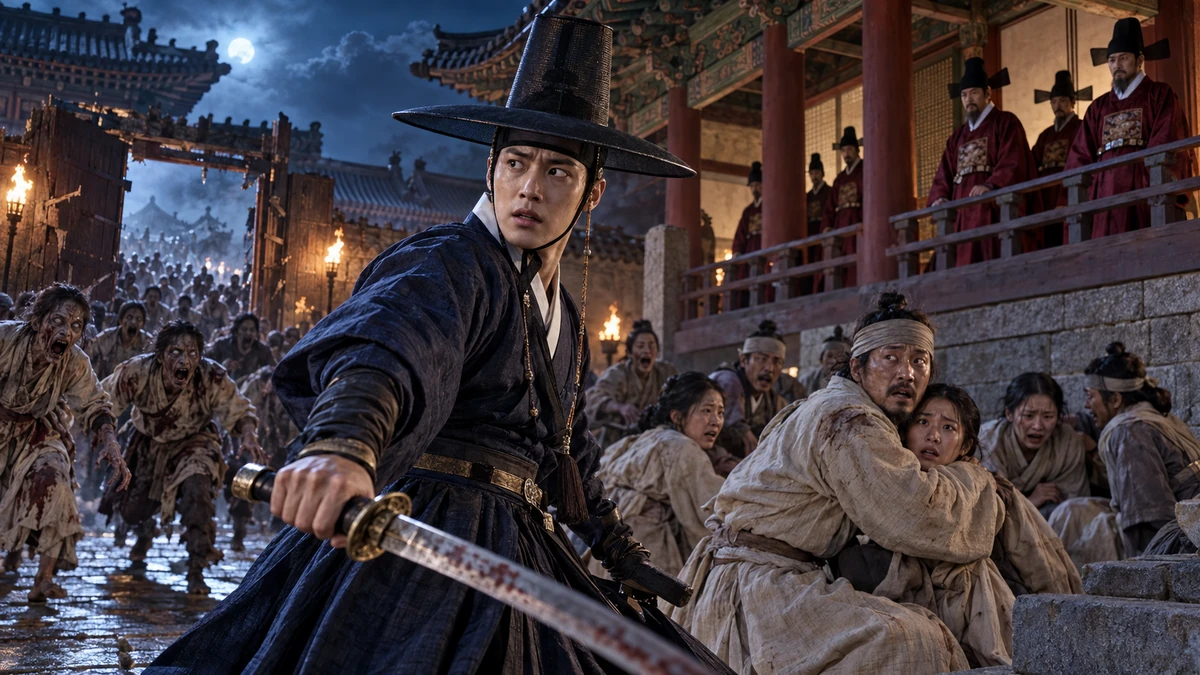
The story unfolds in a fictionalized Joseon kingdom in 1601, three years after a devastating war. Crown Prince Lee Chang, played by Ju Ji-hoon, becomes suspicious when the king falls ill and disappears from public view. His search for answers takes him south, where he discovers a plague that brings the dead back to life — and a conspiracy surrounding succession to the throne.
Accused of treason, Lee must protect ordinary people from the outbreak while resisting a powerful faction determined to remove him. The series treats palace politics not as background decoration but as a force driving the disaster.
Survivors Search for a Cure
Bae Doona plays Seo-bi, a physician from Dongnae who survives the initial outbreak and searches for a treatment. She obtains records containing crucial information about the disease. Ryu Seung-ryong plays Chief State Councilor Cho Hak-ju, head of the powerful Haewon Cho clan and Lee’s chief political rival. Cho seeks to secure the throne through his daughter, Queen Consort Cho, played by Kim Hye-jun, by ensuring that she gives birth to a son.
The supporting cast includes Kim Sung-kyu as Yeong-shin, an outbreak survivor skilled with firearms; Kim Sang-ho as Lee’s bodyguard, Mu-yeong; Jeon Seok-ho as Dongnae magistrate Cho Beom-pal; and Huh Joon-ho as Lord Ahn Hyeon, a war hero and the crown prince’s former teacher. Season two adds Park Byung-eun as military commander Min Chi-rok, while Jun Ji-hyun appears as Ashin, a mysterious woman from the northern region of Hamgyong.
Hunger, Bloodlines and Political Failure
Kim began developing the idea in 2011 as a way to examine modern fear and anxiety through Korea’s historical past. Believing the concept would initially be difficult to produce for television, she worked with artist Yang Kyung-il on the 2014 webtoon “The Kingdom of the Gods: Burning Hell.” The screen series retained the basic premise but otherwise differed substantially from the webtoon.
Kim described the first season as a story about hunger. Through its monsters, she wanted to portray people suffering from poverty and starvation after abuse by those in power. The second season shifted toward blood, linking the zombies’ craving for it with the ruling class’s obsession with preserving a particular bloodline.
In Kim’s telling, the plague reflects corruption, greed, inequality and injustice. She has said the series asks what politics is and how failed government creates resentment, suffering and consequences. The resurrection plant that produces the undead becomes inseparable from the struggle to retain political power.
Historic Palaces and a Large-Scale Production
“Kingdom” used prominent Korean heritage sites to create its vision of Joseon, including sections of Changdeok Palace, Changgyeong Palace and Jongmyo Shrine. Production also traveled to volcanic gorges, waterfalls, fortresses, forests and historical sets across South Korea. Some palace sequences used a digitally combined space based on Geunjeongjeon and Injeongjeon, major throne halls at two royal palaces.
Netflix announced the first season in March 2017 and approved a second before the series premiered. Season two began filming in February 2019, with Park In-je joining as director beginning with its second episode. Production costs exceeded $1.78 million per episode. Although the first two seasons were initially planned at eight episodes each, both were reduced to six.
The production also faced tragedy. An art department staff member died from overwork in January 2018, and another crew member died in a traffic accident during season two filming in March 2019. In January 2021, a fire damaged part of a fortress set during production of “Kingdom: Ashin of the North” after a crew member tried to melt snow. No one was injured in the fire.
The series was nominated in the drama category at the 33rd Korea Broadcasting Writers Awards but was ruled ineligible to win because regulations limited the honor to works considered wholly original, while “Kingdom” drew its core concept from a webtoon.
A Korean Story Built for Netflix
As Netflix’s first Korean original series, “Kingdom” placed a distinctly Korean political and historical setting on the same streaming service used by American audiences. Rather than adopting a contemporary zombie-apocalypse formula, it centers royal succession, court factions and the severe class divisions of Joseon society. Its second season premiered March 13, 2020, after the first received positive reviews.
Ashin’s Story Expands the World
The feature-length special “Kingdom: Ashin of the North” premiered July 23, 2021. Directed by Kim Seong-hun and written by Kim Eun-hee, it explores the past of Ashin, a Jurchen woman played by Jun Ji-hyun, and the origins of the resurrection plant that triggered the events of the series. Park Byung-eun returns as Min Chi-rok.
Kim said the special offered a more compelling way to tell the plant’s story and described it as a bridge toward a third season. By binding a fight for the throne to hunger, bloodline and a zombie epidemic, “Kingdom” turns supernatural horror into a story about the human cost of political power.
Comments
Post a Comment