Image to help understand the article
A sequel that widened the map
When “The Roundup” arrived in South Korean theaters in 2022, it did more than revive a popular detective from a five-year-old crime movie. The film demonstrated how South Korea’s entertainment industry could turn a distinctly local police story into a durable action franchise — one built around a recognizable star, an adaptable ensemble and a formula that could travel beyond a single Seoul neighborhood.
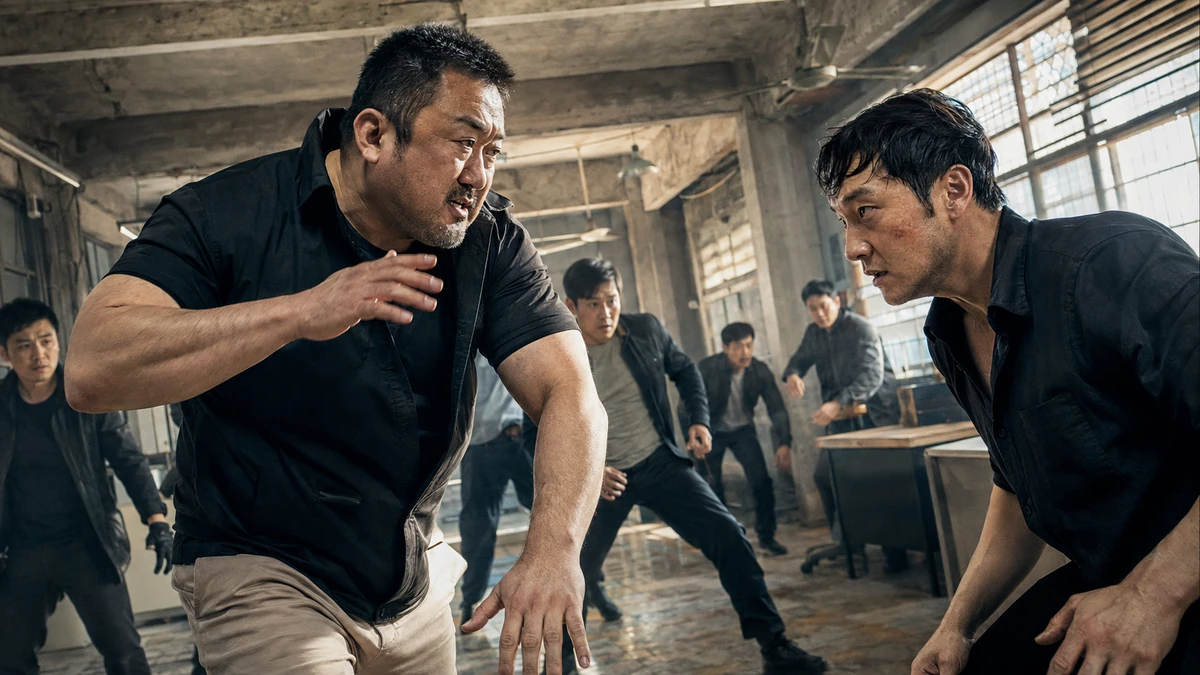
Known in Korea as “The Outlaws 2,” the movie continues the world introduced in the 2017 film “The Outlaws.” Ma Dong-seok, also known internationally as Don Lee, returns as Ma Seok-do, a detective whose physical force, dry humor and unshakable confidence define the series. The sequel sends him beyond South Korea on an overseas operation, where he encounters a violent new adversary, Kang Hae-sang, played by Son Suk-ku.
That shift in location was an important creative decision. Rather than simply repeating the first film’s conflicts, “The Roundup” preserved its central character and police-team dynamics while placing them in a less familiar environment. Lee Sang-yong, an assistant director on the original movie, took over as director and reshaped the material around a cross-border investigation. The result was recognizable enough to satisfy returning viewers but different enough to feel like a new chapter.
This is a familiar challenge in Hollywood, where successful sequels are often expected to deliver the same emotional pleasures on a larger canvas. The “Fast & Furious” movies repeatedly expanded from local street-racing stories into international action spectacles. The “John Wick” series built a broader mythology around a consistent central figure. “The Roundup” operates on a more grounded scale, but it follows a comparable principle: Keep the hero audiences came to see, introduce a memorable opponent and enlarge the setting without discarding the franchise’s identity.
What 10 million admissions mean in South Korea
“The Roundup” became the 28th movie in South Korean box-office history to surpass 10 million admissions, reaching the milestone on June 11, 2022. For American readers accustomed to measuring theatrical success almost entirely in dollars, the importance of that figure requires some explanation. South Korea’s film industry commonly reports box-office performance by the number of tickets sold, and the phrase “10 million audience film” functions almost like a cultural certification.
South Korea has a population of roughly 50 million people, so 10 million admissions represent an extraordinary level of theatrical participation. The figure does not necessarily mean that 10 million different individuals saw the movie, because repeat viewings are included. Even so, crossing the threshold indicates that a film has moved well beyond a narrow fan base. It has become a shared national entertainment event, discussed in offices, schools, families and online communities.
The movie’s momentum was clear from opening day. It sold 467,525 tickets on its first day, the strongest opening at the time for a Korean film released during the preceding 882 days. It crossed 8 million admissions after only 18 days and became the first movie released in South Korea in 2022 to reach that level. Those numbers reflected both intense initial demand and sustained public interest.
The timing made the performance especially significant. The global pandemic had disrupted theatrical attendance, delayed productions and accelerated audiences’ use of streaming services. A homegrown crime-action sequel bringing viewers back to theaters suggested that the communal moviegoing experience still had power when audiences were offered the right combination of familiarity, star appeal and spectacle.
In the United States, there is no exact equivalent to South Korea’s 10 million-admission label. Americans might instead think of a movie becoming the kind of broad-based hit that reaches beyond opening-weekend enthusiasts and enters everyday conversation. The Korean benchmark conveys scale, but it also carries an element of collective pride: A domestic production has persuaded a substantial share of the country to buy a theater ticket.
A hero designed for repetition
The franchise’s strongest asset is Ma Seok-do, a detective constructed around Ma Dong-seok’s distinctive screen presence. The actor combines the intimidating build of a heavyweight fighter with controlled comic timing and an unexpectedly warm persona. His character can dominate a room before throwing a punch, and the films derive much of their appeal from the expectation that confrontation is inevitable — while still making audiences wait for the payoff.
International audiences may recognize Ma from Marvel Studios’ “Eternals,” in which he appeared as Gilgamesh. In Korea, however, his career encompasses a much broader range of crime films, action pictures, dramas and comedies. His performance style helps make Ma Seok-do accessible even when viewers are unfamiliar with the details of Korean police institutions. The character’s appeal is immediate: He is the formidable, rule-bending veteran whom colleagues trust when a case becomes dangerous.
Son Suk-ku provides the sequel with a new source of tension as Kang Hae-sang. A continuing action series needs more than a powerful hero; it needs opponents who can make that hero’s victory uncertain. By replacing the first film’s central villain rather than attempting to recreate him, “The Roundup” established a franchise structure capable of renewal. Ma Seok-do is the fixed point, while the threat, setting and supporting relationships can change around him.
The supporting cast also prevents the movie from becoming a one-man show. Choi Gwi-hwa returns as Jeon Il-man, and Park Ji-hwan again plays Jang I-soo, a character whose presence links the sequel to the first film’s criminal world. Heo Dong-won’s Oh Dong-gyun shifts from the police station’s cerebral investigator to Ma’s right-hand detective. Ha Jun’s Kang Hong-seok assumes more of the team’s analytical role, while Jung Jae-kwang joins as junior detective Kim Sang-hoon.
Those changes matter in the context of Korean workplace culture. Age, rank and seniority often shape professional relationships more visibly than they do in many American offices. Korean police dramas frequently build humor and conflict around the hierarchy between senior detectives, junior officers and their commanding officials. A team’s youngest member — often described with a Korean term meaning the youngest in a group — may be expected to learn by observing more experienced colleagues while handling less glamorous responsibilities. “The Roundup” uses those relationships to give the action a sense of continuity and workplace camaraderie.
The local identity inside an international story
Moving the investigation overseas expands the movie’s geography, but “The Roundup” remains centered on the detectives from Seoul’s Geumcheon Police Station. That distinction is important. This is not a story that transforms its hero into a globe-trotting intelligence agent. Ma Seok-do remains a local cop operating beyond his normal jurisdiction, and much of the tension comes from placing his direct methods in a setting where his authority is less straightforward.
The overseas framework also reflects a wider development in Korean popular culture. As Korean movies and television series have found larger international audiences, their stories have increasingly looked outward without abandoning domestic storytelling conventions. International locations can raise the stakes and broaden visual scale, but the emotional center often remains rooted in Korean relationships, institutions and social expectations.
The film’s Vietnam setting had also been used for the Korean action thriller “Deliver Us From Evil.” In “The Roundup,” the foreign setting creates distance from the familiar streets and police routines of the original movie. Yet the filmmakers do not replace the franchise’s identity with the machinery of a giant international agency. The Geumcheon detectives, with their internal hierarchy and banter, remain the audience’s point of entry.
That balance helps explain why the sequel could appeal to both established fans and first-time viewers. Returning audiences recognized Ma Seok-do and the team around him. New viewers could understand the basic structure without extensive knowledge of the first installment: A powerful detective confronts a dangerous criminal during an overseas operation. The premise is direct, and the cultural details add texture rather than creating an obstacle.
The production also carried a note of sadness. Nam Moon-chul, who played Choi Choon-baek, died on Oct. 4, 2021, after battling colon cancer. “The Roundup” became his final film role. His appearance is part of a large ensemble that fills out both the police organization and the criminal networks surrounding the case.
What the film means for the United States
For the American market, “The Roundup” is useful evidence that the Korean Wave is not confined to polished pop music, romantic television dramas or prestige productions aimed at awards voters. South Korea also produces muscular, commercial genre entertainment that resembles the kind of midbudget action movie Hollywood once released more regularly. Its success at home shows that Korean cinema can build franchises around recurring characters rather than relying only on isolated breakout titles.
American interest in Korean entertainment expanded dramatically through works including “Parasite” and Netflix’s “Squid Game,” but those global sensations can create a distorted impression that Korean storytelling is defined mainly by social allegory, extreme competition or elite festival cinema. “The Roundup” belongs to another important tradition: the crowd-pleasing crime film designed for a Saturday-night audience. It uses action, humor and a charismatic lead in ways that American viewers can understand immediately, even when the police hierarchy and cultural setting are specifically Korean.
For U.S. distributors and streaming companies, films like this offer both an opportunity and a challenge. The opportunity is a growing audience that is more comfortable watching subtitled entertainment and following actors across Korean film and television. The challenge is that domestic Korean box-office success does not automatically translate into mainstream American theatrical reach. U.S. viewers often discover international sequels out of order, through streaming catalogs or recommendations based on a performer rather than through a coordinated franchise rollout.
Ma’s participation in a Marvel production gives the series an unusually clear bridge to American audiences. Viewers who first encountered him in “Eternals” can see how his Hollywood role drew on qualities long established in Korean cinema: physical authority, understated comedy and a protective presence. His career also illustrates a larger evolution in U.S.-Korea entertainment ties. Korean performers are no longer visible in America only through remakes or narrowly defined “foreign film” channels. They increasingly move between Korean productions and globally distributed projects while retaining fan bases in both markets.
The franchise model may also interest American production companies. Hollywood has leaned heavily on superheroes, legacy sequels and intellectual property tied to toys, comics or earlier blockbusters. “The Roundup” shows how a franchise can grow from a comparatively simple asset: a compelling character with a repeatable professional mission. In American terms, Ma Seok-do has elements of the durable action heroes played by Sylvester Stallone, Bruce Willis or Liam Neeson, but the Korean series surrounds him with a workplace ensemble and a strong sense of local institutional culture.
That does not mean an American remake would necessarily improve the material. The police-team hierarchy, Seoul setting and Ma’s particular star persona are not decorative elements that can be replaced without consequence. The more relevant lesson for U.S. companies is structural: Audiences may support a straightforward, star-driven action series when each installment delivers continuity while introducing a credible new threat. At a time when American studios frequently spend enormous sums trying to manufacture cinematic universes, the Korean film offers a reminder that franchise loyalty can begin with one actor, one memorable character and a clear dramatic engine.
The movie also adds a commercial dimension to U.S.-South Korea cultural relations. The alliance between the two countries is usually discussed in terms of security, trade and diplomacy, but entertainment has become one of its most visible people-to-people connections. American fans stream Korean dramas, attend K-pop concerts and seek out Korean films; Korean creators work with U.S. studios and platforms. A popular action sequel may not carry the diplomatic symbolism of a state visit, but repeated cultural encounters can shape how audiences understand a country more effectively than official messaging.
Recognition beyond ticket sales
Although its audience total dominated coverage, “The Roundup” also received recognition for acting and filmmaking. At the 2022 Chunsa Film Art Awards, Park Ji-hwan won supporting actor, the film received the audience-selected award for most popular movie, and Lee Sang-yong was named best new director. The Korean Association of Film Critics Awards honored Son Suk-ku as best new actor and included the movie on its annual top 10 list.
The awards are notable because commercial action sequels are not always treated as serious filmmaking achievements. In both the United States and South Korea, genre hits can be celebrated by audiences while receiving less attention for direction, editing, cinematography or performance. “The Roundup” earned acknowledgment in precisely those areas.
At the Blue Dragon Film Awards, one of South Korea’s most prominent annual film ceremonies, Lee received the award recognizing the year’s most-watched Korean film, while the production also won a technical prize. At the Grand Bell Awards, another major institution in Korean cinema, Joo Sung-lim won for cinematography, Kim Sun-min won for editing, and Park received a people’s choice acting award.
Together, those honors suggest that the movie’s appeal was not simply a product of brand familiarity. Action filmmaking depends on rhythm, spatial clarity and the ability to build anticipation before impact. Cinematography, editing and stunt-related technical work determine whether confrontations feel forceful or merely chaotic. Recognition in those categories supports the argument that the film succeeded as a carefully constructed piece of popular entertainment.
The sequel as a turning point
After its theatrical run, “The Roundup” became available through video-on-demand services on July 23, 2022. The franchise continued with “The Roundup: No Way Out,” released in South Korea on May 31, 2023, while additional production moved forward. That expansion confirms the second film’s larger importance: It was not merely a successful follow-up but the installment that proved Ma Seok-do could anchor an ongoing series.
The creative decisions offer a practical blueprint for sequel building. Lee Sang-yong brought a new directorial perspective while maintaining continuity with the first film, where he had worked as an assistant director. Son supplied a new villain rather than imitating the previous antagonist. The detective team was reorganized, giving returning performers new functions and introducing a junior member. The setting moved overseas, but the story remained attached to the familiar police unit.
Each choice addressed a different risk. Too much continuity could have made the sequel feel repetitive. Too much reinvention could have alienated viewers who liked the original. “The Roundup” found its commercial strength between those extremes. Its opening-day attendance showed the value of the existing audience, while its rapid climb to 10 million admissions showed that positive interest spread far beyond the most committed fans.
For American viewers exploring Korean cinema, the film offers another way to understand the Korean Wave. It is neither an art-house drama requiring specialized knowledge nor a television romance built across many episodes. It is a direct, accessible crime-action movie whose cultural specificity strengthens a familiar genre framework. The workplace hierarchy, recurring ensemble and emphasis on group relationships are distinctly Korean, while the showdown between an imposing detective and a ruthless criminal belongs to a global language of popular cinema.
The record that remains most closely attached to “The Roundup” is its status as South Korea’s 28th film to pass 10 million admissions. But its longer-term significance lies in what followed from that achievement. The movie converted a successful original into a sustainable franchise, strengthened Ma Dong-seok’s status as a cross-border action star and showed that Korean theatrical audiences would return in enormous numbers for a well-designed domestic blockbuster. For U.S. audiences and companies watching Korea’s entertainment industry, that is the trend worth following: Korean content is not only traveling farther. It is also building commercial institutions, recurring heroes and long-running brands of its own.
Comments
Post a Comment