
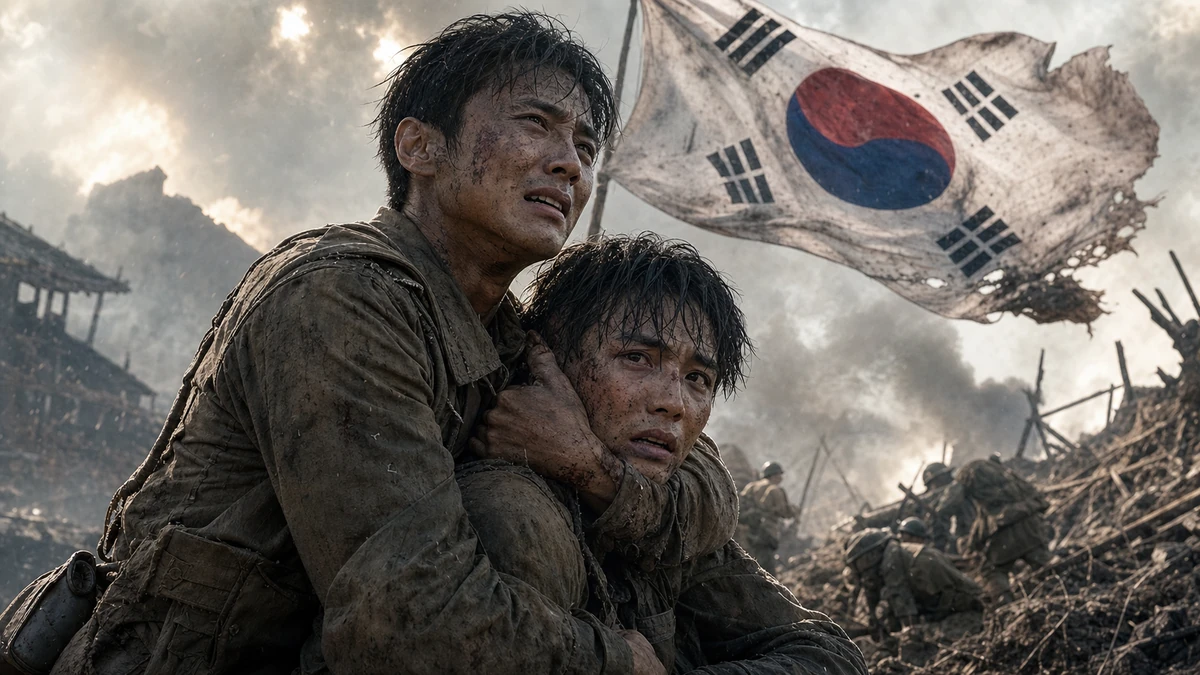
Image to help understand the article
A blockbuster war film that asks a deeply personal question
When Americans think of Korean cinema’s global rise, the usual touchstones are recent: the class warfare of “Parasite,” the survival drama of “Squid Game,” the zombie siege of “Train to Busan.” But two decades before those titles became shorthand for South Korea’s cultural power, director Kang Je-gyu’s 2004 war epic “Taegukgi” helped define what a Korean blockbuster could do. Released internationally as “Brotherhood,” the film took one of the most politically fraught and historically devastating events in modern Korean history — the Korean War — and reframed it through a story that is instantly legible to audiences anywhere: two brothers ripped apart by forces bigger than themselves.
That may sound familiar to American viewers raised on war movies that humanize history through small units, siblings or families. “Saving Private Ryan” used one family’s loss to give emotional shape to the Normandy invasion. “The Deer Hunter” turned Vietnam into a story of friendship, class and psychological fracture. “Taegukgi” works in a related tradition, but with a distinctly Korean emotional register. Its focus is not on battlefield strategy or geopolitical debate so much as the collapse of ordinary life: a shoe-shiner, a student, a mother who runs a noodle shop, a fiancée waiting at home. In the film’s hands, war is not first an ideological contest. It is the destruction of a household.
That helps explain why “Taegukgi” became one of South Korea’s landmark hits, crossing the symbolic threshold of 10 million admissions. In a country of roughly 48 million at the time, that number carried cultural weight similar to a movie becoming a true national event in the United States — less a hit than a common reference point. The film’s popularity was not simply about spectacle, though it offered plenty of that. It was about recognition. For Korean audiences, the war has never been an abstract chapter in a textbook. It remains a founding trauma whose aftershocks can still be felt in divided families, mandatory military service, national security politics and the unresolved reality that the Korean War ended not with a peace treaty, but an armistice.
“Taegukgi” understood that history and translated it into melodrama on a massive scale. That combination — battle realism, emotional intensity and mass-market storytelling — is one reason the film still matters. It also helps explain why, for American audiences looking to understand South Korea beyond K-pop and prestige TV, it remains one of the clearest windows into how Koreans remember the war that shaped the modern peninsula.
The Korean War, seen from the kitchen table rather than the command post
The film begins not in 1950, but in the early 2000s, at a site where the remains of Korean War dead are being excavated in Gangwon Province near the Demilitarized Zone. That framing device matters. It signals that the war in Korea is not over in the emotional sense. It still surfaces in physical remains, missing identities and memories carried by aging survivors. For Americans, the closest parallels may be the long afterlives of Civil War memory, the unresolved accounting of Vietnam-era trauma, or the return of missing service members’ remains decades after a conflict ends. The dead do not stay neatly in the past.
From there, “Taegukgi” moves back to Seoul in June 1950, where the brothers at the center of the story live a modest but recognizable working-class life. The elder brother, Lee Jin-tae, shines shoes and supports the family. The younger, Lee Jin-seok, hopes to attend Seoul National University, the country’s most prestigious school — roughly the Korean equivalent of getting into an Ivy League institution, with all the social aspiration that implies. Their mother runs a noodle shop. Jin-tae’s fiancée, Young-shin, is part of the same household. These details are not decorative. They establish the film’s core point: the war did not interrupt a world of soldiers. It interrupted a world of workers, students, parents and plans.
That perspective is especially important for non-Korean audiences because the Korean War is often remembered in the United States in strategic terms: communist expansion, Cold War containment, Gen. Douglas MacArthur, the Chinese intervention, the armistice at Panmunjom. Those are essential facts, but they can flatten the experience of the civilians whose lives were destroyed almost overnight. “Taegukgi” insists on the opposite view. It asks what war looks like when the front line arrives before people have time to understand what is happening.
In the film, the brothers do not enlist out of patriotic fervor or a sense of military duty. They are swept up in the chaos of flight and forced mobilization as civilians try to escape south. That sense of involuntary descent into violence is central to the story’s power. These are not men chasing glory. They are ordinary people trapped in the machinery of a national disaster.
Why the brothers’ story hits so hard
The emotional engine of “Taegukgi” is straightforward and devastating. Jin-tae, the older brother, becomes obsessed with protecting Jin-seok at any cost. He learns that if he distinguishes himself in combat, his younger brother might be sent home. From that moment, every act of heroism is poisoned by desperation. He is not charging into battle for country or command; he is doing it for family. Yet the more he tries to save his brother, the more he is remade by violence.
This is where the film becomes something more than a conventional war melodrama. It is structured around a moral paradox familiar to anyone who has studied war narratives from Homer onward: love can become a pathway to brutality. Jin-tae’s devotion is sincere, even noble. But it drives him to accept escalating violence, and eventually to embody it. In that sense, the film’s tragedy is not merely that war kills. It is that war distorts the virtues people most cherish — loyalty, sacrifice, protection — until they become instruments of dehumanization.
Jin-seok, meanwhile, travels a different emotional arc. Initially the younger, more sheltered brother, he is forced to grow harder simply to survive. But unlike Jin-tae, he resists the idea that survival alone justifies every moral compromise. Their conflict becomes the film’s deepest argument. What does it mean to protect someone if the cost is becoming unrecognizable to them? Can a family be saved by methods that destroy the very values that family stood for?
Those questions are not uniquely Korean, which is part of why the film traveled. But in Korea they carry special force because the war split not just armies, but communities, ideologies and even bloodlines. The peninsula’s division turned politics into something intimate. People were not merely on different sides of a foreign conflict; they were sometimes on different sides of a civil rupture. “Taegukgi” channels that history through the bond between siblings, making the national fracture feel embodied rather than abstract.
The performances helped cement that emotional impact. Jang Dong-gun brings muscular intensity to Jin-tae, while Won Bin gives Jin-seok a more inward, wounded presence. Their star power mattered in 2004, but so did the way their screen personas were used. The film relies on the audience believing not just that these men are brothers, but that the war has the power to turn that most basic trust into misunderstanding, resentment and grief.
More than spectacle: What the film says about Korean memory
“Taegukgi” arrived at a moment when South Korean cinema was proving it could marry large-scale production values with local historical memory. Kang, who had already directed the espionage hit “Shiri,” was among the filmmakers helping to modernize the country’s commercial film industry. The significance of “Taegukgi” was not simply that it mounted battle scenes on a scale Korean audiences had rarely seen before. It was that those scenes were attached to a national story told from the perspective of the home front, the displaced and the conscripted.
That matters because memories of the Korean War in South Korea have always been politically sensitive. The conflict is inseparable from anti-communism, state legitimacy, censorship and the long shadow of authoritarian rule. According to the source material summarized here, the film itself became entangled in controversy during production, with South Korea’s Defense Ministry objecting to scenes involving forced conscription and unflattering depictions of South Korean personnel. That dispute is revealing. It underscores how contested the war remains in public culture. Even decades later, representations of the conflict can trigger arguments over patriotism, historical accuracy and who gets to define national memory.
For American readers, one way to understand this is to compare it with how U.S. popular culture has wrestled with Vietnam, Iraq or the treatment of veterans. Films are never just films when they touch unresolved national trauma. They become sites of argument over whether a country is honoring sacrifice, exposing failure, or reopening wounds some would rather close. “Taegukgi” belongs to that category of movie — a cultural event that also functions as a battleground over how history should be seen.
The film also resists the cleaner moral lines of many mainstream war pictures. The summary of the Korean article notes that the filmmakers’ intent was not to demonize only one side, nor to romanticize North Korean forces, but to show how human beings degrade under ideological conflict. That is an important distinction. In the American Cold War imagination, the Korean War was often framed primarily as a contest between democracy and communism. “Taegukgi” does not deny ideology, but it demotes it. Slogans matter less than suffering. The true catastrophe, in the film’s telling, is that ordinary people are crushed between competing absolutes.
That emphasis helps explain both the film’s acclaim and some of its criticism. Some viewers saw echoes of Hollywood formulas and objected to what they viewed as heightened melodrama. Others praised it precisely because it used familiar emotional storytelling to expose the savage cost of war. Both reactions can be true. “Taegukgi” is undeniably sweeping, operatic even. But melodrama is not a weakness here; it is the mechanism through which a mass audience is invited to grieve a national wound.
What “Taegukgi” means in the United States
For Americans, “Taegukgi” is more than an acclaimed foreign war film. It is a reminder that the Korean War — often called the “Forgotten War” in the United States — was never forgotten in Korea. That gap in memory matters. Nearly 1.8 million Americans served in the Korean War, and more than 36,000 died. Yet in U.S. public culture, the conflict has long occupied a strangely diminished place, squeezed between World War II’s “good war” mythology and Vietnam’s enduring cultural reckoning. Americans tend to remember Korea in fragments: the TV series “M*A*S*H,” a chapter in Cold War history, perhaps a visit to the Korean War Veterans Memorial in Washington.
South Korea remembers it as a foundational rupture. Watching “Taegukgi” from the United States can therefore be clarifying. It shows Americans what the war looks like from the society that lived with its consequences every day afterward: a permanently divided peninsula, periodic military crises, universal male conscription in the South, and generations of families separated by politics and geography.
That perspective has become more relevant as Korean culture has moved deeper into the American mainstream. U.S. audiences now consume Korean stories at scale, whether through Netflix dramas, theatrical releases, K-pop fandom or Korean American literature. But much of that cultural exchange is tilted toward the contemporary and export-friendly: romance, thrillers, prestige satire, idol culture. “Taegukgi” points back to a harder truth. The South Korea producing global entertainment today was shaped by war, dictatorship, rapid industrialization and division. Its glossy cultural exports exist alongside a historical memory that is far more sobering.
The movie also has implications for the U.S. entertainment business. Hollywood has spent years trying to understand the success of Korean storytelling — why Korean creators move so fluidly between genre, social critique and emotional intensity. “Taegukgi” is an early example of that synthesis at blockbuster scale. It packages war spectacle inside a family melodrama without treating the family story as secondary. American studios have often separated those elements: the combat film over here, the intimate prestige drama over there. Korean cinema has frequently been more willing to collapse them into one popular form.
There is also a diplomatic and strategic backdrop that American readers should not miss. The U.S.-South Korea alliance was forged in the Korean War and remains one of Washington’s most important security relationships in Asia. Tens of thousands of U.S. troops are still stationed in South Korea. Discussions in Washington about deterrence, North Korea’s weapons programs and Indo-Pacific strategy can sometimes sound bloodless. A film like “Taegukgi” puts human stakes back into that conversation. It reminds American audiences that the alliance is not just an item in a policy memo. It is rooted in a war that reordered millions of Korean lives and is still unfinished in formal terms.
If there is a broader lesson for American viewers and companies alike, it is that Korean content travels best not when it hides its specificity, but when it trusts that specificity. “Taegukgi” is deeply Korean in setting, history and emotional code. Yet those qualities are exactly what make it legible abroad. In an era when streamers and studios are chasing international audiences, the film remains a useful case study: local memory, if told with conviction, can become global storytelling.
Why this story still feels current
The most striking thing about “Taegukgi” in 2024 and beyond is not just that it endures, but why it endures. Across the world, audiences are once again confronting images of displacement, conscription, ideological polarization and civilians caught inside wars they did not choose. That does not make every conflict the same, and responsible analysis should avoid flattening history into analogy. Still, the film’s central insight — that political violence is experienced first as the destruction of ordinary routines — remains painfully recognizable.
It also speaks to a larger trend in how nations revisit their most difficult pasts. In South Korea, as in the United States, culture has become one of the primary ways societies argue about memory. Museums, memorials and textbooks matter, but films often do the heaviest emotional lifting. They create shared images, shorthand scenes and moral debates that outlast box office runs. In that sense, “Taegukgi” belongs not just to film history, but to the broader civic process by which South Korea has tried to narrate its 20th century.
For younger audiences in both Korea and the United States, that may be its most valuable function. Few people alive today remember 1950 firsthand. Historical distance can create either perspective or amnesia. “Taegukgi” pushes against amnesia. It says that the Korean War was not merely the prelude to today’s headlines about North Korea, or the backstory to South Korea’s economic success, or the setting for old alliance narratives. It was a human catastrophe that entered homes, schools, train stations and family relationships.
That is why the film’s most haunting symbols are not necessarily its explosions, but its ordinary objects: a fountain pen, a family photograph, a pair of shoes. These are reminders that what war destroys is not just life in the abstract, but life in its most intimate textures. In that respect, “Taegukgi” is not simply a Korean war movie. It is a story about what happens when history invades the private sphere — and about how nations continue to live with that invasion long after the shooting stops.
What to watch next in Korean historical storytelling
If “Taegukgi” still matters, it is partly because it anticipated a wider appetite for Korean stories that combine national history with emotional accessibility. American viewers who discovered South Korean culture through contemporary streaming hits are now increasingly willing to engage with period pieces, political dramas and films rooted in specifically Korean events. That shift has created room for older works to be reappraised, not as stepping stones to the present, but as major achievements in their own right.
The next question is whether the U.S. market will make more room for that kind of historical storytelling. Korean culture in America is no longer niche, but its commercial gateway remains somewhat narrow. K-pop, horror, thrillers and prestige social satire have proven easy to export. Historical memory pieces can be harder sells because they require context. Yet that challenge may now be less daunting than it once was. American audiences are more accustomed to subtitles, more curious about Korea and more aware that the peninsula’s history cannot be reduced to missile tests and summit meetings.
That creates an opening not just for distributors, streamers and repertory theaters, but also for critics and educators. A film like “Taegukgi” offers a way to connect popular culture with one of the most consequential — and often under-taught — wars in modern American history. For U.S. viewers willing to meet it on those terms, the movie delivers more than battlefield drama. It offers a Korean account of a war Americans helped fight, but do not always fully understand.
And that may be the most durable reason to revisit it now. At a moment when South Korea is central to American conversations about entertainment, technology, supply chains and Indo-Pacific security, “Taegukgi” restores depth to the relationship. It reminds us that behind the soft power success story is a nation still shaped by partition and memory. For American audiences, that is not incidental context. It is the story behind the story.


0 Comments