Image to help understand the article
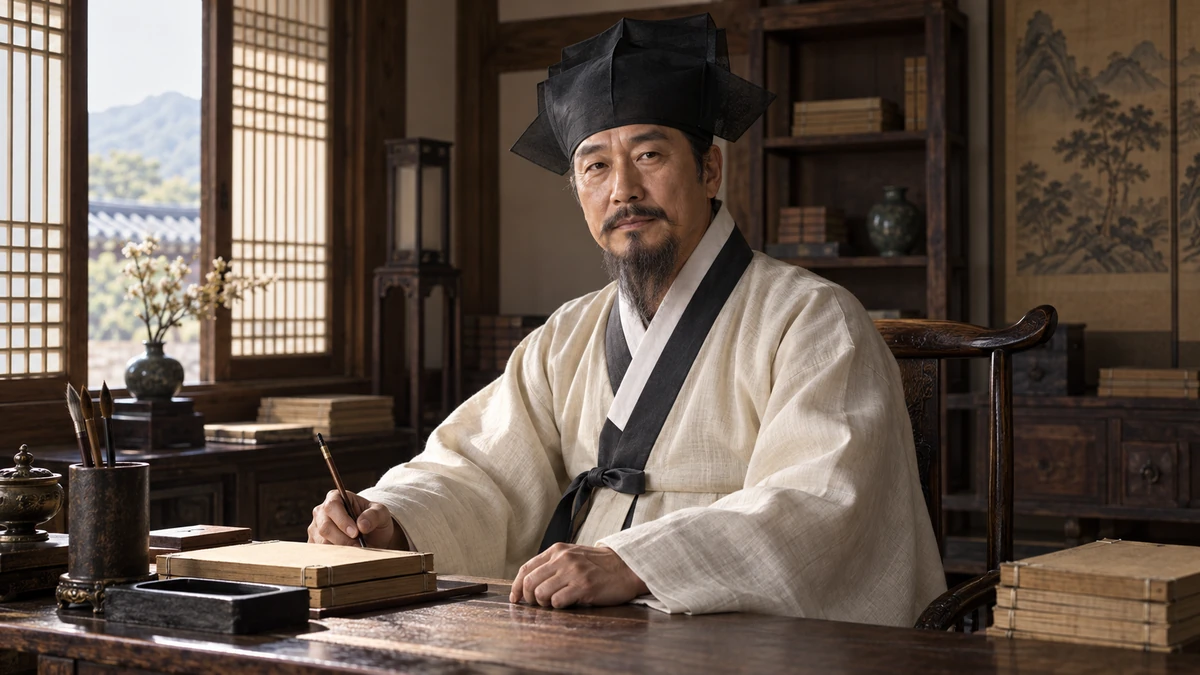
Yu Deuk-gong, an 18th-century scholar, poet and government official, challenged one of the dominant historical narratives of his time by arguing that Balhae, a kingdom that once stretched across parts of Northeast Asia, belonged within the story of Korea.
His best-known work, “Balhaego,” or “A Study of Balhae,” identified the kingdom as a successor to Goguryeo, one of Korea’s ancient Three Kingdoms. By placing Balhae alongside Silla, Yu helped establish the idea that the centuries following the Three Kingdoms should be understood as a “Northern and Southern States” period rather than solely as the era of Unified Silla.
A Scholar Constrained by Birth
Yu was born Dec. 24, 1748, in Hanseong, the Joseon-era capital now known as Seoul. He was the only son of Yu Chun and a woman from the Namyang Hong clan.
Several of Yu’s ancestors had been born outside their fathers’ primary marriages, placing him in the seoeol class. Under Joseon’s rigid status system, such family background could sharply restrict a person’s access to high government office, regardless of talent.
After his father died in 1752, Yu moved to his mother’s family home in Namyang. He returned with his mother to Hanseong in 1757 and later came under the influence of his uncle, Yu Geum. He began studying poetry in his late teens and, after turning 20, became a student of the influential thinker Park Ji-won. He also formed lifelong friendships with scholars including Yi Deok-mu and Park Je-ga.
Although his family had belonged to the Southerners, one of Joseon’s political factions, his studies with Park drew him toward the Northern Learning school. That movement emphasized practical knowledge and argued that Korea should learn from developments beyond its borders.
Reading Beyond Joseon’s Borders
Yu believed strong writing required broad reading across periods and regions. He immersed himself in Chinese classics, including “Romance of the Three Kingdoms” and “Water Margin.” When books were difficult to obtain, he borrowed and copied them by hand so he could continue studying them at home.
His interests extended far beyond China. He read about Manchuria, Mongolia, Muslim societies, India, Vietnam, Laos, Myanmar, Taiwan, Japan and the Ryukyu Islands, as well as Britain, France and the Netherlands. That wide range helped him move beyond a worldview centered exclusively on Qing China.
Yu collected his poetry and prose in “Yeongjaejip” and in 1772 published “Dongsimaeng,” an anthology of Korean writing from earlier periods. He passed a preliminary civil service examination in 1774, but his seoeol status continued to limit his prospects. He nevertheless pursued literary and historical research, publishing a collection connected to travel in Qing China in 1777.
Royal Library Opens a New Historical View
King Jeongjo eased restrictions on the appointment of seoeol scholars, and Yu’s writing ability and broad learning won royal recognition. On July 13, 1779, he was appointed a proofreader at the Kyujanggak, the royal library and research institution. Along with Yi Deok-mu, Park Je-ga and Seo I-su, he became known as one of its four leading proofreaders.
The appointment gave Yu access to historical materials from Korea, China and Japan held at the royal court. After examining those records, he criticized histories that focused too heavily on Silla and began developing his argument that Balhae should be included in the Korean historical framework.
Yu and other scholars associated with Park Ji-won also promoted silsa gusi, an approach emphasizing evidence and practical inquiry, and advocated policies to encourage industry.
King Jeongjo’s support allowed Yu to overcome some of the official barriers attached to his birth. He served in several local and central government posts, including as magistrate of Pocheon in 1786, Yanggeun in 1788 and Gapyeong in 1792. He eventually became the chief administrator of Pungcheon.
Travel, Retirement and Writing
After King Jeongjo died Aug. 18, 1800, Yu left government service and withdrew from public life. He visited former Korean capitals including Kaesong, Pyongyang and Gongju and traveled to Beijing twice. His observations of other places and cultures informed travel accounts, fiction and historical studies.
Yu died Oct. 1, 1807. He was buried at Songsan in what was then Yangju County, an area now within the city of Uijeongbu, north of Seoul.
Bringing Balhae Into Korean History
In “Balhaego,” Yu argued that Balhae’s founder, Dae Jo-yeong, came from the displaced people of Goguryeo, that Balhae occupied former Goguryeo territory and that Goguryeo people helped form the new state. Those points, he said, established a line of succession between the two kingdoms.
Yu disputed the view that Silla alone had unified the lands of the Three Kingdoms. Instead, he described Silla in the south and Balhae in the north as states that existed during the same historical period.
In the book’s preface, Yu criticized historians of the Goryeo dynasty for failing to write a national history that treated Unified Silla as a southern dynasty and Balhae as a northern one. Because Goryeo claimed Goguryeo’s legacy, he argued, its historians should also have incorporated Balhae. He further expressed a desire to recover Balhae’s former territory, while another work, “SagUNji,” examined the historical origins of Korea’s northern regions.
Yu’s other writings included “Gyeongdo Japji,” now valued as a record of urban customs and daily life during the Joseon period, and “Twenty-One Capitals in Retrospective Verse,” a collection of 43 poems about capitals of Korean states from ancient times through Goryeo.
By modern scholarly standards, “Balhaego” has clear limitations. Its lasting importance lies instead in Yu’s decision to look beyond the southern-centered histories available to him and treat Balhae as part of Korea’s past. His work became an early foundation for later research by scholars including Jeong Yak-yong and Han Chi-yun and helped shape the historical concept of a Northern and Southern States period.
Comments
Post a Comment