Image to help understand the article
Two Korean cultural exports meet on one American platform
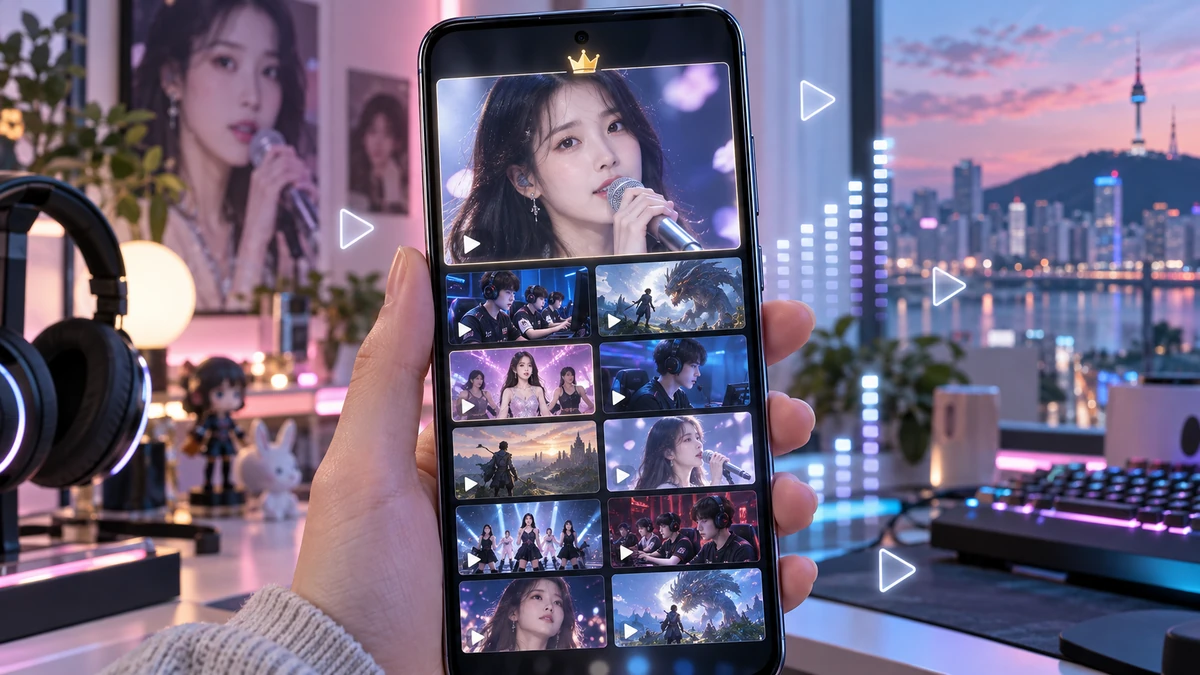
A song attributed to IU, one of South Korea’s most recognizable singers, sits above an esports broadcast, gaming personalities and music associated with internationally known K-pop acts. Together, they offer a picture of Korean entertainment that is broader than the polished music videos that often introduce American audiences to the Korean Wave.
In a Korean news summary describing a Sept. 13, 2026, YouTube popularity snapshot, “Dear my crazy soulmate,” listed under IU - Topic, ranks first with about 1.81 million views. Music and gaming each account for 14 entries in the 30-video collection, leaving just two classified as entertainment. The balance is striking: In this particular sample, competitive play and gaming commentary occupy as much space as recorded music.
For Americans, the connection goes beyond discovering another Korean artist. YouTube is an American-owned distribution platform. South Korea’s competitive gaming culture has developed around franchises with deep U.S. corporate roots. And Korean music companies increasingly address audiences who encounter their artists through the same digital services they use for American pop, sports and video games.
There is an important limit to the evidence: The supplied summary is the basis for the rankings and engagement figures discussed here; the underlying videos and API results have not been independently verified. Its description of a national “trending” list should be treated as the source’s characterization, not as proof of a comprehensive audience survey or a particular YouTube recommendation formula. The snapshot is useful for analysis, but it cannot establish a long-term trend by itself.
What the rankings show — and what they do not
The clearest finding is the concentration of categories. Music and gaming together fill 28 of the 30 collected positions, or roughly 93%. That does not mean those categories accounted for 93% of all YouTube viewing in South Korea. It means they dominated this specific collection at this specific time. News, beauty tutorials, food videos and other major parts of Korean online life may have substantial audiences without appearing prominently here.
The ranking also is not a simple ordering by the view counts presented in the summary. The third-place entry, an LCK Global broadcast titled “HLE vs T1 | 2026 Wooribank LCK Lower Finals,” has approximately 2.91 million views — more than the first-place IU entry. The second-place video, described in its title as a Korean-subtitled “Diablo 5” teaser, has only 18,408 views.
Those differences matter because “No. 1” can sound more definitive than the available evidence supports. The summary does not disclose a ranking formula or explain why these particular videos appear in that order. The counts should not automatically be read as views from South Korean residents, either: A list selected for a country does not, by itself, establish the geographic origin of every view attached to its entries.
The source attributes its collection to the YouTube Data API, a service that lets software retrieve platform information. Without the underlying request parameters and methodology, readers cannot determine exactly how the publisher constructed its list. For an American comparison, this is not interchangeable with a Billboard chart, Nielsen audience measurement or a representative poll. Each answers a different question, using different rules.
IU represents a wider musical landscape than the K-pop label suggests
IU’s position at the top provides an opening to explain a distinction that can disappear in U.S. coverage. Korean popular music is not exclusively an industry of choreographed groups. IU, the stage name of singer-songwriter and actress Lee Ji-eun, represents a prominent solo-star tradition. For American readers, the useful reference point is the singer-songwriter who also becomes a household name through screen work, rather than an exact comparison with any one U.S. celebrity.
The summary identifies “Dear my crazy soulmate” as a music Short posted Sept. 10, with 1,814,840 views and 25,160 likes at collection. Those details describe the supplied listing; they do not establish whether the item is a new single, an excerpt, a catalog upload or part of a broader release campaign. Nor does the ranking explain why listeners responded to it.
Other entries show the breadth within the music category. LE SSERAFIM - Topic appears at No. 8 with “Made My Night,” while Mark Lee - Topic is listed at No. 10 with “My Friend.” Stray Kids - Topic appears at No. 20 with “November 11th.” These artist names provide familiar entry points for international K-pop listeners, but their presence should not obscure less internationally recognizable music elsewhere in the collection.
At No. 14 is “Please Be Happy,” attributed to Lim Young Woong - Topic. Lim is associated with trot, a Korean popular-music tradition known for expressive singing and strong melodic hooks. A rough American analogy is the way country music sustains a large, dedicated audience alongside mainstream pop, although trot has its own history and sound. His inclusion is a reminder that Korean music audiences are not a single youthful, internationally oriented bloc.
The repeated “Topic” label also deserves explanation. YouTube uses automatically generated topic channels to organize music, including recordings delivered through its music systems. A listing on such a channel is not necessarily a personally uploaded video from an artist. That distinction matters when interpreting activity as a deliberate promotional move by a performer or label.
Gaming is not a sideshow to the Korean Wave
The third-place LCK broadcast runs 294 minutes, or four hours and 54 minutes, according to the summary. That is closer to an extended American sports broadcast than a quick social-media clip. Its appearance near the top illustrates why gaming belongs in discussions of Korean cultural influence, even when it does not resemble a television drama or a concert.
LCK refers to South Korea’s top-level League of Legends competition. HLE is Hanwha Life Esports, and T1 is another major esports organization. For newcomers, the broad structure is recognizable: Professional teams, coaching staffs, sponsors and highly invested fans compete within an organized sporting ecosystem. The contest takes place inside a video game, but much of the surrounding audience behavior would be familiar to followers of the NBA or NFL.
South Korea helped turn competitive gaming into a spectator business, supported in part by widespread broadband access and PC bangs — commercial computer gaming venues where customers typically pay for time at a machine. They are more than the old American image of an internet cafe used mainly to check email. They have served as places to socialize, practice and play together, helping make gaming part of everyday public culture.
The collection includes more than professional competition. A 21-minute video from the creator known as Gwaemuljwi ranks fifth, and a 25-minute gaming upload from the creator known as Ddeuddeu ranks seventh. Another entry, at No. 9, refers to a “scrim,” shorthand for a practice match between teams. These are examples of the creator-led programming that surrounds games: Commentary, personality and shared expertise can be attractions in their own right.
That ecosystem has an American counterpart in streamers who turn competitive play, analysis and informal conversation into recurring entertainment. The Korean snapshot suggests that, within this collection, those personalities coexist with official-looking broadcasts and promotional material rather than operating in a separate cultural lane.
Short clips and marathon broadcasts compete side by side
One of the more revealing contrasts is not between music and games but between viewing formats. The source classifies six of the 30 entries as Shorts, including the first-place IU item, the second-place gaming teaser and the LE SSERAFIM and Mark Lee entries. Yet the top three also contain the nearly five-hour LCK broadcast.
The Shorts classifications require caution. The summary does not provide the underlying video links or enough technical detail to confirm how those designations were assigned. It would therefore be premature to conclude that a specific artist launched a successful Shorts strategy based solely on this table. The defensible observation is that the publisher’s collection brings brief-format listings and much longer videos into the same ranking.
For American media executives, that juxtaposition describes a familiar programming challenge. A viewer might encounter a song through a brief clip, then seek out a full performance. A sports fan might watch a highlight without committing to the entire game. Short material and long material can serve different purposes, even when they appear on the same service.
But this snapshot does not demonstrate that viewers moved from one format to another. It contains no audience-overlap data, watch-time figures or referral paths. A label could reasonably investigate whether a short excerpt helps listeners discover a longer recording; an esports organizer could test whether highlights attract viewers to complete matches. Those are business questions raised by the collection, not outcomes proved by it.
Non-Shorts music entries reinforce the point that a single format does not explain the results. A three-minute recording attributed to meomuru - Topic ranks fourth, while the four-minute “Sparkle,” listed under Release - Topic, ranks sixth. Even in a collection led by an item labeled a Short, conventional-length music remains visible.
What this means for the United States
For the United States, the central implication is that the Korean Wave is not simply a stream of foreign entertainment arriving on American shores. It is also a relationship built through American platforms and game businesses, with Korean performers, players and audiences helping shape what those services distribute. YouTube, owned by Google, provides the common venue in this example.
The gaming connections are particularly direct. League of Legends was developed by Los Angeles-based Riot Games, which is owned by China’s Tencent. Diablo and StarCraft are Blizzard franchises, now within Microsoft following its acquisition of Activision Blizzard. The corporate picture is multinational, but American development studios and distribution businesses are deeply embedded in the cultural exchange.
That does not make every gaming title in the supplied list an authenticated corporate announcement. In particular, the second-place entry’s claim to be a “Diablo 5” first-look teaser cannot be accepted as confirmation of a new Blizzard product. The summary names Inven as the uploader, not Blizzard, and supplies no publisher verification. The same caution applies to drawing product conclusions from the listed StarCraft cinematic. A video title is evidence of how an upload is presented, not independent proof that its claim is true.
For American music companies and promoters, the practical lesson is equally measured: Korean visibility can identify material worth investigating, but it cannot substitute for U.S. demand data. An artist’s appearance in a Korean popularity collection does not establish American ticket demand, domestic streaming growth or radio potential. Those decisions require market-specific evidence.
American fans, meanwhile, can use this broader picture to move beyond the idea that Korean entertainment is one genre with one audience. Someone drawn to Stray Kids might discover a solo vocalist; a League of Legends viewer might become interested in Korean teams and broadcasts without following K-pop at all. These are different routes into Korean culture, not necessarily stages of the same fan journey.
The bilateral relationship here is commercial and cultural rather than diplomatic. The data do not support claims about government policy or changes in U.S.-South Korea relations. They do illustrate why that relationship cannot be understood only through exports of finished movies or albums: American companies provide important infrastructure, while Korean cultural communities help give that infrastructure value.
Fresh entries do not necessarily mean a wholesale audience shift
The source says all entries in the published top 20 are marked as new compared with a Sept. 6 snapshot. Several gaming uploads carry Sept. 12 publication dates, including the LCK broadcast and videos from major creators. That clustering makes recent publication an obvious feature of this collection.
Still, “new” is a comparison label, not a complete viewing history. An item absent from one weekly snapshot and present in the next may have appeared at other times between those observations. Likewise, the label does not establish that a creator is newly popular, that a song was newly released everywhere or that an established audience suddenly changed its tastes.
This distinction is especially important for entertainment coverage, where a ranking can quickly become a claim that an artist has broken through or a genre has taken over. Two snapshots cannot establish either conclusion. Repeated observations using consistent collection methods would be needed to determine whether music and gaming regularly command this share of the list.
The view and like counts also answer narrower questions than they might appear to. The supplied figures give the Stray Kids entry more than 1.11 million views and 127,748 likes, while the first-place IU entry has more views but fewer likes. Without comparable exposure periods, audience information and format details, those numbers are not a reliable basis for declaring one fan base more committed than another.
What to watch beyond a single ranking
The next meaningful test is persistence. Do the same categories dominate subsequent collections? Do individual recordings remain visible after their initial appearance? Do gaming broadcasts spike around competition dates and then recede? Answering those questions would turn an interesting snapshot into evidence about recurring audience behavior.
For the American angle, the most useful additional evidence would be geographic: U.S. views, American streaming activity, English-language audience engagement and other measures that distinguish domestic Korean attention from overseas consumption. The presence of English in a song title, or “Global” in a channel name, does not by itself establish an American audience.
Verification also must precede stronger claims about releases and announcements. Official artist catalogs, publisher statements and direct video records would help establish what the listed material actually represents. Subscriber totals and revenue are absent from the supplied data, so the collection cannot show which participant gained the most followers or made the most money.
Even with those limitations, the snapshot offers a useful corrective to a narrow view of Korean cultural influence. Its music includes solo singers as well as globally recognizable group names. Its gaming includes professional competition, creator-led entertainment and promotional-looking clips. And all of it appears within the information systems of an American platform. For U.S. audiences and companies, the story is not simply which Korean video finished first. It is how many different forms of Korean entertainment now meet in the same digital marketplace — and how carefully popularity must be measured before it becomes a business conclusion.
Comments
Post a Comment