Image to help understand the article
A Look Beyond the Korean Wave
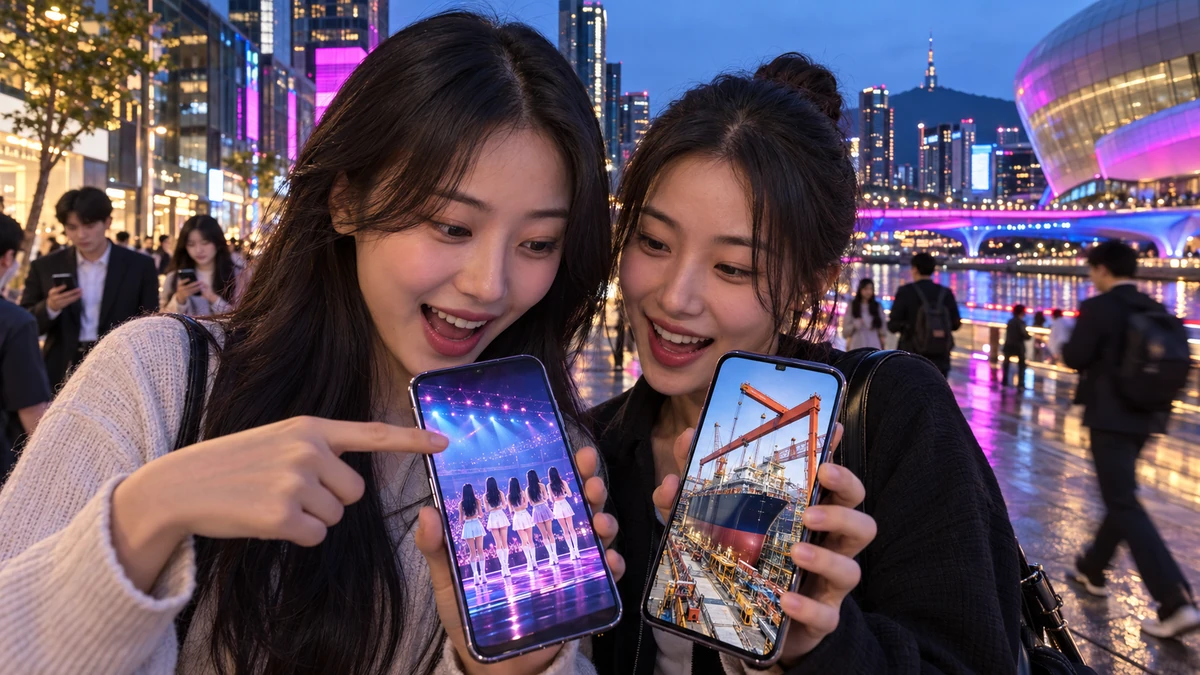
A rising K-pop group and a shipbuilder might seem unlikely neighbors. But in a Korean news roundup of Google’s trending searches for Sept. 14, 2026, RESCENE and Samsung Heavy Industries occupy the first two spots — a reminder that South Korea’s international influence rests on both cultural exports and industrial muscle.
Further down the list are constitutional politics, holiday food prices, a criminal investigation and a commuter rail project. Together, they offer American readers a broader picture of a country often encountered through music, television, smartphones and cars: an export powerhouse whose residents also worry about groceries, government accountability and getting to work.
The roundup attributes the entertainment interest to RESCENE’s reported domestic chart success and the business interest to major ship orders and liquefied natural gas technology. Those developments have potential relevance beyond Korea, including for American music companies and the U.S. energy industry. But search attention alone cannot establish commercial success abroad or explain what every person typing a keyword wanted to know.
The distinction matters throughout this account. The figures and event-specific claims come from the supplied Korean roundup and its summaries of related coverage, rather than an independent review of Google’s historical data or the underlying announcements. Read with that limitation, the list is a useful starting point for understanding overlapping cultural, economic and political interests — not a definitive ranking of South Korea’s priorities.
What a Trending Search Actually Measures
The most revealing number may belong to the term in last place. The Korean word for bicycle appears 10th, with an approximate search-volume figure of 5,000-plus. RESCENE, listed first, carries a figure of 2,000-plus. Samsung Heavy Industries, in second place, has 500-plus.
That is not necessarily a contradiction. The roundup explicitly says its ranking follows the order of Google’s trending list, not a ranking of total searches. It describes the accompanying figures as approximate indicators of each term’s scale. Treating the first entry as the country’s most-searched subject would therefore misrepresent the source.
For Americans familiar with trending topics on social platforms, the general caution should sound familiar: A burst of attention is different from sustained popularity. Neither establishes public approval. People may search because they are fans, confused by a headline, concerned about a development or simply curious.
The snapshot also covers Google activity in South Korea, not every way Koreans find information. Domestic services such as Naver are an important part of the country’s online landscape. A Google list is not a representative public-opinion survey, and a single day cannot establish a long-term shift. Its value lies in identifying subjects worth investigating further.
RESCENE and the Distance Between Korean Buzz and U.S. Success
The roundup connects RESCENE’s search prominence to reports that the girl group placed two songs simultaneously at Nos. 1 and 2 on Melon’s Top 100, with “LOVE ATTACK” maintaining an extended run at the top. It also cites a first-place finish in a September girl-group brand reputation ranking.
Melon is a major South Korean music-streaming service, making its charts a meaningful reference point for domestic listening. American readers might think of the attention surrounding a prominent streaming chart, but should not mistake a Melon position for an equivalent placement on the Billboard Hot 100. The services measure different markets and use different methodologies.
The brand reputation claim requires a separate distinction. Such rankings are not interchangeable with record sales, ticket demand or a representative favorability poll. The supplied summary does not explain the ranking’s methodology, so it cannot support a precise conclusion about the size or purchasing power of RESCENE’s audience.
For U.S. labels, concert promoters and retailers, reported Korean chart momentum can be an early signal to investigate. It is not a business case by itself. The experience of internationally established acts such as BTS and Blackpink shows that Korean pop can attract substantial American audiences. It does not mean every group with a domestic hit is following the same trajectory.
The missing evidence is important: The roundup supplies no U.S. streaming totals, American chart positions, tour plans or distribution agreements for RESCENE. The next question is whether domestic attention produces sustained listening and identifiable demand overseas. Until then, the defensible story is about reported Korean momentum, not a demonstrated American breakthrough.
The U.S. Stakes: Music Discovery Meets Energy Infrastructure
For the United States, the list’s strongest connections run through two very different markets. American fans and entertainment companies have an interest in discovering Korean acts before they become established internationally. American energy companies have an interest in the ships and equipment that move natural gas across oceans. Both relationships depend on commercial capabilities that a search ranking can highlight but cannot measure.
Samsung Heavy Industries is a shipbuilder within the wider Samsung corporate family, not the consumer-electronics business Americans most readily associate with the name. According to the roundup, the company secured ship orders worth 1.6 trillion won, including four LNG carriers, and its commercial-vessel orders for the year surpassed the previous full year’s total.
LNG, or liquefied natural gas, is natural gas chilled into liquid form so it can be transported by specialized ships. The United States is a major LNG exporter, and South Korea is a major shipbuilding country. That creates a clear connection between U.S. energy exports and Korean industrial capacity, even when a particular vessel order has no identified American customer.
The source does not name the buyers, intended routes or financing behind these contracts. It would therefore be unjustified to describe them as U.S. deals or predict a direct effect on American utility bills. The broader relevance is the supply chain: Export terminals need access to shipping, while shipping economics depend partly on vessel availability, technology and operating costs.
The roundup also links attention to Samsung’s participation in Gastech 2026 and efforts to pursue the first licensing of its proprietary SENSE liquefaction system. Licensing would represent a different revenue opportunity from building ships — selling access to technology rather than only delivering a finished vessel. The summary, however, does not establish a completed license agreement.
For Americans assessing the U.S.-South Korea relationship, this is a useful corrective to a culture-only view. The countries are security allies, but their relationship also encompasses entertainment, energy and advanced manufacturing. What matters next is not whether a company remains a trending search, but whether reported commercial milestones become completed contracts, deployed technology and durable cross-border business.
A Constitutional Debate With a Different Starting Point
The fourth entry, the Korean term for constitutional revision, points to another area where American reference points help — provided the differences are made clear. The roundup ties the searches to a dispute over presidential reelection and calls for President Lee to address the controversy before a news conference.
South Korea’s constitutional framework provides for a single five-year presidential term. The United States, by contrast, allows a president to be elected to two four-year terms. A Korean debate about permitting reelection therefore begins from a different institutional baseline than an American debate about the existing two-election limit.
The summary cites lawmaker Yoon Kun-young urging the president to resolve disputes involving constitutional change and the dropping of charges. It does not provide the full proposal, legal context or presidential response. That is insufficient to determine the scope of any amendment, its prospects or how it would operate.
Constitutional revision in South Korea requires a demanding process involving legislative approval and a national referendum; it is not something a president can accomplish alone. For American observers, the relevant questions concern institutional checks, the actual language of any proposal and public consent. A spike in searches establishes none of those outcomes and should not be presented as evidence that voters favor changing the rules.
Chuseok Brings a Familiar Worry: The Holiday Grocery Bill
The fifth search term is strikingly ordinary: meat. The roundup associates it with food supplies and discounts ahead of Chuseok, a major Korean harvest holiday when families commonly gather, travel to their hometowns and share traditional meals. Some families also observe ancestral rites.
Thanksgiving offers Americans a partial comparison, particularly for the combination of family travel, elaborate meals and pressure on household budgets. But Chuseok has its own history and customs. Gift-giving is also significant, and premium food sets can be part of the season’s spending.
According to the roundup, the government supplied seasonal staples above planned levels and provided 149 billion won in discount support across 13 categories of holiday goods. That makes the entry more than a culinary curiosity: It connects family traditions to the practical politics of affordability.
American shoppers experience similar pressures when seasonal demand collides with stretched budgets. Still, a broad search term such as meat could reflect many interests, from recipes to restaurant choices. The holiday measures are a plausible news connection identified by the roundup, not proof of every searcher’s motivation. The source also provides no basis for attributing the attention to U.S. meat imports or predicting benefits for American suppliers.
Industrial Ambition and the Commute Home
Two other entries reveal the physical infrastructure behind South Korea’s economy. Saemangeum, a large development area on the country’s southwestern coast, appears seventh. The roundup connects the attention to a reported 9 trillion won Hyundai Motor investment and plans to develop robotics and artificial intelligence industries there.
For an American audience, the closest comparison is the effort by states and regions to build industrial clusters around major manufacturing investments. The important questions are familiar: What will actually be built, when will the money be spent, how many lasting jobs will result and what supporting infrastructure will be needed?
The summary does not provide a detailed investment schedule, employment commitments or a role for Hyundai’s U.S. operations. It therefore supports a story about reported ambition rather than completed transformation. American companies may find Korean advances in automation commercially relevant, but the search entry does not establish any specific U.S. partnership.
The ninth entry concerns GTX-C, a planned metropolitan express rail line linking communities north and south of Seoul through major employment districts. The roundup says main construction is scheduled to begin Sept. 15 and describes a route connecting Yangju, Seoul’s Gangnam area and Suwon.
Think of the problem addressed by commuter rail around New York or Washington: allowing people to reach concentrated job centers from farther-flung homes. A construction start, however, is not an opening date, and projected travel times are not demonstrated service performance. Alongside the bicycle searches, associated in the roundup with free classes and safety outreach, the rail interest underscores how everyday transportation can command attention beside billion-dollar industrial plans.
Celebrity Intimacy and the Limits of Crime Keywords
The remaining entries reflect two recognizable features of the modern attention economy: intimate celebrity updates and interest in violent crime. The roundup associates searches for Kim Seung-yoon with coverage of wedding preparations involving Jang Dong-yoon and a meal prepared by a prospective mother-in-law. It links Ji Yeon-soo to a reported donation of 5 million won, described as her first YouTube earnings, to support single-parent families.
American readers will recognize the format. Personal milestones and charitable gestures become news because audiences already feel connected to a public figure. YouTube, an American-owned platform with a global creator economy, supplies a direct cross-border connection in the donation story. But one creator’s reported gift does not establish a broader change in giving or platform revenue.
The third-ranked search term, meaning murder, demands greater caution. The roundup links it to an investigation involving a refrigerated storage facility in Paju, northwest of Seoul, and a cafe owner transferred to prosecutors while in custody. It attributes allegations of planning and inconsistent statements to police.
Those are investigative allegations, not a finding of guilt. Referral to prosecutors is a procedural development, not a conviction. Because the keyword is generic, the roundup also cannot establish that every related search concerned this case. Nor can one entry demonstrate an increase in violent crime. The same restraint should apply when interpreting American true-crime traffic: Attention is not a crime-rate statistic.
What to Watch After the Search Spike
The list’s lasting value is not that it crowns a single national obsession. It places cultural exports, industrial contracts, household costs and public institutions in the same frame. That wider view is especially useful for Americans whose exposure to Korea may begin with a playlist, a television series or a familiar corporate logo.
For RESCENE, the next meaningful evidence would be sustained listening and measurable demand in additional markets. For Samsung Heavy Industries, it would be contract execution and confirmed technology licensing. For Saemangeum and GTX-C, it would be investment delivery, construction progress and eventual operating results rather than announcements alone.
The political and household stories require different follow-up: the text and prospects of any constitutional proposal, and whether holiday support materially eases consumers’ expenses. Across every category, the principle is the same. Search activity points toward questions; reporting must still establish the answers. For U.S. audiences and companies looking toward South Korea, that distinction separates a useful early signal from an exaggerated claim about the next big thing.
Comments
Post a Comment