Kim Ha-seong’s first double of the season offers a familiar baseball lesson: progress can show up before the numbers do
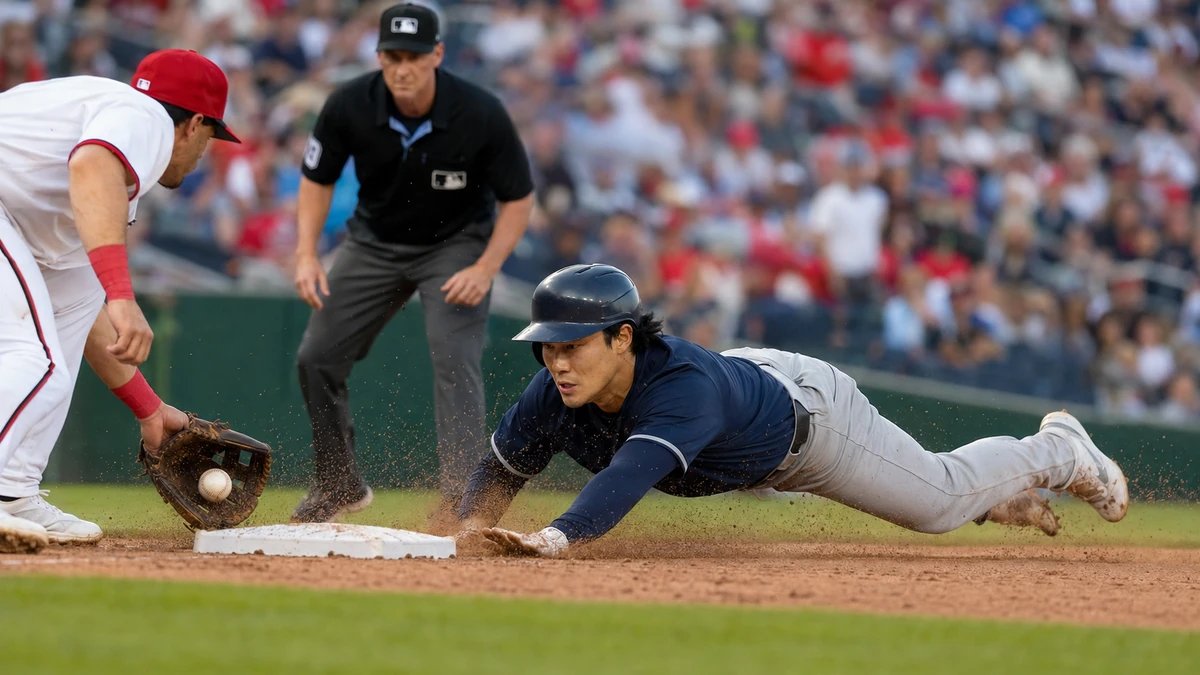
Image to help understand the article
A small box-score line, and a bigger story underneath it
On paper, Kim Ha-seong’s day against Washington did not look like the kind of performance that would stop American baseball fans in their tracks. Batting ninth and starting at shortstop in a road game at Nationals Park, the South Korean infielder went 1-for-3 with a walk and a run scored. His season batting average, according to the game summary, remained at .120. In the long grind of a Major League Baseball season, that is the sort of line that can easily get buried under bigger headlines, especially on a day when Ronald Acuña Jr. supplied the fireworks with a milestone home run.
But baseball, perhaps more than any other major American sport, has always rewarded a closer reading. A hitter can be in trouble even while posting hits, and he can be moving in the right direction even before the overall numbers catch up. That is why Kim’s performance matters beyond the raw stat line. A day after collecting three hits, he followed with his first double of the season, added a walk and once again found a way to impact the game from the bottom of the order. For a player trying to climb out of an early-season slump, that combination can matter more than a temporary jump in batting average.
The most telling moment came in the seventh inning. With his team already ahead 3-0, Kim faced right-hander Max Kranick and got a slider that drifted over the middle of the plate. He drove it to left, but not with the kind of laser contact that leaves no room for interpretation. The ball moved slowly enough that the play still required a decision, and just as important, commitment. Kim did not settle for the easy single. He sprinted out of the box, pushed for second and arrived safely with a headfirst slide for his first extra-base hit of the season.
That one play captured the kind of player Kim has long been, and why he has drawn admiration from managers, teammates and analytically minded front offices alike. He is not defined only by bat speed or home-run totals. His value often appears in the margins: a pitch recognized quickly, an extra 90 feet taken aggressively, a low-probability play turned into a positive result through anticipation and effort. For Korean fans who have followed him since his KBO days, that style is familiar. For American audiences, the closest comparison is the kind of player every contender wants in October — the infielder whose impact extends beyond whatever shows up in the home-run column.
That context matters now because Kim’s early season has been shaped by one ugly number. A .120 average invites concern, criticism and, in today’s sports environment, overreaction. Yet two straight games of improved at-bats suggest a more interesting question than whether he is “back.” The better question is whether his recent production reflects the beginning of a broader correction. For now, the answer is incomplete. But the signs are more encouraging than the season line alone would suggest.
Why this particular double mattered more than an ordinary extra-base hit
The official scorer recorded Kim’s seventh-inning drive as a double. The box score gives no special credit for the sequence of judgment that followed, but the play itself offered a clear reminder that not all extra-base hits are created equal. Some are the product of brute force, the kind of line drive that splits the gap before an outfielder has time to react. Others are built out of instant calculation: how hard was the ball hit, where is the outfielder positioned, how quickly can I get out of the box, can I beat the throw?
Kim’s double fell into the second category. That distinction is important because it says something about the broader state of his game. Players in a slump can become passive. They wait for perfect contact. They hesitate on the bases. They let one poor at-bat bleed into the next. Kim’s play suggested the opposite. He recognized a mistake pitch, put it in play, then refused to let the imperfect shape of the contact limit the result. By turning what may have been a single into a double, he did more than improve his own line. He created a scoring opportunity that immediately paid off when Acuña’s three-run homer brought him home.
That sequence also fits a longstanding truth in baseball evaluation: recovery at the plate is often visible before it becomes statistically obvious. Coaches and scouts frequently look for signs such as better swing decisions, harder contact on hittable pitches, willingness to use the whole field and the confidence to remain aggressive after earlier outs. Kim had made outs in his first two at-bats, grounding out in the third inning and later fouling out to the catcher. Instead of spiraling, he adjusted within the same game. That is one of the strongest indicators that a hitter is solving problems rather than simply waiting for luck to change.
He then added another positive data point in the eighth inning by drawing a walk. That matters because slumps are not just about missed swings. They can also distort a hitter’s strike-zone judgment, making him chase pitcher’s pitches out of frustration. A single extra-base hit can be dismissed as a good swing on one mistake. Pairing that hit with a walk makes the day more convincing. It shows another path to base, another sign that the hitter is seeing the game more clearly.
For Kim, whose game has never depended on one offensive tool alone, the blend is especially meaningful. His appeal has always rested in versatility — contact when needed, on-base ability, alert baserunning and capable defense in the middle infield. A double created through hustle and a walk earned through patience tell a more complete story than a random bloop single ever could.
What Korean fans see in Kim, and what American fans should understand
To understand why performances like this resonate so strongly in South Korea, it helps to know how Korean baseball culture often talks about players. In American sports language, stars are commonly sorted into broad buckets: sluggers, aces, closers, five-tool prospects. In Korea, discussion around players frequently places special emphasis on what might best be translated as sincerity, concentration and relentless effort — qualities that are easy to romanticize, but that also carry real weight in how athletes are judged.
Kim has long fit that mold. He is not celebrated primarily as a towering power hitter. He is appreciated as an infielder who competes on every pitch, squeezes extra value from each plate appearance and turns baseball IQ into production. That is one reason a play like his first double of the season draws attention beyond the number itself. In Korean sports coverage, the process often matters as much as the result. A hitter who transforms a modestly struck ball into an extra-base hit through instinct and aggression can be praised as much as a player who simply overpowers a mistake pitch.
American readers can think of it this way: Kim’s appeal is closer to the admiration many U.S. fans have had for players who win with detail, discipline and energy rather than raw physical dominance alone. He belongs to a baseball tradition that values pressure, adaptability and the willingness to manufacture offense. That does not mean style matters more than results. Major league careers are still decided by production. But it helps explain why two consecutive games of improved quality — three hits one day, then a double, walk and run the next — would generate renewed optimism even while his overall average remains poor.
There is also a national dimension to that attention. Korean fans follow their major leaguers intensely, often across time zones and with a level of daily commitment that resembles how U.S. basketball fans track international stars in the NBA. Every stretch of success or struggle becomes part of a larger story about how Korean players are representing themselves in the sport’s highest league. That scrutiny is not unique to Korea, but it is especially visible when a player like Kim, already known at home for his consistency and professionalism, hits a rough patch and then begins to show signs of pulling out of it.
So while Americans might see a player trying to nudge his batting line upward, many Korean fans see something larger: a trusted big leaguer rediscovering the specific traits that made him a success in the first place. In that sense, this was not just about a first double. It was about seeing the outline of Kim’s game come back into focus.
Why the United States should pay attention to this trend
For American baseball audiences, Kim’s recent stretch matters for reasons that go beyond one player’s stat line. It speaks to a broader trend in the U.S. game: the growing importance of internationally developed players whose value cannot always be captured by the loudest metrics. In an era dominated by exit velocity, barrel rate and home-run pace, teams still need players who can extend innings, pressure defenses and connect the bottom of the order to the top. Kim’s game is a reminder that offense is not only about damage; it is also about continuity.
That is especially relevant in the current American baseball marketplace, where clubs routinely spend large sums seeking lineup depth rather than just headline stars. U.S. front offices increasingly prize players who can handle premium defensive positions, run the bases intelligently and avoid becoming one-dimensional liabilities when their power goes quiet. Kim has built his reputation in exactly that space. Even when his average is low, a performance like this shows why teams remain interested in players who contribute in multiple phases.
There is also a cultural and commercial layer here. Korean players in MLB occupy an important place in the widening baseball connection between the United States and South Korea. They bring not only talent but also audiences — fans in Korea who tune in overnight, Korean American communities that follow closely and American fans whose interest in the KBO and Korean athletes has grown over the past decade. When a player like Kim rebounds, it matters to broadcasters, digital publishers, merchandise sellers and the league itself. MLB has spent years trying to deepen its international footprint, and Korean stars are part of that strategy.
For U.S. companies, the lesson is not limited to sports media. Brands increasingly understand that Korean cultural influence travels well in America, whether in music, television, beauty products or food. Sports do not move in isolation from that broader Korean Wave. A recognizable Korean athlete thriving on an American field can become part of a larger ecosystem of attention, identity and consumer interest. That does not mean every good week at the plate becomes a business story. But it does mean that Korean players now exist within a U.S. market far more receptive to Korean cultural presence than it was a generation ago.
And there is a specifically baseball comparison Americans will understand. U.S. fans have often celebrated players who survive slumps not by waiting for a three-homer breakout, but by rebuilding the basics — controlling the strike zone, using speed, taking the extra base and forcing the game to speed up around them. Kim’s recent two-game improvement fits that pattern. It is the kind of correction coaches trust because it is rooted in habits rather than hype.
More than one night in Washington: what changed, and what to watch next
The temptation after any good game is to declare a turning point. Baseball punishes that kind of impatience. One productive week can vanish inside a six-month season. That is why the more useful frame here is not comeback but direction. Over the last two games described in the Korean report, Kim has shown multiple forms of offensive life: a three-hit game, an extra-base hit, a walk and the kind of aggressive baserunning that can generate value even when the ball is not scorched.
That variety matters. If a struggling hitter suddenly homers twice but continues expanding the zone and making weak outs the rest of the time, evaluators may stay skeptical. Kim’s recent production looks different because it has arrived through several channels. He has made contact, reached base more than once in a game and shown enough confidence to take an extra base when the opportunity appeared. The batting average remains low, but averages are backward-looking by nature. They summarize everything, including the worst part of the slump, and therefore tend to lag behind current form.
The next thing to watch is not whether Kim posts another headline number immediately. It is whether the at-bat quality holds. Does he continue laying off pitches that get him into trouble? Does he drive mistakes rather than merely foul them away? Does he keep turning modest contact into pressure on the defense? Those are the signs that a rebound is becoming sustainable.
The context of the lineup matters too. Batting ninth, Kim can be overlooked as a secondary figure, but the modern No. 9 hitter is often asked to do more than simply avoid damage. He can act as a second leadoff man, especially in front of dangerous bats. That is effectively what happened here. Kim’s double gave the inning shape, and his run scored on Acuña’s historic home run turned a personal achievement into a team moment. Lower-order production can be the difference between a lineup that feels top-heavy and one that keeps pressure on opponents throughout the game.
That is another reason American fans should resist judging this stretch solely through the lens of batting average. The shape of Kim’s contribution — traffic on the bases, extended innings, pressure before the lineup turns over — reflects a style that many successful teams rely on even if it rarely dominates highlight packages.
What this says about U.S.-Korea baseball ties
Kim’s recent performance also lands in the middle of a broader and increasingly mature relationship between American and Korean baseball. Major League Baseball no longer treats Korean talent as a novelty. Korean players arrive with established resumes, sophisticated fan bases and a track record that has taught American teams to scout the KBO with seriousness. That relationship has been built over years through posting systems, media rights, trans-Pacific fan interest and the visibility of Korean players who have succeeded or struggled in public view.
For the United States, that connection means more than importing talent. It means importing context. American clubs and audiences are learning that Korean players often arrive with different developmental backgrounds, different media expectations and different styles of public scrutiny. When those players succeed, it strengthens MLB’s standing in Korea. When they struggle, it can become a national story there in a way many U.S. fans may not fully appreciate. Kim’s two-game uptick is therefore not just a baseball note; it is part of an ongoing conversation between two baseball cultures that watch each other more closely than ever.
For American audiences, that relationship increasingly looks familiar. It resembles the way the NBA has long benefited from global stars whose impact extends beyond the floor, or the way European soccer clubs cultivate huge U.S. followings through players who act as bridges between markets. Baseball’s version is more diffuse, but it is real. Korean players help keep MLB relevant to a dedicated overseas audience, and the American stage, in turn, amplifies their stature at home.
That reciprocal interest matters at a time when live sports remain one of the few forms of entertainment that can reliably command attention across borders. A player like Kim does not need to be an MVP candidate to matter in that ecosystem. Sometimes steady relevance is enough. A shortstop who grinds through a slump, regains his timing and helps create runs with the details of the game can be just as useful to that cross-Pacific story as a slugger chasing a record.
The bigger takeaway: baseball still rewards the players who can solve problems in real time
In the end, the strongest reason to pay attention to Kim Ha-seong’s latest game is not because it guarantees a breakout. It is because it showed the specific skills that make a breakout possible. He did not erase his season average. He did not suddenly turn into a middle-of-the-order masher. What he did was, in some ways, more convincing. He adjusted within the game, punished a hittable pitch, used urgency to create extra value and then reached base again with a walk.
That is the kind of progress baseball people trust because it reflects decision-making rather than luck. It suggests a player whose confidence is beginning to return not as bravado, but as execution. In a sport where failure is routine and slumps can feel endless, the first real signs of recovery often look exactly like this: a cleaner swing at the right pitch, a sharper read on the bases, a calmer plate appearance the next time up.
For American readers, the cultural translation is straightforward. Kim’s game against Washington was not a grand comeback story. It was a credible baseball story — one about a skilled player using instincts, effort and discipline to change the direction of his season. For Korean fans, it reaffirmed the qualities they have long associated with him. For U.S. fans, it offered a reminder that some of the most meaningful movement in baseball happens before the season line catches up.
If this really is the start of a rebound, the evidence will build in the days ahead, not in one night’s headlines. But after two straight games of better results and more varied offense, there is finally something more substantial to watch than the .120 average. There is a pattern beginning to form. And in a sport that asks for patience from everyone — players, coaches and fans alike — that may be the most important development of all.
Comments
Post a Comment