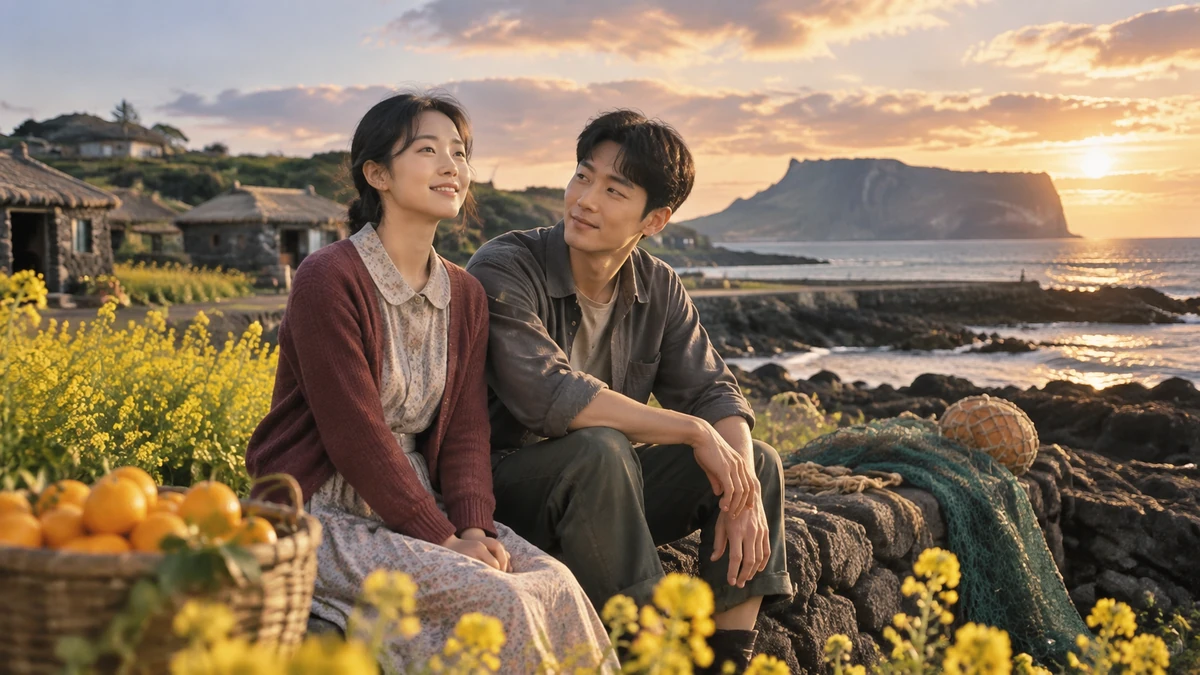
Image to help understand the article
A Korean Family Story Rooted in the Island of Jeju
Netflix’s Korean drama When Life Gives You Tangerines introduces international audiences to a deeply local story that carries a universal message: every family has a history shaped by sacrifice, love and perseverance. The series, originally titled 폭싹 속았수다 in Korean, follows the lives of Oh Ae-sun and Yang Gwan-sik, two people born in 1950s Jeju who grow through decades of social change, personal challenges and family responsibilities.
For viewers in the United States and other English-speaking markets, the series offers a window into a part of Korea that is often less visible internationally. While Seoul has become the familiar image of modern South Korea through K-pop, technology and global business, Jeju represents a different side of the country: an island community with its own history, dialect, traditions and relationship with nature.
The drama follows Ae-sun, a young woman who dreams of becoming a poet despite limited educational opportunities, and Gwan-sik, a quiet and dependable man whose strength comes from patience and loyalty. Their journey unfolds across the seasons, reflecting not only a romantic relationship but also the experiences of parents and grandparents who built their families during periods of major transformation in Korea.
Rather than focusing only on dramatic events, the series pays attention to ordinary moments: family conversations, difficult choices, small victories and the emotional bonds that connect generations. This approach places it within a growing wave of Korean storytelling that explores everyday life as a source of drama and meaning.
The Meaning Behind a Title That Does Not Translate Easily
The original Korean title, 폭싹 속았수다, contains a cultural meaning that is difficult to capture in a direct translation. In standard Korean, the word “sokda” can mean being deceived, but in the Jeju dialect it carries a very different meaning: to work hard, to struggle or to endure effort. The phrase expresses appreciation, similar to saying “you worked so hard” or “thank you for your efforts.”
This regional expression is central to understanding the emotional foundation of the series. It is not simply a story about hardship; it is a recognition of the labor and sacrifices made by previous generations. Many Korean families share memories of parents and grandparents who endured economic difficulties, rebuilt their lives after war and prioritized their children’s futures.
The English title, When Life Gives You Tangerines, adapts the familiar Western phrase “When life gives you lemons, make lemonade.” Instead of lemons, the series uses tangerines, a fruit strongly associated with Jeju Island. The title connects the show’s message of resilience with the landscape and agricultural identity of its setting.
For international audiences, this title choice highlights an important feature of Korean cultural exports: successful global content often does not erase its local identity. Instead, it uses specific regional details and then connects them to emotions that audiences everywhere can understand.
Jeju Island as More Than a Background Setting
Jeju plays a central role in the storytelling. Located south of the Korean mainland, the volcanic island is one of South Korea’s best-known destinations, famous for its natural scenery, distinctive food culture and unique dialect. However, When Life Gives You Tangerines presents Jeju not only as a travel destination but as a place where generations of people lived, worked and formed communities.
The series explores a period when life on the island was far removed from the highly connected, technology-driven Korea familiar to many global viewers today. The 1950s setting reflects a country still recovering from the Korean War and facing economic uncertainty. The lives of Ae-sun and Gwan-sik show how ordinary people navigated limited opportunities while holding onto dreams and relationships.
For American audiences, the story may evoke comparisons with family dramas that examine immigration, rural communities or changing social values across generations. Like many American family histories, the series asks how children understand the sacrifices made by their parents and grandparents.
The drama also introduces viewers to the importance of regional identity in Korea. Just as accents, traditions and local histories shape experiences across the United States, Korean regions have their own cultural characteristics. Jeju’s language and customs are not simply decorative elements; they help define the characters’ worldview.
A Prestige Korean Drama Built Around Everyday Lives
When Life Gives You Tangerines was written by Lim Sang-choon and directed by Kim Won-seok, two creators known for character-driven storytelling. Lim previously wrote the acclaimed Korean television drama When the Camellia Blooms, while Kim has directed several influential Korean series recognized for their detailed character development.
The production brought together major Korean actors, including IU, Park Bo-gum, Moon So-ri and Park Hae-joon. IU, one of South Korea’s most recognized entertainers as both a singer and actress, portrays Ae-sun and her daughter Yang Geum-myeong. Park Bo-gum plays Yang Gwan-sik, while Moon So-ri and Park Hae-joon portray the characters during later stages of their lives.
The series consists of 16 episodes divided into four parts, released weekly through March 2025. This release strategy reflected Netflix’s broader approach of combining traditional television-style storytelling with global streaming access.
The drama’s reception also demonstrated the continued influence of Korean television beyond simple entertainment trends. It received recognition at major Korean award ceremonies, including the Baeksang Arts Awards, the Blue Dragon Series Awards and the Seoul International Drama Awards. These honors highlighted the series’ writing, acting performances and overall emotional impact.
What This Means for the United States and the Global Korean Wave
For American audiences, When Life Gives You Tangerines represents another stage in the evolution of the Korean Wave, often called “Hallyu,” the global spread of Korean culture through music, television, film, food and fashion. Early international attention toward Korean entertainment was often driven by high-energy K-pop performances or genre-focused dramas. More recently, global viewers have shown interest in quieter stories centered on identity, family and history.
The success of Korean dramas in the United States has expanded beyond niche fan communities. Streaming platforms have made Korean storytelling more accessible to mainstream audiences who may not previously have watched foreign-language television. Shows such as Netflix’s Squid Game demonstrated the commercial power of Korean productions, while family-oriented dramas like When Life Gives You Tangerines show that emotional storytelling can travel across cultural boundaries without relying on action or spectacle.
The series also reflects broader cultural connections between the United States and South Korea. Korean American communities have long maintained connections to Korean language, food and entertainment, while younger American audiences increasingly engage with Korean culture through streaming platforms and social media. Stories about family history and generational change can resonate particularly strongly among communities shaped by migration and cultural exchange.
From a business perspective, the continued global popularity of Korean content creates opportunities for American entertainment companies, streaming platforms and creative partnerships. The growth of international audiences encourages investment in productions that maintain cultural authenticity while reaching viewers worldwide.
At the same time, the series offers a reminder that global success does not require removing local details. The Jeju dialect, regional traditions and Korean family dynamics are precisely what make the story distinctive. For American viewers, understanding those cultural elements can deepen appreciation rather than create barriers.
A Broader Trend: Local Stories Finding Global Audiences
The popularity of When Life Gives You Tangerines reflects a larger shift in international entertainment. Audiences are increasingly seeking stories that feel specific and personal rather than universally generic. A family’s experience on a small Korean island can become meaningful to viewers thousands of miles away because themes such as love, ambition, aging and gratitude are shared human experiences.
Korean dramas have increasingly demonstrated that cultural specificity can become a global advantage. A story deeply connected to one place can still speak to people from different countries when it explores emotions that cross borders.
For viewers discovering Korean culture through this series, Jeju becomes more than a scenic location. It becomes a symbol of endurance, memory and the connections between generations. The drama’s lasting appeal comes from its ability to show how ordinary lives become extraordinary when viewed through the passage of time.
As Korean entertainment continues to expand internationally, productions like When Life Gives You Tangerines suggest that the next chapter of the Korean Wave may not only be about global-scale hits, but also about intimate stories that preserve local voices while reaching audiences around the world.
Comments
Post a Comment