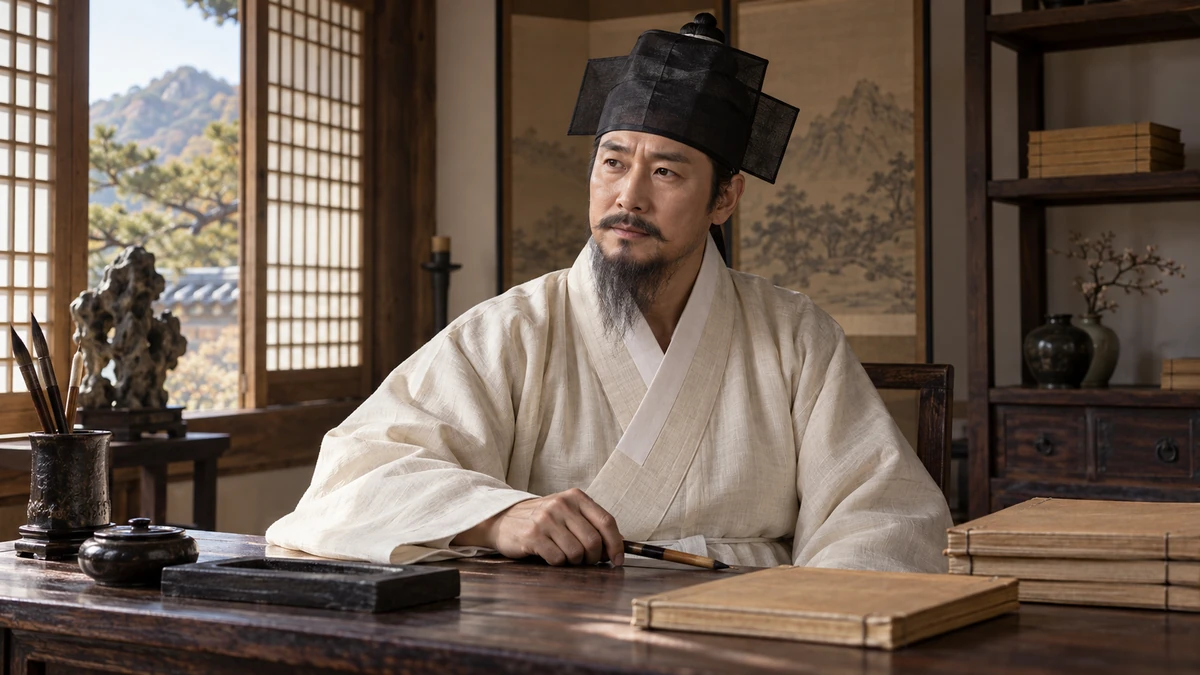
Image to help understand the article
Pak Je-ga was an 18th-century Korean scholar who challenged the economic and social orthodoxy of the Joseon Dynasty, arguing that commerce, foreign trade and advanced technology could strengthen the country and improve ordinary people’s lives.
Born in 1750, Pak became a leading figure in the Northern Learning school, a branch of Korea’s practical-learning movement known as silhak. Its scholars believed knowledge should address real problems in agriculture, industry, government and daily life rather than remain confined to abstract Confucian debate.
Overcoming the Barriers of Birth
Pak was the son of government official Pak Pyeong and a secondary wife from the Jeonju Yi clan. That made him a seoeol, a child whose family status restricted access to government service in Joseon’s rigid social hierarchy.
He showed an early talent for poetry, calligraphy and painting and immersed himself in study, repeatedly copying books by hand. After his father died, Pak left the family home and lived in difficult circumstances while facing discrimination because of his birth.
After marrying in 1766, he studied Neo-Confucianism and writing with support from his father-in-law. Around age 19, he became a student of the prominent scholar Pak Ji-won and developed close relationships with Northern Learning intellectuals including Yi Deok-mu, Yu Deuk-gong and Yi Seo-gu. He also associated with Jeong Yak-yong, another major practical-learning thinker.
Pak and three fellow scholars published a poetry collection in 1776 that became known in Qing China. But three years earlier, an effort to enter government through a hereditary appointment system had failed because of his seoeol status.
Reform Ideas Shaped by Qing China
Pak first traveled to Qing China in 1778 as part of a diplomatic mission. After returning, he wrote “Bukhagui,” or “Discourse on Northern Learning,” an influential account of what Joseon could learn from its more commercially and technologically developed neighbor.
The work’s first section proposed improvements to tools, transportation and everyday facilities. Its second examined contradictions in Joseon’s political and social institutions and offered reforms. Pak ultimately visited Qing China four times and formed connections with more than 100 Chinese intellectuals.
Many Joseon elites regarded the Qing Dynasty, founded by the Manchus, as culturally inferior and supported the idea of a northern campaign against it. Pak dismissed such ambitions as unrealistic. He instead viewed Qing China as a center that had adopted new scholarship and Western science and technology.
He criticized those who mocked unfamiliar ideas simply because they came from elsewhere, writing that people used narrow knowledge to judge unfathomable depths and fixed perspectives to discuss endless change.
A Scholar in the Royal Library
King Jeongjo appointed Pak to the Kyujanggak, the royal library and research institution, in 1779 alongside Yi Deok-mu, Yu Deuk-gong and Seo I-su. The appointments were part of an effort to loosen restrictions on talented men of secondary birth.
Pak spent 13 years in positions connected to the Kyujanggak, reading its holdings and editing and publishing books under royal orders. He later held military and local administrative posts. In 1794, he placed first in a military examination held at the palace’s Chundangdae grounds.
When Jeongjo asked officials in 1786 to propose remedies for the country’s problems, Pak called for ending status discrimination, promoting commerce and industry, expanding foreign trade, teaching science and technology, and inviting Western missionaries with technical expertise. He argued that talented people should be appointed according to ability regardless of birth and criticized an official system that allowed family background and government positions to become effectively hereditary.
Those proposals threatened the interests of established elites and drew opposition from a powerful conservative political faction.
Pak also rejected rigid literary conventions. He believed writers should describe what they had actually seen and heard in their own language. During Jeongjo’s campaign against unconventional writing styles, Pak was ordered to submit a statement of self-criticism, but used it to defend his work.
Prosperity Through Commerce and Technology
In “Bukhagui,” Pak disputed the idea that unconditional frugality would revive the economy. He argued that consumption stimulated production and that expanding commerce would also help handicrafts and agriculture grow.
He proposed increasing the circulation of money while preventing the production of poor-quality coins. Better roads suitable for wheeled vehicles and greater use of ships, he wrote, could improve domestic distribution and overseas trade.
Pak wanted society to show greater respect for merchants and traders, convert smuggling into regulated commerce, and establish trading ports around Kaesong, Incheon and riverside areas in the Chungcheong and Jeolla regions. He proposed first expanding trade with southern China and Shandong, then broadening commercial ties to Japan, Vietnam and regions inhabited by Uyghurs once Joseon became stronger.
He also advocated inviting Westerners to teach astronomy, agriculture, sericulture, medicine, mining, glassmaking, artillery, vehicle use, shipbuilding, and the construction of fortifications and bridges.
Agriculture, in his view, could not develop in isolation. It required stronger markets, handicraft production, transportation, improved tools and better farming methods. Pak also argued that the scholar-official class should participate in farming, physical labor and commerce, reducing the number of people who did not contribute to production.
Pak refused to romanticize deprivation as honorable simplicity. He observed that in a village of 10 households, only a few might manage to eat twice a day. Poverty, he believed, was not a morally elevated condition but an environment that damaged the human spirit. Building national wealth and improving people’s lives were therefore central purposes of scholarship.
An Artist and Northern Learning Pioneer
Pak was also accomplished in poetry, calligraphy and painting. Through his exchanges with Qing scholars, he introduced a paired-calligraphy format to Joseon and worked in several major script styles. His calligraphy helped prepare the way for the influential style later associated with Kim Jeong-hui, who studied writing and painting under him.
Pak painted landscapes, people and animals, including pheasants and fish. His surviving writings include “Bukhagui,” “Jeongyujip,” “Jeongyusigo” and “Myeongnongchogo.”
After returning from his fourth mission to Qing China in 1801, Pak was accused of involvement in a treasonous-writing case connected to a relative by marriage and was exiled to Jongseong in Korea’s far northeast. He was released in 1805 and died of illness that year.
His proposals found limited acceptance in a society where the scholar-official elite often looked down on commerce and trade. Political changes after Jeongjo’s death further narrowed his opportunities to pursue reform. Pak nevertheless remains a defining Northern Learning thinker for his insistence that scholarship should serve daily life, national defense and effective government — and that useful ideas should be adopted from abroad to help people live better.
Comments
Post a Comment