Image to help understand the article
South Korea Hosts First Central Asia Summit as Seoul Declaration Sets New Cooperation Framework
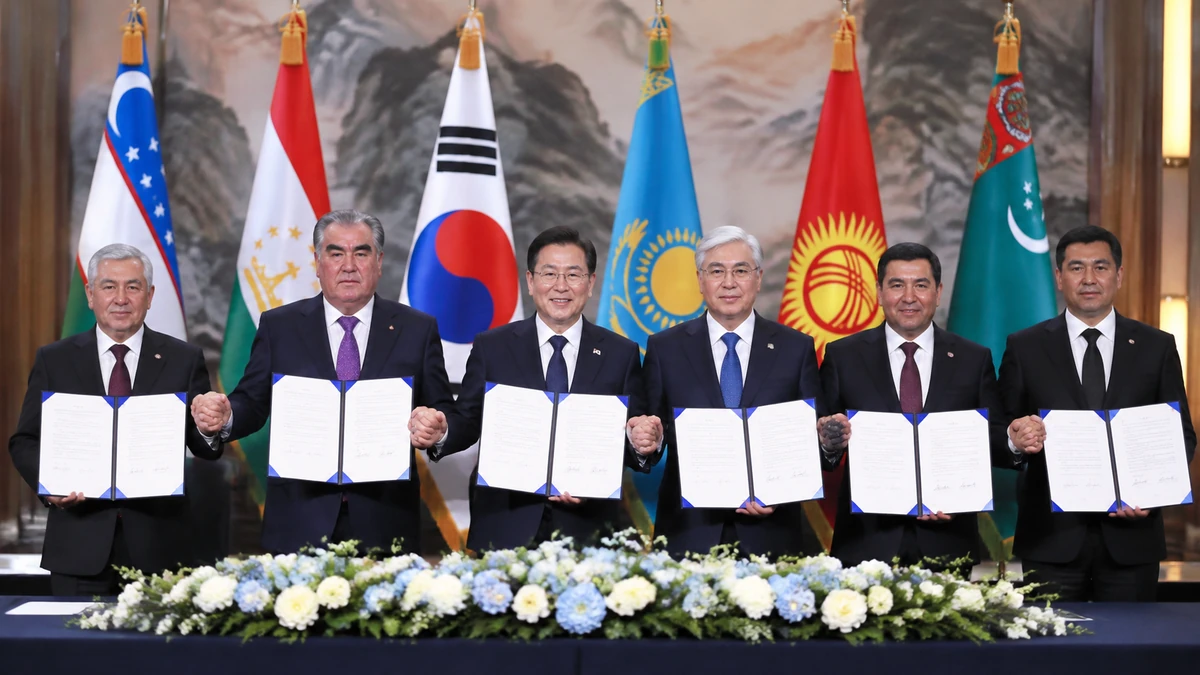
South Korea and five Central Asian nations have agreed to deepen diplomatic and economic cooperation through the adoption of the Seoul Declaration, a joint document unveiled during the first Korea-Central Asia Summit in Seoul. The meeting brought together South Korean President Lee Jae Myung and the leaders of Kazakhstan, Kyrgyzstan, Tajikistan, Turkmenistan and Uzbekistan, marking a new institutional chapter in relations between Seoul and the resource-rich region.
For many Americans, Central Asia can seem like a distant geopolitical region located between Russia, China and the Middle East. The five countries involved in the summit are former Soviet republics that have spent decades building independent diplomatic and economic identities since the collapse of the Soviet Union in 1991. In recent years, their strategic importance has grown because of their energy resources, critical minerals, transportation routes and role in global supply chains.
The Seoul Declaration frames the partnership around four broad themes: institutionalizing cooperation, promoting peace and stability, advancing innovation and economic growth, and strengthening connections between people. South Korean officials described the agreement as a milestone that could expand Seoul’s diplomatic reach across Eurasia.
A Regular Summit Structure Creates a Long-Term Diplomatic Channel
One of the key elements of the declaration is the decision to make the Korea-Central Asia Summit a regular event. Leaders agreed to hold the gathering every two years, with implementation reviewed through ministerial-level cooperation forums. The next summit is scheduled to take place in Kazakhstan in 2028.
This approach reflects a broader trend in international diplomacy: countries are increasingly creating recurring dialogue platforms rather than relying only on individual state visits or one-time agreements. For South Korea, which has historically focused much of its foreign policy attention on major powers such as the United States, China and Japan, stronger engagement with Central Asia represents an effort to diversify diplomatic and economic relationships.
The participating leaders — Shavkat Mirziyoyev of Uzbekistan, Emomali Rahmon of Tajikistan, Kassym-Jomart Tokayev of Kazakhstan, Sadyr Japarov of Kyrgyzstan and Serdar Berdimuhamedow of Turkmenistan — expressed support for continued cooperation with South Korea through the new framework.
In practical terms, regular meetings can provide a platform for discussing trade, investment, technology cooperation and regional challenges. However, the long-term impact will depend on how effectively governments translate broad commitments into specific projects and measurable outcomes.
Security Issues Connect Korean Peninsula Concerns With Central Asian Experience
The Seoul Declaration also included language related to security, including a reaffirmation of support for the complete denuclearization of the Korean Peninsula and the establishment of lasting peace. The document expressed support for South Korea’s stated goal of reducing tensions and rebuilding dialogue with North Korea through confidence-building measures.
The declaration also highlighted the importance of Central Asia’s nuclear-weapon-free zone. The region established a legally recognized nuclear-weapon-free framework in 2006, reflecting Central Asian countries’ efforts to strengthen nonproliferation cooperation after the Soviet nuclear legacy left environmental and security concerns in parts of the region.
For international audiences, including those in the United States, the security language reflects overlapping concerns. Washington has long played a central role in discussions surrounding North Korea’s nuclear program, while Central Asian nations have their own history of managing security challenges related to nuclear materials, borders and regional stability.
The declaration does not create a new security alliance, but it signals that Seoul and Central Asian governments view political stability as an important foundation for economic cooperation.
Critical Minerals and Business Access Become Economic Priorities
Economic cooperation is one of the most significant areas highlighted in the agreement. The declaration calls for stronger support for South Korean companies operating in Central Asia, including the creation of dedicated government channels in Central Asian countries to assist Korean businesses with trade procedures, investment issues and regulatory communication.
The focus on critical minerals is particularly notable. Central Asian countries possess important reserves of resources used in modern industries, including technologies related to energy, manufacturing and advanced electronics. South Korea, home to major global companies in semiconductors, batteries and automobiles, has been seeking to diversify supply chains for materials considered strategically important.
The agreement identifies cooperation on critical minerals as an opportunity to strengthen economic security and supply chain resilience. It also points to broader areas of collaboration, including urban development, manufacturing facilities and infrastructure construction.
For South Korea, which imports many natural resources while maintaining a highly industrialized economy, stable partnerships with resource-producing nations have become increasingly important. The effort is part of a wider global competition among countries seeking reliable access to materials needed for emerging technologies.
What the Seoul Declaration Means for the United States and American Interests
The Korea-Central Asia partnership has implications beyond Asia. The United States has maintained significant diplomatic and economic interests in both South Korea and Central Asia, particularly in areas such as regional stability, energy security and supply chain diversification.
South Korea is one of America’s closest allies in the Indo-Pacific, with a security relationship built around decades of cooperation following the Korean War. At the same time, Central Asia has gained attention in Washington as governments seek balanced relationships among major powers, including Russia, China and Western partners.
The critical minerals discussion is an area where American and Korean interests may overlap. The United States has been working with allies to strengthen supply chains for materials used in clean energy technologies, electronics and advanced manufacturing. Greater cooperation between South Korea and Central Asian countries could become part of a broader effort among partner economies to reduce vulnerabilities in global production networks.
For American companies, the agreement may also provide insight into future opportunities in Central Asian markets, particularly in sectors where Korean firms have experience, such as infrastructure, technology and industrial development. However, the declaration itself does not announce specific U.S. business projects or agreements.
American audiences may also view the summit through the lens of South Korea’s expanding global role. Once primarily viewed through the security concerns of the Korean Peninsula, South Korea is increasingly active in economic diplomacy, technology partnerships and cultural influence worldwide. The country’s transformation into a major technology and entertainment exporter has changed how many countries engage with Seoul.
A New Chapter in Korea’s Eurasian Strategy
The Seoul Declaration represents an attempt by South Korea and Central Asian governments to build a more structured relationship after more than three decades of diplomatic ties. The agreement combines traditional diplomacy with modern economic priorities, including technology, resources and people-to-people exchanges.
South Korean officials characterized the summit as the beginning of a new era based on accumulated trust. The challenge ahead will be implementation: turning general commitments into investment, trade growth, research cooperation and lasting institutional connections.
For global observers, including those in the United States, the summit illustrates a broader shift in international relations. Middle powers such as South Korea are increasingly seeking wider networks of cooperation as economic competition, supply chain risks and geopolitical uncertainty reshape global affairs.
The next several years will show whether the Seoul Declaration becomes primarily a diplomatic symbol or develops into a practical framework that changes how South Korea and Central Asia work together.
Comments
Post a Comment