Image to help understand the article
SEOUL, South Korea — Cigarette smoking has declined sharply in South Korea over the past decade, but the use of liquid-based electronic cigarettes has more than doubled, according to national health survey results released Sept. 30 by the Korea Disease Control and Prevention Agency.
The 2025 Korea National Health and Nutrition Examination Survey covered about 10,000 people age 1 and older from 4,800 households in 192 areas nationwide. Researchers used health examinations, interviews and self-administered questionnaires to assess smoking, alcohol use, physical activity, obesity and other measures.
Fewer cigarettes, more vaping
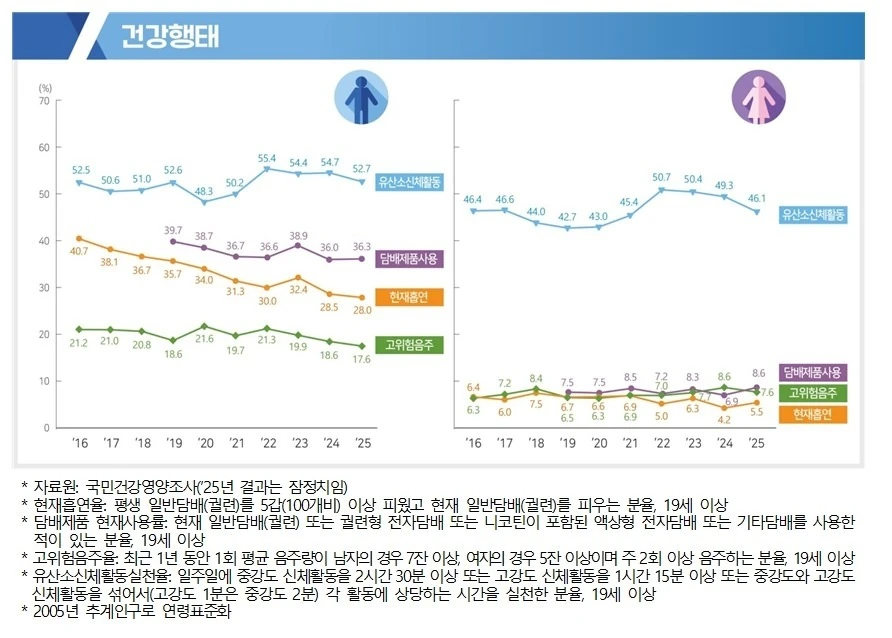
The share of men using any tobacco product was 36.3%, up 0.3 percentage points from a year earlier. Among women, the rate rose 1.7 percentage points to 8.6%.
Conventional cigarette smoking stood at 28% for men and 5.5% for women, with the rate among women increasing 1.3 percentage points. Overall use of liquid-based e-cigarettes was 4.8%, while 7.3% used heated tobacco products, with little change from the previous year.
The longer-term trend showed a shift in the types of nicotine products people use. The conventional cigarette smoking rate fell 29%, from 23.9% in 2016 to 17% last year. Over the same period, liquid-based e-cigarette use rose 109%, from 2.3% to 4.8%.
Heavy drinking falls as exercise declines
The rate of high-risk drinking — defined in the survey as consuming at least seven drinks for men or five for women in one sitting at least twice a week — fell to 12.6% from 13.6% a year earlier.
The monthly binge-drinking rate also declined for both men and women, reaching 35.1%. The largest drops were among men in their 20s, down 8 percentage points; women in their 30s, down 7.3 points; and women in their 20s, down 6.2 points.
Physical activity moved in the opposite direction. The share of people meeting the survey’s standard for aerobic exercise fell from 52.1% to 49.5%. The rate dropped 2 percentage points among men and 3.2 points among women.
Nearly half of men classified as obese
The obesity rate was 49.1% among men and 28.7% among women. Among men, it exceeded half in three consecutive age groups: 59% for those in their 30s, 53.3% for those in their 40s and 54% for those in their 50s.
Dietary patterns also shifted, with carbohydrates accounting for a smaller share of energy intake and fat accounting for more. Among men and women in their 20s and 30s, the proportion of energy obtained from fat exceeded the recommended upper limit of 30%.
Survey adds loneliness and life satisfaction
For the first time, the national survey included questions about social support, life satisfaction and loneliness. Overall, 94.5% of respondents said they had someone to rely on during difficult times. That figure declined with age, from 98.6% among people in their 20s to 87.8% among those 70 and older.
Average life satisfaction was 6.9 on a 10-point scale. More than 10% of people in their 20s and 30s, as well as those 70 and older, rated their satisfaction at 4 or below, a larger share than in other age groups.
Overall, 6.4% said they felt lonely always or often. The rate was 7.5% among women and 5.3% among men, rising to 9.7% among women in their 30s.
Comments
Post a Comment