
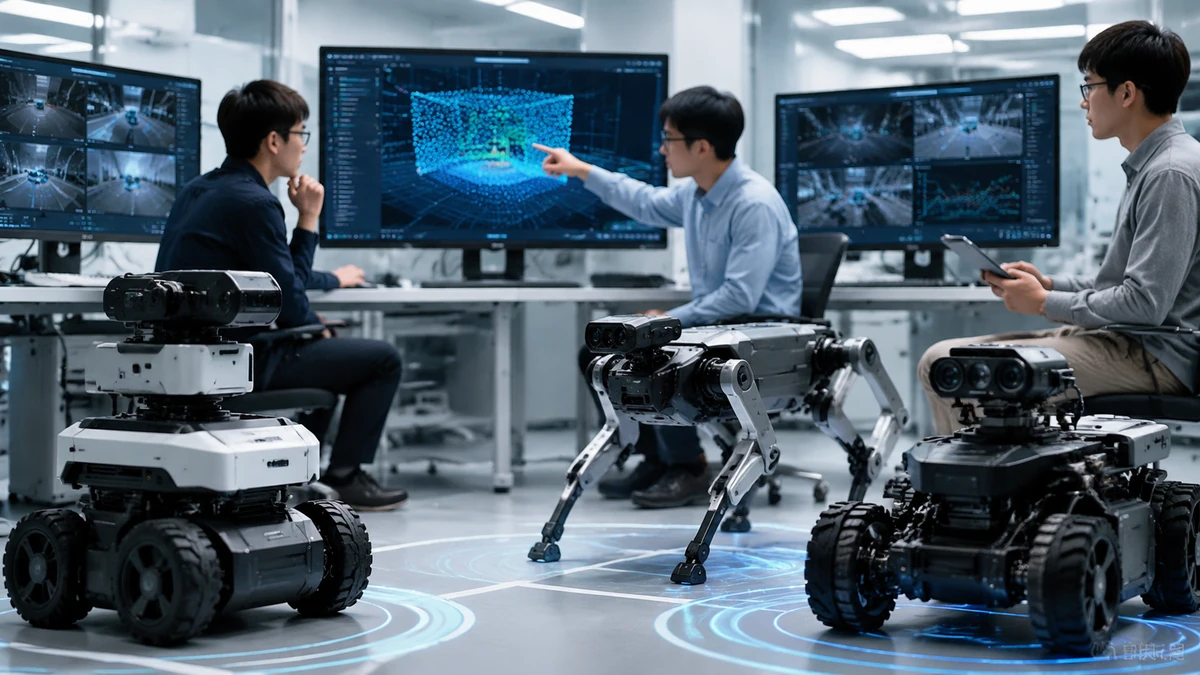
Image to help understand the article
A New Approach to Teaching Robots Through Shared Experience
South Korean researchers have developed a new artificial intelligence technology that could change how robots learn from the world around them. A team led by Professor Joo Kyung-don at the Artificial Intelligence Graduate School of the Ulsan National Institute of Science and Technology (UNIST) has created an AI-based federated learning system called FeDepth, designed to improve robots’ ability to estimate distances and understand their surroundings.
The technology addresses one of the biggest challenges facing modern robotics: how to help machines learn from many different environments without requiring companies to collect massive amounts of data in one central location.
For people in the United States, the idea may sound similar to how autonomous vehicles, smart devices and industrial robots are being developed. A self-driving car, warehouse robot or delivery machine needs to understand the physical world around it. It must recognize how far away objects are, judge available space and make decisions quickly. These abilities depend heavily on computer vision, where cameras become the robot’s equivalent of human eyesight.
FeDepth focuses on improving this “robot vision” by allowing different machines to benefit from each other’s experiences while keeping their original data private. Instead of sending every image or video collected by robots to a central database, the system allows robots to exchange learning results rather than raw information.
The research reflects a broader shift in artificial intelligence. As companies and governments increasingly worry about data privacy, security risks and the cost of managing enormous datasets, the future of AI may depend not only on collecting more information but also on finding smarter ways to use existing data.
Why Robot Distance Recognition Matters for the Future of Automation
Robots are becoming more common in industries ranging from manufacturing and logistics to agriculture and emergency response. But a robot’s ability to perform useful tasks depends on how accurately it can interpret its environment.
A camera alone does not make a robot intelligent. The machine must analyze images, understand depth and calculate distances. A delivery robot navigating a sidewalk needs to know whether a pedestrian is nearby. A warehouse robot moving shelves must understand the position of objects around it. A disaster-response robot entering a damaged building must recognize obstacles and dangerous areas.
Traditional AI models often require enormous amounts of training data collected from many different locations. However, gathering and managing such data can be expensive and complicated. In many cases, companies may also face restrictions because images captured by robots can contain sensitive information about people, workplaces or private spaces.
Federated learning has emerged as one possible solution. In this approach, individual devices or machines train AI models using their own data and share only the improvements from that training. The original information stays where it was collected.
However, conventional federated learning has a weakness. If participating machines operate in very different conditions, simply combining their learning results can reduce accuracy. A drone flying over farmland, a robot operating inside a factory and an autonomous vehicle traveling through a city street may all collect completely different types of visual information.
UNIST’s FeDepth attempts to solve this problem through a method called soft clustering. Rather than treating every robot as identical, the system groups robots based on similarities in their visual environments and learning characteristics.
How FeDepth Improves on Existing AI Learning Methods
The key innovation behind FeDepth is that robots are not permanently assigned to a single learning group. Instead, a robot can connect with multiple groups depending on the information it provides and the environment it encounters.
For example, a drone monitoring forests may share useful learning patterns with a four-legged robot moving through mountainous terrain. At the same time, that drone may also exchange information with other drones operating in different locations. The system looks for common knowledge between machines rather than forcing them into separate categories.
This approach is important because robots rarely operate in perfectly controlled environments. Real-world conditions constantly change. Weather, lighting, terrain and human activity can all affect how a robot interprets what it sees.
According to the research team, experiments using three different depth-estimation AI models showed that FeDepth reduced relative distance estimation errors by approximately 17% to 32% compared with conventional federated learning methods.
Additional testing using overlapping robot groups showed that FeDepth improved performance compared with existing clustered federated learning approaches. The reported relative error decreased from 0.264 to 0.249, representing about a 6% improvement in that experiment.
While these results come from research testing rather than commercial deployment, they highlight a major direction in robotics: machines may become more capable not simply by having better hardware, but by learning more effectively from one another.
What This Means for the United States and the Global Robotics Race
The development of FeDepth has implications beyond South Korea. The United States is one of the world’s largest markets for robotics, artificial intelligence and automation, with major companies investing in autonomous vehicles, industrial robots, warehouse systems and AI-powered machines.
American technology companies have also been exploring ways to build AI systems while addressing concerns about privacy, cybersecurity and data ownership. Federated learning has attracted attention in sectors such as healthcare, finance and mobile technology because organizations often want to collaborate without sharing sensitive information directly.
For the U.S. robotics industry, technologies like FeDepth represent a possible future model for cooperation between different types of machines. A logistics company, for example, could operate thousands of robots across warehouses without necessarily creating a single massive database containing every image collected by every machine.
The U.S.-Korea technology relationship may also become increasingly important as both countries compete and collaborate in artificial intelligence. South Korea has invested heavily in AI research, semiconductor manufacturing and robotics, while American companies remain major players in AI platforms, cloud computing and autonomous systems.
The broader lesson for American businesses is that the next stage of robotics may depend less on owning the largest collection of data and more on developing secure systems that allow machines to learn collectively. This mirrors challenges already seen in industries such as healthcare, where institutions often want to share knowledge while protecting private records.
For American consumers, the impact could eventually appear in everyday services. More advanced delivery robots, smarter manufacturing systems, improved disaster-response equipment and safer autonomous vehicles all depend on better environmental understanding. Technologies that allow robots to learn from diverse experiences could help accelerate those developments.
South Korea’s Growing Role in AI Beyond Hardware
South Korea is widely known internationally for its electronics industry, including companies that produce smartphones, displays and semiconductors. But researchers and policymakers are increasingly focused on another area of competition: artificial intelligence systems that can make better use of technology infrastructure.
FeDepth represents this shift. The research is not about building a new robot body or creating a more powerful camera. Instead, it focuses on the intelligence layer that allows different machines to interpret information and improve over time.
This direction is especially important for South Korea because the country faces strong competition from global technology leaders. The United States has major AI companies and research institutions, while China has rapidly expanded its robotics and AI capabilities. South Korea’s strategy has increasingly emphasized specialized technologies, advanced manufacturing and research-driven innovation.
The concept also connects with a cultural feature often associated with South Korea’s technology sector: a strong focus on efficiency, rapid adoption and practical applications. Korean companies have historically moved quickly to commercialize technologies, from mobile networks to consumer electronics. AI robotics is now becoming another field where research breakthroughs could translate into industrial advantages.
For global observers, FeDepth demonstrates that the future of robotics may not be determined only by which country builds the most advanced machines. It may depend on which countries develop the best systems for allowing machines to cooperate, learn and adapt.
The Next Challenge: Turning Research Into Real-World Robot Intelligence
Although FeDepth represents a promising research advance, several challenges remain before such technology becomes widespread. Real-world robots must operate reliably under unpredictable conditions, and companies must consider issues such as safety, regulation and cost.
Industries adopting AI-powered robots will also need standards for communication between different machines. A future where robots from multiple manufacturers learn together will require cooperation between hardware makers, software developers and governments.
Researchers around the world are increasingly exploring similar ideas: artificial intelligence systems that are decentralized, privacy-aware and capable of learning continuously. The development of FeDepth places South Korea among countries working to solve one of robotics’ central questions: how can machines become smarter through shared experience without creating new risks?
The answer could shape the next generation of automation. As robots move from factories into streets, homes, farms and emergency zones, their ability to understand the world around them will determine whether they become reliable partners in human environments.
South Korea’s FeDepth research suggests that the future of robotics may not belong only to the machines with the strongest hardware. It may belong to the machines that learn best together.


0 Comments