South Korea’s Ruling Party Splits Its Defense of Cabinet Nominees as Younger Voters Sour on Government
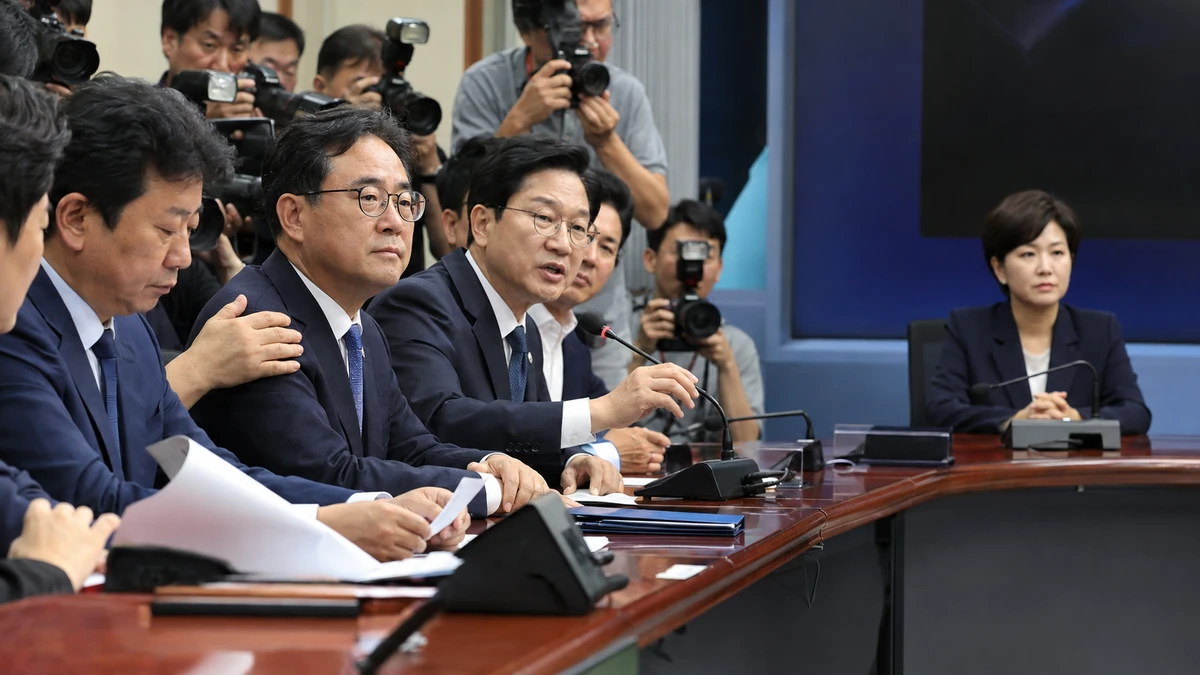
Image to help understand the article
Two Nominees, Two Political Strategies
South Korea’s governing Democratic Party is drawing a careful distinction between two embattled Cabinet nominees, offering a public defense of one while keeping its distance from the other. The contrasting response is more than a tactical choice in a pair of confirmation disputes. It points to a broader challenge confronting President Lee Jae-myung’s administration: how to protect presidential authority without forcing the ruling party to absorb every political cost created by a controversial appointment.
At a party leadership meeting on Feb. 4, senior Democratic Party figures, including floor leader Han Byung-do, spoke in support of Kim Seung-won, the nominee for justice minister, as he faced allegations involving an improper request related to a new pharmaceutical drug. Party officials challenged the provenance of material being used against Kim and questioned whether it had come from prosecutorial investigative records. The party’s message was unmistakable: Kim would not face the controversy alone.
The response to Yong Hye-in, the nominee to lead the Ministry of Gender Equality and Family, was markedly different. Party leaders did not publicly defend her at the meeting, and the party issued no separate statement supporting her. Democrats have not formally demanded that she withdraw, but their silence amounts to political distancing in a system where the governing party ordinarily plays a central role in shepherding a president’s nominees through confirmation hearings.
The difference reflects both the nature of the allegations and the nominees’ political affiliations. Kim is a Democrat, giving the party an institutional and partisan reason to defend him. Yong is not a Democratic Party member. She comes from a smaller progressive political force, and her selection had been presented as an effort to broaden the administration’s coalition beyond the president’s own party. For Democratic leaders, defending her would mean taking ownership of a controversy involving a politician from outside their ranks.
That distinction gives the party room to maneuver. It can respect Lee’s constitutional power to choose his Cabinet while declining to stake its own credibility on every nominee. Rather than openly breaking with the president or aggressively defending Yong, Democratic leaders have chosen a third option familiar in both Korean and American politics: say little, wait for public opinion to settle and allow pressure for a withdrawal to build without issuing a formal ultimatum.
A Confirmation System With Different Rules
For American readers, South Korea’s confirmation process can look familiar at first glance. Nominees appear before lawmakers, opposition politicians scrutinize their records, and damaging disclosures can dominate television coverage. But the legal structure differs from the United States. In Washington, most senior executive branch nominees require Senate confirmation. A failed vote can prevent a nominee from taking office. In South Korea, the National Assembly holds confirmation hearings for ministers, but its reports are generally not binding in the same way. A president can often proceed with an appointment despite legislative opposition.
That makes political legitimacy, rather than a final confirmation tally, especially important. Hearings can expose ethical problems, intensify partisan conflict and push public opinion against the administration. A nominee who survives procedurally may still become too costly politically. Presidents must decide whether appointing that person is worth spending public trust and legislative capital.
The governing party occupies an awkward position in this process. It is expected to support the president, rebut opposition attacks and help advance the administration’s agenda. At the same time, its lawmakers must protect their own electoral standing. If a nomination is broadly viewed as unfair or politically tone-deaf, unconditional support can damage the party long after the hearing ends.
The Democratic Party’s divided approach to Kim and Yong illustrates that calculation. Party leaders appear to believe there is a clearer case for defending Kim, or at least for challenging the evidence and tactics used against him. With Yong, they appear less willing to argue that the party itself should bear the burden of disproving or minimizing the criticism. Silence does not necessarily mean they accept every allegation. It means they have not concluded that a full-throated defense is politically advantageous.
This is particularly significant because Cabinet appointments in South Korea are often evaluated as symbols of a president’s governing philosophy. Regional background, school ties, professional networks, ideological balance and factional loyalties can all become part of the debate. A choice promoted as an act of inclusion can quickly become evidence of poor judgment if the nominee fails to win support from the constituency he or she was expected to represent.
Why Voters in Their 20s and 30s Matter
The political danger is sharpened by a new Gallup Korea survey released Feb. 4. According to the poll cited in Korean news coverage, Lee’s job approval rating stood at 40%, its lowest point since he took office. Approval among respondents in their 20s fell to 25%, entering the 20% range for the first time, while approval among those in their 30s dropped to 31%.
A single poll cannot establish that either nomination caused the decline. Public approval reflects economic conditions, policy disputes, partisan identification and other events. Still, the concentration of weakness among younger adults is setting off alarms inside the governing party because South Korean voters in their 20s and 30s have become unusually attentive to questions of fairness, access and unequal opportunity.
Those concerns are rooted in the pressures of life in one of the world’s most competitive advanced economies. Young South Koreans face expensive housing, intense competition for stable jobs and a credential-driven system in which university admissions and early career opportunities can have lasting consequences. Against that backdrop, allegations of preferential treatment do not register merely as questions about one politician’s résumé. They can become symbols of a system perceived to reward connections over merit.
Yong has faced criticism described by detractors as a case of sudden political advancement and multiple layers of preferential treatment. Democratic lawmaker Song Young-gil used language that can be translated roughly as a lightning-fast rise and double or triple privilege. The political power of those phrases comes from their connection to a recurring debate in South Korea: whether well-connected people gain access to opportunities unavailable to ordinary citizens.
That debate is sometimes discussed through the Korean term gongjeong, meaning fairness or justice in procedures and outcomes. The concept carries particular weight among younger voters. It has surfaced in controversies over university admissions, hiring practices, military service exemptions, real estate and the careers of politicians’ children. In American terms, the argument resembles public anger over legacy admissions, insider hiring, unpaid internships accessible mainly to affluent families or public officials appearing to play by a different set of rules.
For the Democratic Party, the risk is not limited to whether the allegations against Yong are ultimately substantiated. Political damage can occur if young voters conclude that the nomination process itself reflects favoritism or that party leaders are dismissing legitimate concerns. Defending a nominee too aggressively could turn an individual controversy into a judgment on the government’s values.
An Outreach Appointment That May Be Backfiring
Yong’s nomination had been described as part of an effort to unify South Korea’s broader progressive camp. Unlike the United States, where two parties dominate nearly every level of national politics, South Korea has smaller parties that can influence legislative coalitions, policy debates and presidential campaigns even when they hold relatively few seats. Bringing a figure from outside the ruling party into the Cabinet can signal ideological breadth and reward political cooperation.
Such appointments can be compared with an American president selecting a Cabinet member from a rival faction, an allied third-party movement or an important advocacy community. The goal is not only administrative competence. It is also to show that the government includes voices beyond its core loyalists.
But a coalition appointment works only if it broadens support. Yong has drawn criticism not just from conservative opponents but also from parts of the progressive political establishment and women’s organizations. That creates a deeper problem for a nominee assigned to lead the ministry responsible for gender equality and family policy. If groups most closely engaged with that portfolio do not see the nominee as a credible representative, the appointment’s symbolic value and policy rationale both weaken.
The ministry itself occupies a contentious place in Korean politics. It handles issues including gender equality, family policy and support for vulnerable populations, but its mission has become entangled in the country’s increasingly polarized debate over feminism and gender. Conservative critics have called for the ministry to be abolished or restructured, while women’s rights advocates argue that persistent workplace inequality, gender-based violence and caregiving burdens make its work essential.
In that environment, the minister needs more than the president’s confidence. The office requires credibility with advocacy groups, lawmakers and a public divided over what gender policy should accomplish. A nominee already facing questions about fairness and political advancement may struggle to establish that authority.
The nomination therefore appears to be producing the opposite of its intended effect. A choice designed to demonstrate progressive unity is exposing fractures within the left. Rather than expanding the government’s coalition, it may be forcing Democratic leaders to decide how much political capital they are prepared to spend on an ally who is not one of their own.
What This Means for the United States
The immediate dispute is domestic, but it matters to the United States because South Korea is a treaty ally, a major trading partner and an increasingly influential source of technology, entertainment and cultural power. American policymakers and companies benefit from a stable Korean government capable of sustaining commitments on security, industrial policy and economic cooperation. A prolonged personnel controversy is unlikely by itself to disrupt the alliance, but falling presidential approval can narrow an administration’s room to maneuver.
Washington and Seoul coordinate on North Korea, regional deterrence and the broader balance of power in East Asia. American and Korean companies are also deeply connected through semiconductors, electric vehicle batteries, automobiles, shipbuilding and other strategic industries. Decisions made in Seoul can affect U.S. factories, supply chains and investment plans, just as American tax incentives and trade restrictions can reshape Korean corporate strategy.
The political lesson will also be recognizable to Americans. U.S. presidents frequently use Cabinet appointments to balance party factions or appeal to specific constituencies. Those choices can backfire when a nominee’s background becomes a liability or when the intended constituency rejects the appointment. The comparison is not exact because the confirmation systems differ, but the strategic question is the same: When does loyalty to a president become more costly than allowing a nominee to fail?
American audiences should also pay attention to the generational dimension. Younger voters in both countries have shown skepticism toward institutions that promise meritocracy while appearing to preserve advantages for insiders. In the United States, that distrust emerges in debates over student debt, housing affordability, college admissions and access to professional networks. In South Korea, similar frustrations are amplified by intense employment competition and a housing market that has placed ownership beyond the reach of many young adults.
For American businesses operating in South Korea, the episode is a reminder that reputational questions involving fairness can quickly become national political issues. Corporate hiring, executive appointments and partnerships with public institutions are judged within the same social environment. Companies that misunderstand the sensitivity surrounding privilege and opportunity can find themselves pulled into debates that extend far beyond the original dispute.
There is also a cultural diplomacy dimension. South Korea’s global profile has risen through K-pop, film, television, beauty products and food, giving millions of Americans a connection to the country that is not centered on military affairs. Fans who first encountered Korea through BTS, Oscar-winning cinema or streaming dramas are increasingly engaging with its politics and social debates. The nomination controversy offers a window into themes frequently dramatized in Korean popular culture: competition, hierarchy, elite networks and the anger produced when institutions appear unfair.
The Cost of Forcing a Decision
Some Democratic lawmakers have begun to suggest publicly that Yong should step aside. One senior party figure argued that an early withdrawal could be appropriate and explicitly raised the possible effect of an appointment on support among voters in their 20s and 30s. That is not yet the party’s official position, but the public airing of such concerns shows that the issue has moved beyond routine preparation for a confirmation hearing.
Every available outcome carries a cost. If Yong withdraws, the administration could contain the controversy before it consumes more attention. But a withdrawal would also be interpreted as evidence that the selection process failed. It could embarrass a president who promoted the appointment as an exercise in political inclusion and strain relations with smaller progressive allies.
If Lee keeps the nomination in place, he would demonstrate that he will not surrender his appointment power in response to political pressure. Yet he would also prolong criticism from younger voters, women’s groups and parts of the progressive camp. Even if Yong takes office, the controversy could follow her into the ministry and weaken her ability to advance policy.
The Democratic Party’s current posture shifts much of that decision back to the president and the nominee. By withholding an official defense without calling for withdrawal, party leaders avoid direct responsibility for either outcome. Their message appears to be that Lee retains the right to make the appointment, but the party will not automatically absorb the resulting backlash.
A parliamentary leadership official reportedly said the party was not in a position to demand Yong’s resignation, particularly because she belongs to a different party. Some Democrats would prefer that she make the decision herself, according to the account. That distinction reveals the gap between what governing-party lawmakers may want politically and what they believe they can properly demand.
A Test of Presidential Authority and Party Survival
The central question now is whether the Democratic Party’s silence remains temporary or develops into an unmistakable campaign for Yong to withdraw. Public support could return if she offers persuasive answers during the vetting process. Alternatively, additional criticism from progressive groups or another decline in approval among younger adults could make the party’s position harder to sustain.
The treatment of Kim bears watching as well. By defending him openly, Democrats have attached their credibility to the argument that attacks against him are unfair, unsupported or politically motivated. If stronger evidence emerges, the party could face criticism for applying different ethical standards to one of its own. If the allegations weaken under scrutiny, its decision to challenge them may appear justified.
Together, the two nominations reveal how a governing party ranks political risk. Party affiliation matters. So does the strength of the available defense, the nominee’s value to the president’s coalition and the likelihood that a controversy will reinforce existing voter grievances. The result is not a consistent rule of defending all presidential nominees. It is a case-by-case calculation about which battles the party can afford to fight.
For Lee, the dispute is an early warning about the limits of personnel choices as instruments of political unity. Appointing a figure from outside the ruling party can broaden an administration, but it also complicates accountability. When trouble arises, the president may expect support from the governing party while party lawmakers question why they should take responsibility for someone they did not select and do not directly control.
The larger trend extends beyond one Cabinet fight. South Korean politics is increasingly shaped by voters who evaluate not only ideology and policy results but also the fairness of the pathways through which leaders rise. A nomination can therefore become a referendum on opportunity, privilege and institutional trust. That helps explain why the Democratic Party’s most consequential statement about Yong may be the statement it has chosen not to make.
Comments
Post a Comment