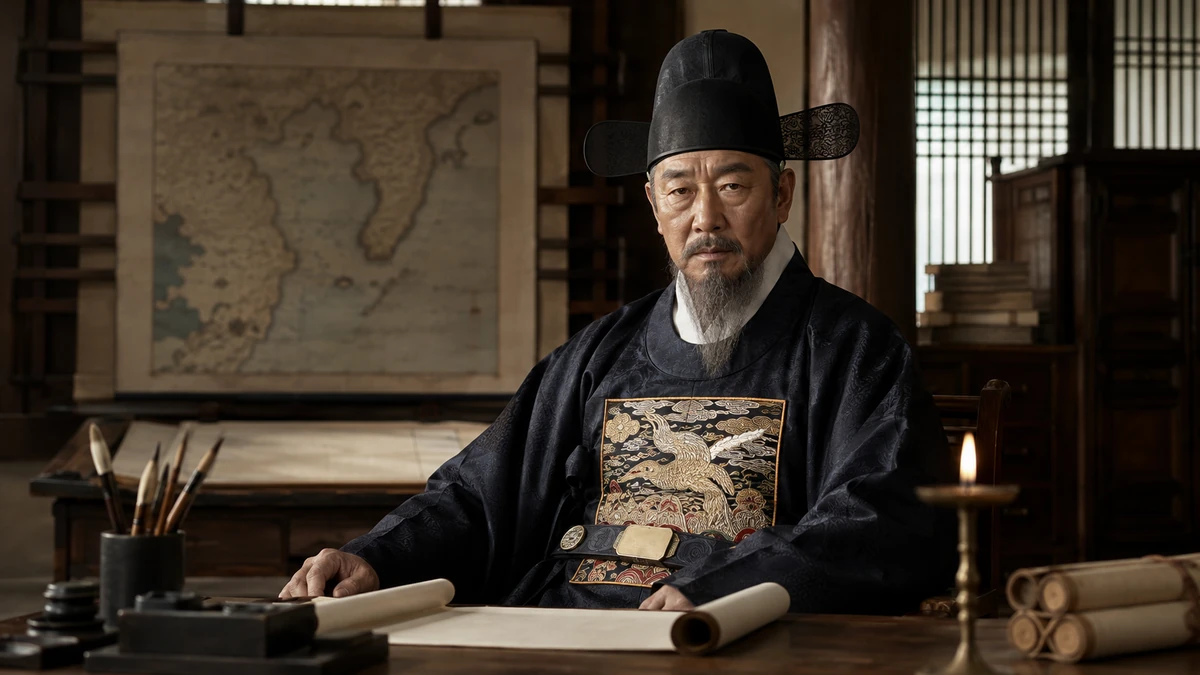
Image to help understand the article
A Crisis Manager Remembered for His Regrets
More than four centuries after Japanese forces invaded the Korean Peninsula, Ryu Seong-ryong remains one of the most compelling figures in Korean political history: a senior official who helped hold a collapsing government together, promoted commanders who changed the course of the war and later documented the failures that had left his country exposed. His story is not simply a heroic account of leadership under fire. It is also a case study in how political loyalty, factional pressure and wishful thinking can distort national security decisions.
Ryu served during the middle of Korea's Joseon dynasty, a Confucian kingdom that governed the peninsula for centuries. When Japan invaded in 1592, the royal court was forced to flee north, military defenses broke down and civilians endured years of devastation. Ryu eventually became the government's chief minister and oversaw military and civilian affairs during much of the emergency. Korean historians have described him as a statesman who helped rebuild the country's shattered landscape.
Yet Ryu had also supported the more reassuring of two contradictory reports about the likelihood of a Japanese attack. That decision helped bring official preparations to a halt shortly before the invasion. The tension between those two parts of his record — misjudgment before the war and exceptional service during it — is central to his legacy. It also explains the lasting importance of his wartime account, the Jingbirok, commonly understood as a record of reflection and warning. Rather than erase the government's failures, Ryu preserved them as lessons for those who came after him.
From Confucian Prodigy to Broad-Minded Scholar
Ryu was born in 1542 in what is now the southeastern region of South Korea. The traditional account places his birth on the first day of the 10th lunar month, a reminder that Joseon society organized ceremonial and family life around the lunar calendar rather than the modern Western calendar. He belonged to the Pungsan Ryu clan, part of the lineage system through which elite Korean families traced ancestry and maintained social identity.
Like other prominent Joseon scholars, Ryu is known by several names. His courtesy name was I-gyeon, while his pen name was Seoae. He later received the posthumous title Munchung. Such names were not casual aliases. In the Confucian scholarly world, they marked stages of adulthood, intellectual identity and official remembrance. For American readers, the closest analogy may be the way a public figure can be known through a formal title, a professional identity and a historical epithet, although the Joseon naming system carried much greater ritual significance.
Ryu gained a reputation as a prodigy after reportedly reading the Confucian classic known as the Great Learning at age 3. As a teenager, he encountered the writings associated with Wang Yangming, the influential Chinese thinker whose teachings emphasized moral knowledge and action. Ryu initially showed interest, but his intellectual direction changed under Yi Hwang, better known by his pen name, Toegye. Yi was one of Korea's most revered Neo-Confucian philosophers and rejected the Wang Yangming school as a threat to orthodox learning.
Ryu accepted his teacher's criticism without discarding every useful idea he had encountered. That combination of doctrinal discipline and selective pragmatism would characterize much of his career. Although deeply trained in Neo-Confucian thought, he did not treat scholarship as an abstract pursuit. He studied ritual and music as tools of social order, but he also examined military administration, public finance, writing and calligraphy. In modern terms, his education crossed the boundaries between political theory, economic management, defense policy and the humanities.
Government Service in an Age of Factional Conflict
Ryu entered government through Joseon's civil service examination system. The exams tested mastery of Confucian texts and literary composition and functioned as the principal route into the elite bureaucracy. The system was merit-based in theory, but access to years of classical education heavily favored families with status and resources. It combined features that Americans might associate with a competitive federal examination, an Ivy League credential and membership in a governing class.
After passing preliminary and higher examinations in the 1560s, Ryu advanced through offices responsible for royal documents, historical records, personnel, education, law and diplomacy. He traveled to Ming China as part of an official mission and reportedly earned respect among Chinese intellectuals. That relationship mattered because Joseon operated within a regional diplomatic order centered on the Ming dynasty. Korea governed itself, but its security and foreign policy were deeply connected to China, especially during the coming war with Japan.
Ryu's rise coincided with the formation of political factions known as the Easterners and Westerners. These were not political parties in the American sense. They lacked mass memberships, election platforms and modern campaign organizations. Instead, they were networks of scholar-officials divided by personal ties, appointments, philosophical lineages and competing interpretations of proper government. Because access to the king shaped careers and policy, personnel disputes could grow into ideological confrontations with life-or-death consequences.
Ryu joined the Easterners in the 1570s. The faction later fractured over how severely to punish Jeong Cheol, a senior Westerner associated with a sweeping political purge. Hard-liners demanded execution, arguing that victims and their families deserved justice. Ryu and other moderates opposed killing a former chief state councilor and favored exile or leniency. The hard-line camp became known as the Northerners, while the moderates formed the Southerners, with Ryu emerging as one of their central figures.
The labels can be misleading to outsiders. They did not represent straightforward geographic blocs, nor do they map neatly onto liberal and conservative politics in the United States. The conflict instead illustrates how a bureaucracy governed by shared Confucian ideals could still be consumed by patronage, retaliation and disputes over moral legitimacy. Ryu's preference for restraint distinguished him from rivals, but it did not free him from factional calculation.
The Intelligence Failure Before the Japanese Invasion
Ryu showed foresight in several decisions before the war. When Japan sent a message concerning the movement of its forces toward Ming China, another senior official favored ignoring it. Ryu argued that the communication had to be reported to the Ming government. After the invasion began, that disclosure helped counter suspicions that Joseon and Japan might have secretly cooperated against China. It was an early recognition that alliance management depends not only on military capability but also on transparency and credibility.
He also recommended several military leaders when King Seonjo asked for capable commanders in 1591. Among them were Kwon Yul and Yi Sun-sin, who would become two of the best-known Korean commanders of the war. Yi, an admiral whose naval victories disrupted Japanese operations, occupies a place in Korean public memory comparable in stature — though not in biography — to the reverence Americans reserve for foundational military figures. Ryu had known Yi and Yi's family from an early age, and personal connections apparently influenced the recommendation. The result, however, placed an extraordinarily capable officer in a position where he could alter the war.
Ryu's gravest prewar error came from a diplomatic mission sent to evaluate Japan. The two leading envoys returned with opposing assessments. Hwang Yun-gil warned that an invasion was imminent. Kim Seong-il said there was little cause for concern. Another delegate aligned with Ryu's Eastern faction supported Hwang's warning, meaning the evidence did not break cleanly along partisan lines. Even so, Ryu backed Kim, a fellow Easterner, and the court settled on the less alarming conclusion. Defensive preparations were discontinued.
Japan invaded in 1592. The speed of the offensive exposed the weakness of Joseon's readiness, and the royal court fled toward Uiju near the Chinese border. Ryu initially lost office after critics blamed him for supporting the report that had minimized the danger. It is the kind of intelligence failure familiar to many countries: leaders receive conflicting assessments, choose the one that better fits their expectations and discover too late that uncertainty was not a reason for inaction.
The lesson is more complicated than saying Ryu ignored all warning signs. His earlier handling of Japan's diplomatic message showed that he understood the stakes. His recommendation of talented commanders suggested concern about military capacity. The failure lay in how political identity and judgment interacted when officials had to decide whether a threat was immediate. His record demonstrates that intelligent and experienced policymakers can make catastrophic choices without being indifferent to national security.
Running a Government During National Collapse
After his dismissal, Ryu was soon recalled. He served as a regional wartime coordinator and later took on responsibility for military affairs across four provinces. As chief state councilor, the highest-ranking official under the king, he helped manage both the government and the war effort. His work included gathering provisions, assessing conditions among civilians, appointing personnel and coordinating with Ming forces that entered the conflict on Joseon's side.
At Anju, Ryu questioned residents directly about their circumstances and worked to secure military supplies. When he met the Ming commander Li Rusong, he provided a map of Pyongyang to assist operations there. These details help explain why his reputation recovered despite the disastrous prewar decision. He was not remembered merely as a court theorist issuing instructions from safety. He became an administrator confronting shortages, displacement, battlefield confusion and the practical demands of coalition warfare.
One episode from the royal flight captures his instinct for preserving order amid humiliation. Ryu encountered the defeated commander Yi Il wearing inadequate clothing and straw shoes. Before the king could see him in that condition, Ryu arranged for the officer to receive a proper military robe and join the procession. The gesture may appear cosmetic, but status and ritual were essential components of authority in Joseon society. Restoring the commander's appearance helped protect the dignity of a government whose legitimacy was visibly unraveling.
Ryu also remained connected to Admiral Yi Sun-sin's turbulent career. In 1597, Yi was accused of serious wrongdoing, stripped of command and threatened with execution. The historical record offers conflicting accounts of Ryu's conduct. In the Jingbirok, Ryu said he defended the admiral before the king and became vulnerable to attacks because he had recommended him. The official royal chronicle, however, records Ryu as saying that his recommendation reflected a failure to judge the man correctly and suggests he went along with the case against Yi.
Other officials intervened, and Yi escaped execution. After serving as a common soldier, he returned to command and again played a decisive role, including at the Battle of Myeongnyang. The contradiction in the sources prevents a simple verdict on Ryu. It also makes his story more valuable. Political memoirs, official chronicles and later reputations do not always align, especially when powerful figures are defending their choices after a crisis.
What Ryu's Story Means for the United States
For American readers, Ryu's life offers more than a window into Korean history. It provides a distant but recognizable example of problems that continue to shape U.S. policy: how governments process warnings, how political camps influence supposedly objective assessments and how allies maintain trust when military intentions are uncertain.
The United States and South Korea are now treaty allies, a relationship created in a radically different era and under modern international law. Ryu's world of royal courts, tributary diplomacy and handwritten envoys should not be equated directly with today's alliance. Still, his insistence on informing Ming China about Japan's message carries a durable strategic principle. Allies need timely disclosure, particularly when one country's actions could be interpreted as cooperation with a potential adversary. Washington and Seoul regularly operate in a region where signaling, intelligence sharing and perceptions of credibility matter alongside weapons and troop strength.
His failure before the invasion is equally relevant to an American audience accustomed to postmortems of Pearl Harbor, the Sept. 11 attacks and other national security shocks. The comparison is not that these events were identical. They were not. The useful parallel is institutional: warnings rarely arrive as a single, uncontested prediction. Officials must evaluate contradictory reports, personalities and political incentives. A government can possess pieces of accurate intelligence and still fail to act.
Ryu's legacy also matters as Korean historical storytelling reaches audiences far beyond the peninsula. American viewers and readers often encounter premodern Korea through sweeping palace dramas, war films and stories centered on Admiral Yi. Understanding the bureaucracy behind the battlefield adds depth to those narratives. Joseon was not simply a kingdom of monarchs and warriors. Scholar-officials controlled appointments, taxation, ritual, diplomacy and military administration, and their factional conflicts could determine whether warnings reached the throne or disappeared in political argument.
For U.S. media and entertainment companies seeking Korean stories, Ryu represents the kind of morally complicated historical figure who travels well across cultures. His arc resembles the political drama of an official who contributes to a preventable failure, becomes indispensable during the emergency and then tries to shape the historical record. But responsible adaptation would require preserving the Korean context rather than turning the factions into modern American parties or reducing Confucian governance to palace intrigue.
American fans of Korean culture may also find in Ryu a counterpoint to the conventional lone-hero narrative. Admiral Yi's battlefield achievements are dramatic and immediate. Ryu's contribution involved logistics, appointments, diplomatic communication and reconstruction — the less cinematic machinery that allows a state to survive. His career highlights a truth familiar to the American defense establishment and emergency management agencies: wars and disasters are decided not only by bravery but also by supply chains, reliable information and competent public administration.
A Fall From Power and a Disputed Record
Ryu's wartime standing did not protect him from the factional struggles that had defined his career. In 1598, a Ming official accused Joseon of conspiring with Japan to attack China. Ryu was criticized by Northern faction rivals for not personally going to explain the matter. He was stripped of office on the same day as the Battle of Noryang, the final major naval battle of the war.
He withdrew to his home region near Andong. Although his status was restored in 1600 and the government repeatedly called him back, he declined to return. The ending reinforces the instability of Joseon political life. A chief minister could direct a national war effort and still be removed through accusations tied to diplomacy and factional rivalry.
Modern readers should resist treating Ryu either as a flawless savior or as the official responsible for Korea's unpreparedness. Both interpretations flatten the record. His support for the wrong prewar assessment had enormous consequences. His later administration also helped a devastated kingdom continue functioning. His recommendation of Yi Sun-sin proved historically consequential, but the evidence concerning his defense of the admiral is contradictory. Even his moderation in domestic politics can be read as principled restraint, strategic calculation or some combination of the two.
The Enduring Power of a Written Warning
Ryu's greatest contribution may be the decision to leave behind an account shaped by the idea of learning from disaster. The title Jingbirok is associated with admonition and remembrance: looking back at past trouble so that future generations remain alert. In that sense, the work belongs not only to Korean literature but also to a global tradition of public officials writing after catastrophe to explain what happened and what should never happen again.
Such documents are never neutral. Ryu wrote as a participant with a reputation to defend, and his version of the case against Yi Sun-sin conflicts with the royal chronicle. Yet that tension does not diminish the book's value. It encourages readers to compare sources, examine motive and distinguish memory from contemporaneous documentation. Historians often learn as much from the gaps between accounts as from points of agreement.
Ryu's life ultimately shows why societies need honest institutional memory. Governments naturally celebrate victories and heroic commanders. It is harder to preserve records of ignored warnings, factional bias and failed judgment. By linking his service to reflection on those failures, Ryu helped make the Japanese invasions more than a story of survival. They became a warning about readiness, leadership and the cost of allowing political allegiance to overtake evidence.
That warning remains legible in the United States and anywhere else officials must make decisions before uncertainty disappears. The central question is not whether leaders can predict every attack. They cannot. It is whether they build institutions capable of taking dissenting assessments seriously, preparing for costly possibilities and acknowledging mistakes after the danger has passed. Ryu Seong-ryong's legacy endures because he stood on both sides of that question: first as a statesman who misjudged the threat, and then as one who helped rescue the country from the consequences.
Comments
Post a Comment