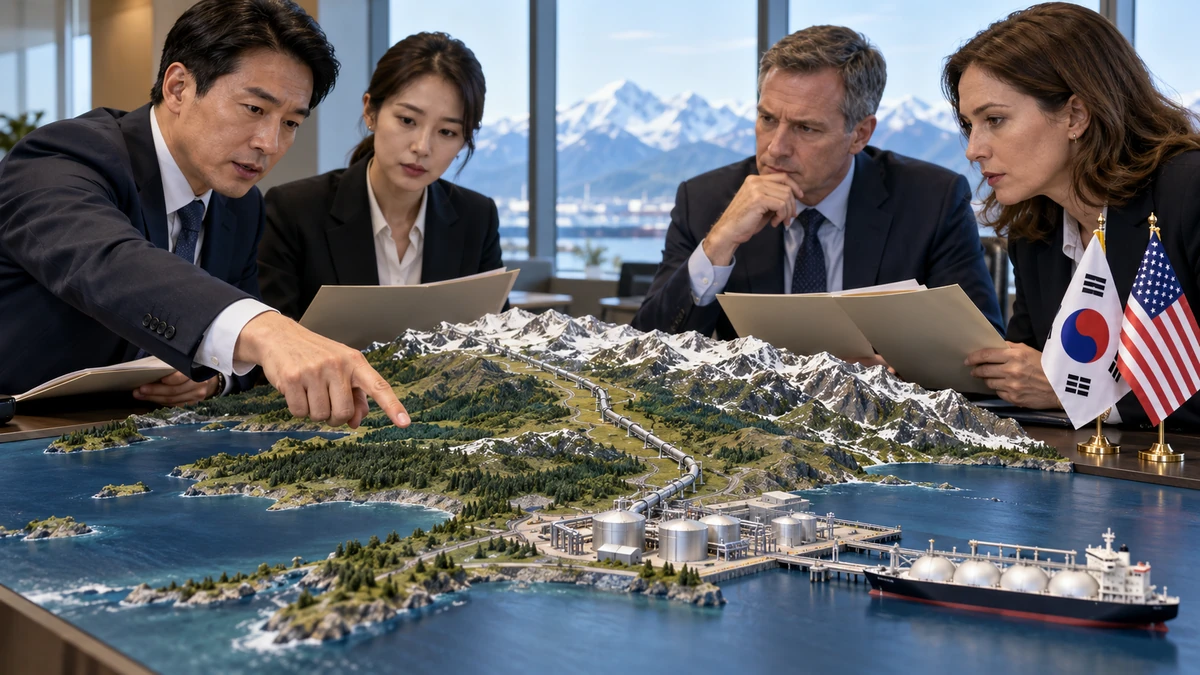
Image to help understand the article
Alaska energy cooperation remains conditional
The United States and South Korea have agreed to begin work on possible cooperation in the Alaska liquefied natural gas project, but any participation depends on the project’s commercial viability and compliance with both countries’ domestic laws, according to a U.S. government document released Sept. 30.
The language appears in a fact sheet from the U.S. Commerce Department outlining strategic investment projects between the allies. South Korea’s Ministry of Trade, Industry and Energy also said it would review the project under those conditions, emphasizing that neither an investment decision nor an investment amount has been finalized.
For South Korea, commercial viability means determining whether expected revenue over the life of the project would be sufficient to repay the principal and interest on its investment. Industry Minister Kim Jung-kwan said the government would proceed only if that standard is met.
Trump presents project as part of broader investment push
President Donald Trump said the same day that South Korea was preparing to begin investments of up to $200 billion in the United States. He identified the Alaska LNG project, eight nuclear reactors and a natural gas-fired power project in Texas as potential investments.
In a Truth Social post, Trump said the two countries had agreed to begin cooperation on a $50 billion Alaska LNG project. His post did not mention the commercial and legal conditions contained in the U.S. fact sheet. The official document also did not say South Korea had made a final investment decision or committed a specific amount.
The fact sheet said the United States would support participation by South Korean companies and suppliers. It also said Washington would seek, where possible, to ensure South Korea could buy Alaska-produced LNG at commercially viable prices and receive priority access.
Financing still needed before construction
Glenfarne Group CEO Brendan Duval said construction could begin once financing is secured. He estimated that building the pipeline would take three years and that LNG exports could begin in about five years.
The project has not completed financing or reached a final investment decision, and it has gone through repeated efforts and delays over several decades. Trump’s presentation of the conditional agreement as a firm achievement has also drawn attention because Alaska was considered a competitive Senate state with the midterm elections about a month away.
Texas power plant and nuclear projects
The bilateral plans also include a $22.3 billion combined-cycle natural gas power plant in Encinal, Texas. The first phase is scheduled to begin commercial operations in 2029, with the full facility targeted for operation in 2032.
The two governments also agreed to pursue construction of eight large nuclear reactors in the United States, with South Korean investment capped at $120 billion. Two reactors would use South Korea’s APR1400 design. The countries also plan to explore South Korean companies acquiring a 5% to 10% stake in Westinghouse.
Comments
Post a Comment