
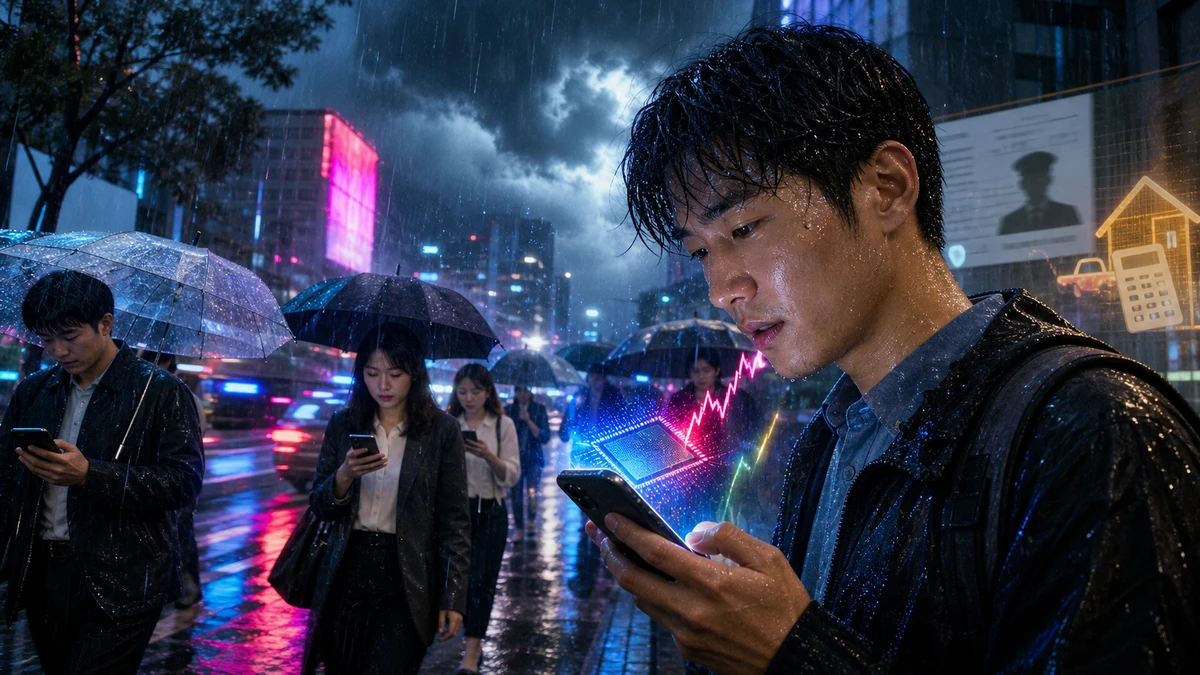
Image to help understand the article
Google search trends offer a revealing snapshot of modern South Korea
On any given day, a list of trending Google searches can look like digital clutter: a weather term, a government agency, a celebrity name, a tax phrase, a highway, an unexplained number. But taken together, these spikes in attention often function like a social seismograph, picking up tremors before outsiders notice the larger pattern. That was true in South Korea on Sept. 1, 2026, when the country’s real-time Google trending searches captured a cross-section of public anxiety and practical need: torrential rain, military service, property taxes, retail disputes, a bereavement in the entertainment world and an international energy headline involving Venezuela and the United States.
The top Korean search terms that day were not dominated by a single celebrity scandal or one major breaking political event. Instead, they reflected something more textured and arguably more important: how people in South Korea navigate daily life in a country where state policy, seasonal risk, family obligation and global markets all press closely against one another. Two of the biggest search surges, according to Google’s approximate figures, were for “jangma,” the Korean term commonly used for the summer rainy season, and “000660,” a numeric keyword whose exact trigger could not be confirmed from the headlines available. Close behind were searches for the Military Manpower Administration, known in Korean as the 병무청, and for the comprehensive real estate holding tax called the 종합부동산세.
For American readers, this matters for more than curiosity’s sake. South Korea is one of the United States’ closest treaty allies, a major technology exporter, a critical cultural powerhouse and an increasingly familiar reference point in American life through K-pop, Korean film, television, beauty brands, food and semiconductors. A seemingly narrow story about Korean search behavior can therefore tell us something broader about the pressures shaping one of America’s most important partners in Asia.
Just as trending searches in the United States might swing from hurricane warnings to IRS deadlines to NFL injuries to Federal Reserve speculation, Korea’s search data can reveal where public attention is moving between immediate survival concerns and longer-running structural pressures. What stands out in this particular Korean snapshot is not just the variety of topics, but the coexistence of clearly explainable spikes driven by policy or weather and other terms whose rise is harder to account for from public reporting alone. That combination is a reminder that in the age of algorithmic attention, not every public concern arrives neatly labeled.
Still, the broad contours are clear. Korea on that day was searching for answers about danger from above, in the form of heavy rain; duty to the state, in the form of military service; cost of ownership, in the form of property taxes; and uncertainty in markets, from retail tenancy to international oil. In other words, the search list looked less like entertainment-driven distraction and more like a concentrated portrait of a highly wired society reacting in real time to the demands of modern life.
Rainfall, not just rainfall season, drove one of the day’s biggest spikes
The term “jangma” ranked among the day’s strongest Korean searches, with Google indicating roughly 2,000-plus searches. For non-Korean readers, jangma refers to the East Asian monsoon period that typically brings sustained seasonal rain to the Korean Peninsula. It is more than a weather term. In Korea, as in parts of Japan and China with their own monsoon rhythms, rainy-season language carries practical, emotional and even economic weight. It can shape commuting, school schedules, agricultural planning, flood response and consumer behavior.
What made this search spike especially notable was timing. Sept. 1 sits at the edge of seasonal transition, when many people expect summer to be winding down. Yet Korean reports said a “second rainy season” system had shifted toward central regions, bringing heavy downpours on the first day of September. KBS reported intense rainfall in Taean, in South Chungcheong Province, with hourly precipitation topping 70 millimeters and warnings about flooding risk. Other weather reports described a split-screen country, with heavy rain in some areas and heat advisories in the south.
To Americans, the dynamic may sound familiar. It resembles the way searches spike in the U.S. when a storm system arrives outside the expected calendar window — a late-season heat wave in the Northeast, a surprise atmospheric river in California or a tropical system that forces residents to suddenly reassess whether the season really ended when they thought it did. These are not abstract climate searches. They are functional searches: Is my commute safe? Will my basement flood? Are schools closing? Should I cancel plans? Is this a one-day storm or something bigger?
That distinction matters. The Korean search surge around jangma appears to have been driven less by broad seasonal curiosity than by immediate safety concerns. In a country with dense urban development, heavy reliance on public transit and fresh memories of extreme weather in recent years, sudden rain can quickly become a public-safety issue. A trending weather term in Korea often means people are looking for localized information, not simply checking the forecast for convenience.
It also underscores a larger trend visible around the world, including in the United States: weather is no longer experienced as routine background information. It increasingly behaves like breaking news. The more climate volatility unsettles familiar seasonal expectations, the more people turn to search engines for minute-by-minute interpretation. Korea’s Sept. 1 trend list suggests that weather remains one of the most reliable drivers of mass public attention precisely because it cuts across politics, class and age. Everyone needs to know if the roads flood, the trains slow and the sky opens up on the way home.
Military service remains one of the clearest windows into Korean society
The second major explanatory trend came from searches for the Military Manpower Administration, after news reports said the agency had announced the selection of 1,837 people for KATUSA service in 2027, with an average competition rate of 8.8 to 1. One monthly intake reportedly drew an even steeper ratio of 10.9 to 1. In South Korea, where most able-bodied men are required to perform military service because the country technically remains at war with North Korea, this is not a niche bureaucratic issue. It is a defining part of social life, career timing and family planning.
KATUSA, short for Korean Augmentation To the United States Army, is especially meaningful in the U.S.-Korea context. The program places selected South Korean conscripts in units alongside the U.S. Army. For many Korean applicants, KATUSA carries prestige because of its connection to the American military, the potential for English-language exposure and the perception that it can shape later educational or career opportunities. Competition has long been intense.
To an American audience, the closest comparison is not an exact one, because the United States does not have universal conscription. But the public attention resembles what happens when a high-stakes federal pathway opens or closes: a military academy announcement, a selective public-service appointment, or a visa and immigration rule that suddenly affects thousands of families. Once a number is released — how many slots, what the odds are, when the process starts — people rush to confirm details.
The search spike around the Military Manpower Administration therefore tells us something deeper than the popularity of a government website. It points to the enduring centrality of compulsory service in Korea’s social structure. Military duty affects college timelines, employment planning, dating and marriage expectations and intergenerational family conversations. News about selection numbers and competition ratios can instantly activate large networks of applicants, relatives and peers.
For Americans who know South Korea primarily through BTS, Oscar-winning cinema or globally successful dramas, this is a useful reminder that beneath the country’s cultural modernity sits a hard geopolitical reality. Korea’s popular culture may be globally mobile, but Korean citizenship still carries obligations rooted in unresolved regional security tensions. On a day when Koreans were also searching for rain and taxes, they were simultaneously searching for one of the most enduring facts of national life: who serves, where and under what odds.
Tax policy and housing pressure continue to command public attention
Another of the day’s strongest searches concerned the comprehensive real estate holding tax, after reports said the government had scrapped a proposal to reduce the basic deduction for nonresident owners of a single home and would instead maintain the 1.2 billion won threshold. Other coverage said the baseline deduction had effectively been restored from 900 million won to 1.2 billion won, and that caps on tax burden had also been reverted.
Even without knowing every technical detail of Korea’s tax code, the pattern is easy to recognize for American readers: housing policy creates instant search demand whenever the government changes who pays, how much and under what definition of ownership. In the U.S., a mortgage-rate move, a property-tax reassessment, a change to capital gains rules or a federal housing credit can trigger the same kind of scramble for clarification. Homeowners want to know whether they are exposed. Prospective buyers want to know whether they should wait. Investors and expatriates want to know whether the rules still work in their favor.
In Korea, housing carries especially intense political and emotional significance. Real estate has long been one of the country’s most sensitive economic issues, particularly in and around Seoul, where prices, household debt and perceptions of generational fairness have repeatedly become flashpoints. Tax changes tied to home ownership are rarely experienced as abstract fiscal policy. They are treated as signals about who the state intends to protect, discipline or accommodate in a tight and unequal market.
The search interest in this case appears to have been driven by the reversal of a proposed reduction for nonresident single-home owners. That kind of change can matter to Koreans living abroad, families maintaining one property while working elsewhere and people whose residency status intersects awkwardly with tax obligations. It is precisely the sort of policy tweak that sends affected households to search engines immediately.
What matters analytically is not just that the term trended, but why it trended. It rose because the public believed the policy had direct consequences. That places it in a different category from curiosity-driven or celebrity-driven searches. It belongs to the class of “tell me what this means for me now” terms, which often reveal the true points of social pressure in a digitally connected society. If weather searches reflect fear of immediate physical disruption, tax searches reflect fear of financial disruption. Both are practical. Both are urgent. Both expose how much of daily life depends on rapidly digesting government decisions.
A bereavement in musical theater shows how Korean entertainment fandom also works
The name Kim Sun-young also appeared among the day’s top searches following reports of the musical actor’s father’s death and a casting change connected to the production “Dear Evan Hansen.” News accounts said she would observe the loss privately with family, and that her husband, Kim Woo-hyung, was at the funeral hall. Given the sensitivity of bereavement reporting, the available facts should remain narrow, and the significance of the trend is best understood through media behavior rather than speculation about private grief.
For American readers, one useful point of context is that South Korea’s entertainment ecosystem is not limited to K-pop idols and television stars. Musical theater also commands loyal audiences, and casting changes can become highly visible to fans who follow productions closely. A performer’s personal news can therefore quickly spill into ticketing, schedules and online discussion, much as it would on Broadway if a major actor unexpectedly withdrew from a production because of a family emergency.
The appearance of this search term alongside taxes, military administration and severe weather also says something about the breadth of Korean search culture. Korean users often move seamlessly between hard news and arts coverage because both are distributed through the same highly interconnected portal and mobile ecosystems. The result is a public sphere where a tax-code headline, a weather emergency and an entertainment casting update can all compete for attention within hours.
That does not make them equal in consequence. But it does mean that understanding Korean digital life requires abandoning simplistic assumptions about what “trends” represent. A trending list in Korea is often less a popularity contest than a compressed bulletin board of whatever people need to check, confirm or emotionally process at that moment.
Some trending terms remain opaque — and that ambiguity is part of the story
Not every search surge came with a clean explanatory headline. The top-ranked numeric term “000660” showed roughly 2,000-plus search volume, but the available headline set did not establish why it rose. The same was true, to a lesser extent, for “Yeongdong Expressway,” which appeared with a modest volume estimate but without enough reporting in the provided material to confidently tie it to one incident or traffic condition. A search term linked to the newspaper Dong-A Ilbo also rose, even though the directly associated headlines focused on pension contributions by foreigners and did not clearly explain why the media outlet’s name itself trended.
There is a temptation in digital journalism to force every metric into a story line, but in this case restraint is the more responsible approach. Trending data is suggestive, not self-explanatory. A term can rise because of a developing news story, an online rumor, a market move, a social-media post, a television segment or even a feedback loop created when people begin searching because they see that others are searching. Without verified reporting, assigning causation risks turning analytics into fiction.
That uncertainty is itself revealing. It shows the limits of headline-based interpretation in a real-time information environment. Even in one of the world’s most connected democracies, not every burst of public attention can be neatly translated into a documented event by day’s end. Some spikes remain partially hidden, especially if they originate in finance communities, platform-native conversations or niche audiences before broad media coverage catches up.
For journalists, analysts and readers in the United States, this is a useful caution. Americans increasingly live with the same phenomenon. A ticker symbol, a county name, a phrase from a court filing or an unexplained celebrity reference can explode on search and social platforms long before conventional reporting clarifies what happened. Korean search data on Sept. 1 illustrates that this ambiguity is no longer an exception; it is a basic feature of the digital public sphere.
What this means for the United States
For Americans, the most important takeaway is that South Korea’s daily search trends are not merely local curiosities. They illuminate pressures inside a country that sits at the center of several U.S. interests at once: security, technology supply chains, consumer culture and energy geopolitics.
Start with the military angle. The KATUSA-related spike is a direct reminder that the U.S.-South Korea alliance is not an abstract diplomatic phrase but a lived institutional relationship that shapes Korean households. American troops remain on the peninsula, and programs tied to that presence still carry social prestige and practical significance. When Korean families track KATUSA selection odds, they are in part tracking one way their own lives intersect with America’s long-standing military footprint in East Asia.
Then consider the unexplained numeric search term, “000660.” While the source material does not confirm why it trended, American business readers may recognize that number as the stock code for SK hynix on the Korea Exchange. Because the available reporting does not establish causation, it would be wrong to say that was definitively the reason for the surge. But the very possibility highlights why U.S. readers should watch Korean attention data closely. South Korea is a major player in semiconductors, batteries and advanced manufacturing. Search spikes involving Korean corporate identifiers can matter well beyond Seoul because American companies, investors and consumers are deeply exposed to Korean industrial performance.
The property-tax search is relevant to Americans for a different reason. South Korea has become one of the world’s most closely watched case studies in how high-pressure housing markets reshape politics, family formation and middle-class expectations. U.S. cities from New York to Los Angeles to Seattle wrestle with their own versions of affordability strain, tax burdens and the tension between owner protection and market fairness. Korea’s policy reversals do not map neatly onto the American system, but they reflect a familiar democratic reality: once housing becomes a source of intergenerational anxiety, tax language turns into headline news.
Even the weather spike deserves U.S. attention. South Korea’s search response to severe rain mirrors how Americans increasingly consume climate risk — through urgent, behavior-changing checks of forecasts, flooding alerts and local advisories. Korea’s digital responsiveness can offer a preview of how densely connected societies react when weather volatility blurs the line between seasonal expectation and emergency management.
And finally there is the culture angle. The Kim Sun-young search, tied to bereavement and a cast change in “Dear Evan Hansen,” underscores how deeply Western and Korean entertainment ecosystems now overlap. An American musical title sits inside a Korean news cycle, and Korean audiences respond to theater casting with an intensity that American readers will recognize from Broadway fandom. Cultural exchange between the two countries is no longer one-way, and audience habits increasingly travel in both directions.
In short, Korea’s search list matters in the U.S. because it reveals a partner country whose domestic concerns are tightly interwoven with American strategic, economic and cultural life. Americans do not need to follow every Korean trending keyword. But they should pay attention to the pattern those keywords create.
The broader trend is a public searching for immediate answers in an age of constant pressure
What changed on Sept. 1 was not Korea itself so much as the visible arrangement of its anxieties. The day’s search list showed a public turning to the internet not mainly for diversion, but for actionable information. Rain threatened commutes and flooding. Military selection numbers affected future plans. Tax policy touched household balance sheets. Retail and eviction-related stories spoke to commercial instability. A Venezuela oil headline pointed outward to the global energy system. Together, those searches form a map of a society under multiple, simultaneous forms of pressure.
That pattern is not uniquely Korean. It is increasingly common in advanced, highly connected economies, including the United States. But South Korea often presents these dynamics in especially sharp form because of its dense urban environment, strong digital adoption, unresolved security situation and outsized role in global cultural and industrial networks. What trends there can sometimes serve as an early, concentrated version of pressures appearing elsewhere.
The lesson for readers is that trend data is most useful when treated less as gossip and more as civic telemetry. On Sept. 1, Korea’s searchers were asking practical questions: Is the rain dangerous? Did the military selection result come out? What did the government decide on taxes? Why was a cast changed? What is happening in retail space? What does the oil news mean? Even the unexplained spikes tell us something: people often sense movement before institutions can fully explain it.
That is why a list of trending terms deserves serious attention. It offers a compressed portrait of what people fear, need and prioritize in real time. In South Korea on this particular day, that portrait was of a country managing climate stress, bureaucratic obligation, economic sensitivity and global interdependence all at once. For Americans trying to understand a close ally beyond the shorthand of K-pop and geopolitics, that may be the most useful insight of all.


0 Comments