Image to help understand the article
A Search List That Reads Like a National News Feed
South Korea’s Google trending searches for Sept. 5, 2026, offered a revealing snapshot of how news, personal finance, severe weather and celebrity culture compete for attention in one of the world’s most connected societies. The terms ranged from international marriage and a high-interest savings account for newborns to storm damage on Jeju Island, a forthcoming Netflix drama and glimpses inside a comedian’s newlywed home.
The list should not be read as a straightforward ranking of the country’s most important issues. Google Trends measures changes in search interest, and the approximate volume attached to each term does not necessarily determine its position. That helps explain an apparent contradiction in the data: international marriage ranked first with roughly 2,000 or more searches, while comedian Kim Jun-ho, listed sixth, had the largest stated volume at more than 10,000. Saemaul Geumgo, a network of community-based financial cooperatives, ranked second with more than 5,000.
Trending data is best understood as a measure of acceleration rather than a public opinion poll. A broad or previously quiet phrase can jump rapidly after several news outlets publish related stories, while a celebrity with a larger baseline audience may accumulate more searches without taking the top position. Search totals also do not show whether users approve of a person, distrust an institution or are simply trying to understand a headline.
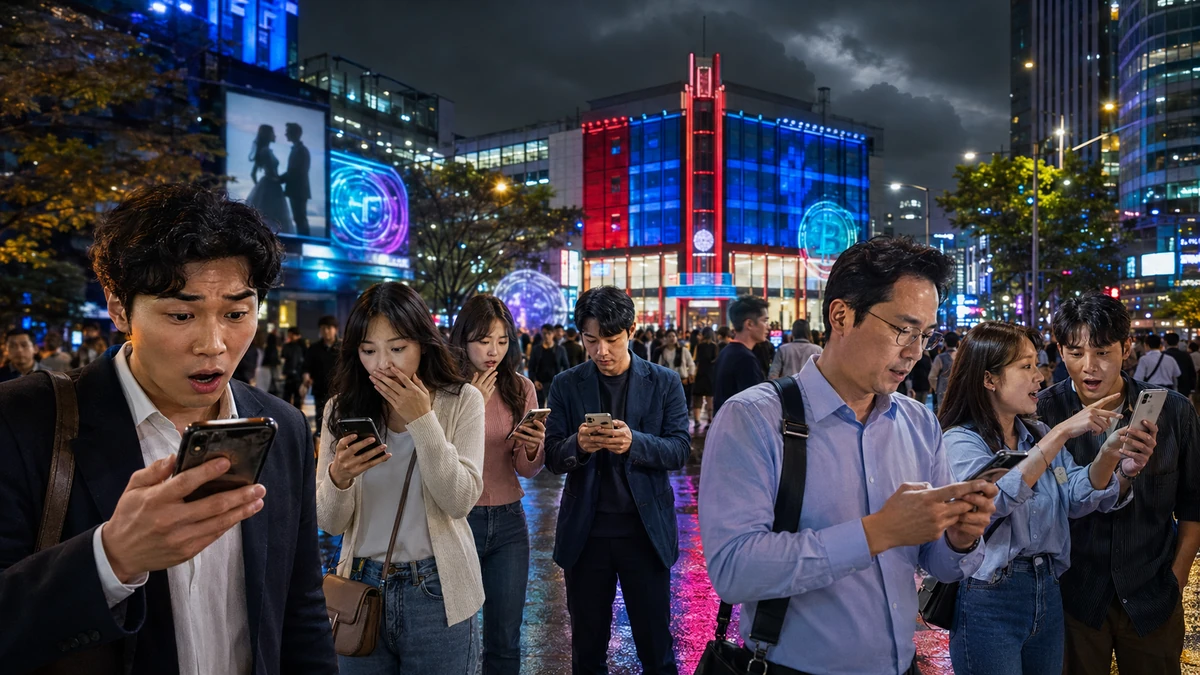
Still, the mix is significant. It captures the fragmented character of modern Korean media consumption: an alleged crime can sit beside a banking product, a weather emergency, a Netflix production and a celebrity fashion item. In the smartphone era, those categories do not occupy separate lanes. They arrive through the same portals, recommendation systems and social feeds, often within minutes of one another.
International Marriage Becomes a Crime-Story Keyword
The top-ranked phrase, international marriage, appears to have surged because of reports about a Korean man in his 50s who died about 90 days after marrying a Vietnamese woman. Headlines referenced a note attributed to the man and allegations that he had complained of violence. The available source material does not establish the full circumstances of his death, determine legal responsibility or provide enough verified information to reach conclusions about anyone involved.
The choice of search term matters. Rather than trending only under a person’s name or a location, the case became attached to an entire social category. In South Korea, the Korean expression commonly translated as international marriage often refers to marriages between Korean citizens and foreign spouses, including unions arranged through commercial brokers. The term is especially associated with some rural communities and smaller cities where population decline and gender imbalances have shaped the marriage market.
Many spouses who migrate to Korea through marriage come from Vietnam, China, the Philippines, Cambodia and other parts of Asia. Korean government and civic institutions often describe these households as multicultural families, a policy term that can provide access to language classes, child care assistance and settlement programs. At the same time, the label can mark families as outsiders in a country that long emphasized ethnic homogeneity as part of its national identity.
That history makes crime coverage involving a foreign spouse particularly sensitive. A single case can reactivate broad debates about marriage brokers, immigration, domestic violence, economic inequality and the social isolation of migrant spouses. It can also encourage stereotyping if headlines emphasize nationality or sensational personal details without sufficient evidence or context.
For American readers, the closest comparison is not simply interracial marriage, which has its own long history in the United States. The Korean discussion combines immigration policy, demographic decline and a commercial matchmaking industry in ways that do not map neatly onto the American experience. The safest conclusion from the search spike is that concentrated news coverage drew attention to the case. It does not demonstrate a national judgment about international couples or Vietnamese immigrants.
A 12% Baby Account and Korea’s Demographic Emergency
The second-ranking term, Saemaul Geumgo, was tied to reports about a savings product for newborns offering an annual interest rate advertised at 12%. News headlines said more than 22,000 people had enrolled in the product, known as the Georeumma Jeokgeum, or Toddler Steps Savings Account.
Saemaul Geumgo is difficult to describe with a perfect American equivalent. Its branches operate as locally rooted financial cooperatives, with a role that resembles a mix of community banks and credit unions. The institution traces its identity to Korea’s village development tradition, and its name contains Saemaul, meaning new village, a phrase closely associated with the government-led rural modernization campaign of the 1970s.
Korean installment savings accounts also work differently from the ordinary savings accounts familiar to many Americans. Customers generally deposit a fixed amount at regular intervals and receive interest after maintaining the account for a specified term. Eye-catching promotional rates may depend on eligibility rules, contribution limits or other conditions, so the headline percentage alone does not reveal how much money a family will ultimately earn.
The newborn focus gives the product broader political meaning. South Korea has spent years confronting an exceptionally low birthrate, later marriage, high housing prices, demanding education costs and a work culture that can make parenthood difficult. Governments and companies have responded with child care subsidies, housing benefits, fertility programs and bonuses for new parents. A financial cooperative offering a premium rate to families immediately after a child’s birth fits that larger competition to make family formation more affordable and publicly visible.
The search interest therefore likely reflects more than a hunt for yield. A 12% figure stands out in any financial environment, but attaching it to newborns connects household budgeting to a national demographic debate. The product becomes both a banking offer and a symbol of how urgently Korean institutions are trying to respond to population decline.
Storm Damage Turns Weather Into a Safety Crisis
A tropical depression ranked third as reports focused on strong winds and damage on Jeju Island, the volcanic island off the southern coast of the Korean Peninsula. Headlines attributed the conditions to the effects of Typhoon Krovahn and reported that a crane toppled at Jeju Port, striking two people. One was described as being in cardiac arrest. Other reports referred to dozens of wind-related incidents, as well as deaths, injuries and rescues, though the limited information provided does not allow a definitive account of the total toll or the precise causes of each incident.
Jeju occupies a place in Korean life somewhat comparable to Hawaii in the American imagination, though the islands differ greatly in size, history and political status. It is a major tourism destination known for beaches, honeymoon travel, citrus farms and Hallasan, South Korea’s highest mountain. It is also directly exposed to weather systems moving north from warmer waters.
Search behavior during a storm often serves a practical purpose. People look for flight cancellations, ferry suspensions, school closures, road conditions and warnings from local authorities. When an industrial accident or serious injury is added to the weather story, a technical phrase such as tropical depression can quickly become a public-safety keyword.
The episode also illustrates why climate and disaster coverage increasingly overlap with infrastructure questions. Cranes, ports, construction sites and transportation systems can become points of vulnerability when strong winds hit densely developed areas. The search spike does not by itself measure concern about climate change, but it shows how quickly a regional weather event can become a national story when images of visible damage circulate online.
Netflix, Hanbok and the Global Packaging of Korean Drama
Entertainment occupied several places on the list. The term scandal, ranked fourth, referred not to a new celebrity controversy but to a Netflix production titled Scandal featuring Son Ye-jin, Ji Chang-wook and Nana. Coverage emphasized images from the set, including Son wearing a fluorescent yellow-green hanbok, Korea’s traditional clothing. Some Korean headlines described the project as an adults-only romance involving dangerous relationships and sexual intrigue.
For viewers outside Korea, Son is widely known from the international hit Crash Landing on You, while Ji has developed a substantial overseas following through action and romance series. Nana first became prominent as a member of the K-pop group After School before building an acting career. Their combined casting gives the project access to overlapping audiences across television drama, streaming and idol fandom.
The hanbok image is more than a costume detail. Traditional Korean clothing has become an increasingly recognizable part of the Korean Wave, appearing in historical dramas, fashion editorials, museum exhibitions and modernized designs worn by pop stars. A neon-colored version generates attention because it blends historical visual language with the high-saturation style favored by contemporary promotional photography.
The keyword also shows the hazards of reading translated trend lists without context. An English-speaking observer seeing scandal might assume a political controversy or misconduct allegation. Korean users, however, may have been searching for a title. Search terms are shaped by language, branding and the way entertainment companies seed images through local media. Understanding the trend requires knowing not only what a word means but how it is being used on that particular day.
Kim Jun-ho produced the largest stated search volume, at more than 10,000, even though he ranked sixth. Coverage focused on a newlywed home he shares with fellow comedian Kim Ji-min, particularly its reported size, Han River view and sightline toward Seoul’s major fireworks festival. In Korean real estate measurements, homes are often described in pyeong, a traditional unit equal to about 35.6 square feet. Reports characterized the home as 77 pyeong, which would be roughly 2,740 square feet, although Korean property descriptions can vary depending on whether they refer to total supplied area or usable interior space.
Celebrity-home stories have an obvious American parallel in Architectural Digest tours, reality television and social media videos showing actors’ kitchens, closets and pools. In Seoul, however, the fascination is intensified by extraordinarily expensive housing and limited space in the most desirable neighborhoods. A large apartment with a Han River view functions as a marker of success much as a Manhattan penthouse or a Los Angeles hillside home does in the United States.
Crime, Cryptocurrency and the Problem With Broad Keywords
Cryptocurrency ranked fifth, but the underlying story was not primarily about markets. Reports said a man in his 40s received a five-year prison sentence for collecting information about North Korean defectors and military officers under instructions from a North Korean operative. Headlines said he was paid more than 600 million won through bitcoin and other digital assets. That amount would be several hundred thousand dollars, depending on the exchange rate.
The case places cryptocurrency within the unresolved security conflict on the Korean Peninsula. South and North Korea remain technically at war because the Korean War ended with a 1953 armistice rather than a peace treaty. Intelligence activity, cyberattacks and attempts to obtain information about defectors or military personnel therefore carry immediate national-security implications in South Korea.
For American readers, the story echoes U.S. cases in which cryptocurrency appears not as the subject of an investment debate but as a payment tool in ransomware, sanctions evasion, espionage or other criminal allegations. The distinction is important. A spike in searches for cryptocurrency does not necessarily signal enthusiasm about bitcoin prices. It may reflect concern about the use of digital assets to move money across borders or obscure financial relationships.
Another trending term, discovery, demonstrates an even greater analytical problem. It was linked to at least two unrelated overseas stories: the reported discovery of 49 gold bars during work on a century-old house, and the discovery of 1,600-year-old human remains inside a jar with a sword. Because discovery is an ordinary word appearing in many headlines, it is impossible to determine from the trend alone which story contributed most to the increase.
The lower portion of the list included searches apparently tied to actress Lee Mi-sook, former rhythmic gymnast Son Yeon-jae and mixed martial arts fighter Jung Chan-sung. Lee’s trend followed entertainment coverage about gaining roughly 3 kilograms, or about 6.6 pounds, and remarks about remarriage. Son’s search interest appeared connected to lifestyle stories about shopping at an upscale department store and wearing a white lace skirt. Jung, known internationally by his nickname the Korean Zombie, had an estimated 500 or more searches, but the supplied headlines did not identify a cause. Without supporting reporting, attributing the increase to a fight, announcement or personal event would be speculation.
What the Search Mix Means for the United States
For American audiences and companies, the most consequential part of the list is the extent to which Korean domestic attention now intersects with global platforms. Netflix is not merely distributing Korean shows after they succeed at home. Its brand appears inside the Korean entertainment news cycle while projects are still being promoted, photographed and discussed. A costume reveal or casting update in Seoul can become marketing material for subscribers in Los Angeles, New York and dozens of other markets.
That creates opportunities and complications for U.S. entertainment businesses. Korean productions have shown that stories rooted in local class divisions, family expectations, historical settings and social anxieties can travel internationally without being stripped of their cultural specificity. American studios once tended to treat subtitled programming as a specialty product. Streaming has trained a much broader audience to cross language barriers, whether through subtitles, dubbing or fan-created commentary.
At the same time, trend data can mislead international marketers if it is separated from Korean context. The word scandal may be a program title rather than a controversy. Interest in Kim Jun-ho may be driven by real estate and marriage content rather than a new comedy project. Cryptocurrency may point to national security rather than investment. Companies using search data to make advertising or acquisition decisions need local-language analysis, not just automated translation.
The international marriage story also has relevance for U.S.-Korea relations because the alliance increasingly extends beyond defense into immigration, education and people-to-people ties. Large Korean American communities maintain family, business and cultural connections across the Pacific, while Americans live, study and serve in the military in South Korea. Responsible coverage of migration and cross-border families matters in both countries, particularly when an individual tragedy risks being generalized into suspicion of an entire nationality or type of marriage.
The severe-weather trend has a bilateral dimension as well. The United States and South Korea cooperate on scientific research, disaster response and climate-related technology, while airlines, tourism companies and supply chains depend on accurate information about storms affecting the peninsula. Jeju may be geographically distant from most Americans, but disruptions at Korean ports and airports can ripple through travel plans and commerce.
American financial companies should view the popularity of the newborn savings account less as a product ready for direct imitation than as evidence of demand for targeted, easy-to-understand family benefits. The United States has its own debates over child tax credits, paid leave, education savings accounts and the cost of raising children. Korea’s approach reflects its institutions and demographic urgency, but the underlying consumer question is familiar: Can public policy and private finance reduce the economic penalty of becoming a parent?
What to Watch Beyond a Single Day
The most important trend is not that one celebrity or headline dominated for several hours. It is that Koreans are using search engines as a bridge among urgent information, financial decision-making and entertainment participation. The same person may check a storm warning, compare a savings account, read about an alleged crime and look up a Netflix cast before lunch. News organizations and technology platforms package all of those impulses into a shared attention economy.
Several questions will determine whether these searches represent lasting developments. Investigators and journalists may establish more verified facts in the death associated with the international marriage keyword, allowing the public to distinguish evidence from sensational framing. Consumers will want to know the full conditions and practical returns of the newborn account, not merely its maximum advertised rate. Authorities will assess the extent of the Jeju damage and whether infrastructure or workplace protections failed during the storm.
For the entertainment industry, the test is whether online attention around Scandal translates into sustained viewership in Korea and abroad. Global casting recognition and striking images can produce an initial burst of curiosity, but international success depends on storytelling, distribution, dubbing, subtitles and the recommendation systems that determine what appears on American screens.
The list also offers a warning about using search rankings as a substitute for reporting. Approximate volumes are not exact audience counts. A trend is not an endorsement. A repeated word may combine unrelated stories. The absence of linked headlines, as in Jung Chan-sung’s case, should lead to restraint rather than imaginative explanations.
Viewed carefully, however, the Sept. 5 data provides a compact portrait of contemporary South Korea: globally connected but intensely focused on domestic safety, fascinated by celebrity lifestyles yet anxious about housing and family costs, enthusiastic about financial opportunities while alert to security threats. For Americans following the Korean Wave, that broader context matters. Korean culture reaches the United States not only through polished music videos and streaming dramas, but through the social pressures, consumer habits and everyday concerns that shape what Koreans choose to search for in the first place.
Comments
Post a Comment