What South Korea’s Google Searches Reveal About Celebrity, Global Risk and the Reach of Korean Pop Culture
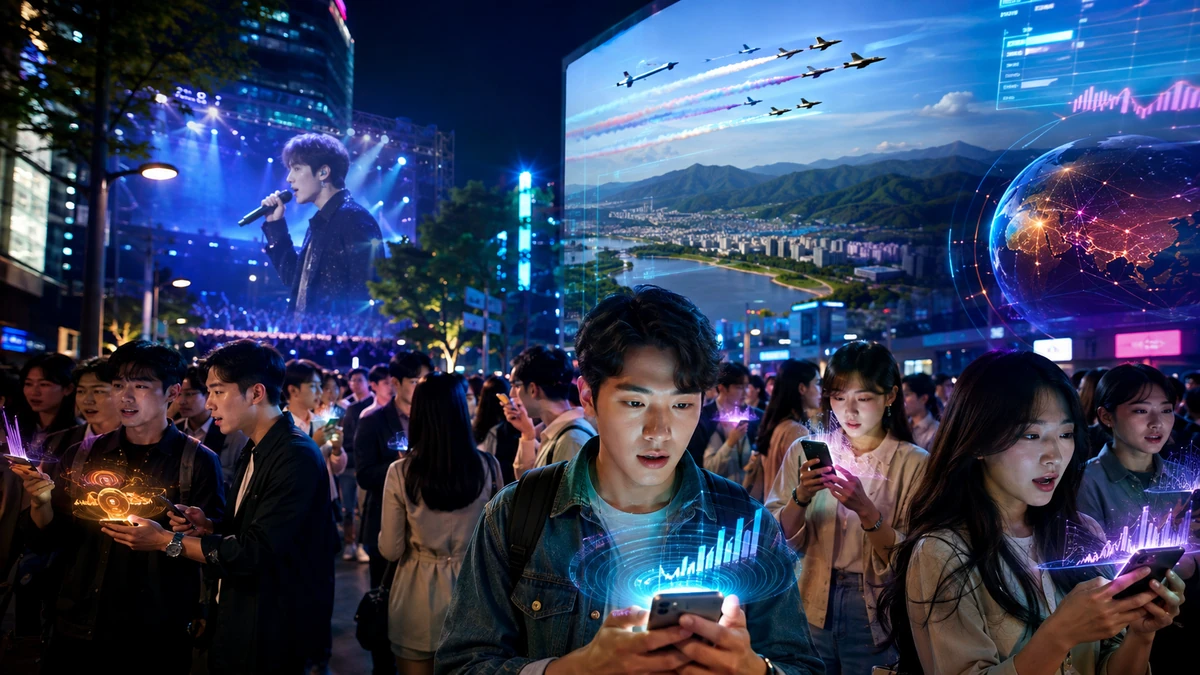
Image to help understand the article
A search chart that reads like a snapshot of modern South Korea
South Korea’s trending Google searches on Sept. 6, 2026, brought together a striking mix of celebrity news, stadium-scale entertainment, an overseas military aviation disaster, cryptocurrency speculation, corporate earnings and neighborhood charity campaigns. Taken together, the list offers more than a ranking of popular queries. It shows how quickly Korean audiences move between domestic entertainment and international events, and how online attention increasingly ignores the boundaries that once separated celebrity culture, financial news and public safety.
The two largest terms in the chart were “Lee Soo,” the stage name of a Korean singer, and “air show,” each with an estimated search volume of more than 5,000, according to Google Trends’ real-time data for South Korea. North Chungcheong province, known in Korean as Chungcheongbuk-do, followed with more than 2,000. Other terms included “performance,” “meme coin,” Indonesia’s Soekarno-Hatta International Airport, athletic apparel company Lululemon, the Korea Ladies Professional Golf Association, actor Nam Bo-ra and the generic district name “Buk-gu,” meaning northern district.
Those figures require an important caveat. Google describes them as approximate indicators, not audited counts of individual users. A person may search repeatedly, and a trending term can rise because its normal search traffic is low rather than because it has suddenly become a subject of nationwide interest. The headlines grouped beneath a term also do not necessarily prove why people searched for it. In several cases, the available articles offered only an indirect connection or no clear explanation at all.
That uncertainty is part of the story. Search charts can identify a burst of curiosity, but they do not automatically reveal its cause. They are closer to a live seismograph than a public opinion poll: useful for detecting movement, less reliable for explaining exactly what produced it.
Why a singer’s name rose when the headlines focused on his former wife
Lee Soo ranked first, but the accompanying headlines centered on singer Lyn and her life after divorce. The stories highlighted comments about her former marriage, including descriptions of sleeping on a bathroom floor, not cooking after becoming single and visiting a jewelry store. Yet the headlines provided in the trend report did not directly name Lee Soo, making it impossible to conclude from the available material precisely what caused his name to surge.
For readers unfamiliar with Korean entertainment, this is a common feature of the country’s celebrity news cycle. A television appearance, social media post or interview involving one member of a former couple can send audiences searching for the other person’s name. Korean portal sites and entertainment outlets often package remarks from variety programs into multiple short articles, each built around a different quote. That can amplify an otherwise limited disclosure and create a wave of related searches.
It also reflects the unusually porous line between entertainment programming and celebrity journalism in South Korea. Variety shows frequently ask entertainers about family, relationships, money and personal hardship. Those conversations then become news stories, video clips and social media posts. American audiences see a similar pattern when a podcast comment, reality television scene or late-night interview generates a fresh cycle of coverage about a celebrity’s former partner.
Still, the distinction between correlation and causation matters. The available evidence suggests that Lyn’s comments may have renewed interest in Lee Soo, but it does not establish that connection conclusively. The top ranking therefore says more about the networked nature of celebrity attention than it does about a single confirmed event.
Im Young-woong and the rise of arena-sized Korean fandom
The search term “performance,” with an estimated volume above 500, was most clearly associated with singer Im Young-woong’s 10th anniversary and an appearance at Goyang Stadium. One headline emphasized the experience he had accumulated over a decade and the increased scale of his stage. Another quoted him as saying he was approaching the anniversary with the feeling of making his debut again.
Im is closely associated with trot, a Korean popular music genre known for emotionally direct lyrics, distinctive vocal inflections and melodies that can evoke older styles of Korean popular song. For Americans, its cultural position is not identical to country music, but the comparison can be helpful: Both genres have deep multigenerational roots, strong regional and working-class associations, and stars whose appeal extends beyond the format’s traditional audience. Modern trot performers also borrow heavily from pop concert production, television competition shows and social media marketing.
Im’s trajectory illustrates how Korean fandom is no longer defined only by the idol groups most visible overseas. International discussions of the Korean Wave, or “Hallyu,” often focus on K-pop acts such as BTS and Blackpink. Inside South Korea, however, the entertainment market is more varied. Ballad singers, trot stars, television personalities and actors can command intensely organized fan communities. These groups buy albums, stream music, attend concerts and sometimes coordinate charitable giving in a performer’s name.
A stadium performance is significant because it turns fandom into visible infrastructure. It requires ticketing capacity, transportation planning, security, sponsorship and sophisticated live production. The attention around Im’s anniversary suggests that Korean music’s domestic concert economy is maturing alongside its global expansion. The trend is comparable to the way American artists can build durable touring businesses without dominating every national radio format. A performer’s cultural power may be measured as much by the ability to fill a major venue as by a position on a weekly singles chart.
An air show disaster demonstrates the speed of international news
“Air show” also drew more than 5,000 estimated searches after Korean outlets reported that an F-4 Phantom fighter jet crashed during an event in Greece or the Athens area, killing two pilots. The available headlines agreed on the basic reported facts of a crash and two deaths. They did not provide enough information to establish a cause or identify additional consequences.
The F-4 Phantom carries particular resonance in both South Korea and the United States. Developed in the United States and widely associated with the Vietnam War era, the aircraft served for decades in several allied militaries. South Korea operated the type as part of a broader defense relationship with Washington and retired its final F-4s in 2024. For Korean readers, the name “Phantom” can therefore evoke both military history and the country’s long security partnership with the United States.
The search spike also shows how an overseas accident can become immediate domestic news even when no Korean connection is apparent in the initial reports. Video-friendly events such as air shows are especially likely to travel across borders through television footage and social platforms. American news consumers saw a similar dynamic after aviation accidents at public demonstrations in the United States, where dramatic images drove intense searches before investigators had determined the cause.
That speed creates a familiar journalistic hazard. Search interest peaks when verified information is often at its thinnest. Early reports can establish that an accident occurred, but technical explanations require evidence from flight data, maintenance records, eyewitness accounts and official investigations. The responsible reading of the trend is therefore narrow: Koreans showed substantial interest in reports of a fatal crash, but the search ranking itself offers no insight into why the aircraft went down.
Volcanic ash, airports and Asia’s interconnected travel economy
Soekarno-Hatta International Airport, the major gateway serving Jakarta, appeared in fifth place with more than 200 estimated searches. The associated coverage reported that Indonesia’s Anak Krakatau volcano erupted, sending ash as high as roughly 9 miles and leading to the temporary closure of six airports and the disruption of numerous flights.
The headlines did not establish whether Soekarno-Hatta was among the six airports that closed or describe a specific operational change there. Its appearance may reflect travelers searching for the status of Indonesia’s best-known international airport after seeing broader reports about volcanic ash. That interpretation is plausible, but it remains an inference.
For South Koreans, air travel within Asia is part of everyday business, tourism and family life. Indonesia is both a major regional economy and a destination connected to South Korea through trade, investment and travel. When volcanic activity threatens flights, passengers may search for a large hub even if the eruption affects smaller airports elsewhere. Americans behave similarly when severe weather strikes one part of the country and searches jump for major hubs such as Atlanta or Chicago O’Hare, whether or not those airports are at the center of the disruption.
Volcanic ash presents a distinct aviation danger because fine particles can damage jet engines and reduce visibility. Airlines and regulators may reroute or cancel flights far beyond the immediate area around an eruption. The search pattern underscores how climate, geology and transportation have become part of a shared regional information system: An eruption on an Indonesian island can quickly become a concern for passengers in Seoul.
Meme coins and Lululemon connect Korean searches to American markets
Two midranking searches were directly tied to financial stories with global implications. “Meme coin,” at more than 500 estimated searches, appeared alongside headlines about tokens on the Solana and BNB Chain networks. The reports cited rapidly changing market capitalizations, including one token said to have exceeded $100 million and others associated with smaller valuations or promotional events.
Meme coins are cryptocurrencies whose value is often driven more by online communities, jokes, celebrity attention or speculative momentum than by a conventional business model. Americans are familiar with the category through Dogecoin and Shiba Inu. The Korean interest is notable because South Korea has long had an active retail trading culture, including enthusiastic participation in stocks and digital assets. Cryptocurrency prices and narratives cross borders almost instantly, making it difficult to separate a “Korean” crypto story from developments on U.S.-linked exchanges, blockchain projects and social media platforms.
Lululemon, meanwhile, ranked sixth with more than 200 estimated searches after reports about weak results, reduced guidance, analyst price-target cuts and a 17% stock decline. Lululemon is Canadian, but its commercial identity is deeply connected to the American athletic apparel market. Its performance is watched as a measure of consumer appetite for premium workout clothing and the broader “athleisure” category, in which apparel designed for exercise is also worn as everyday fashion.
Korean consumers are an important audience for global lifestyle brands, particularly those that can position themselves at the intersection of fitness, status and urban fashion. At the same time, Korean apparel and beauty trends increasingly influence U.S. shoppers. The appearance of Lululemon beside meme coins on the same search list captures a defining feature of contemporary retail investing: Consumers follow companies not only because they buy the products, but also because they encounter stock commentary, influencer videos and market memes on the same platforms.
The American comparison is the pandemic-era “meme stock” boom, when companies such as GameStop became cultural symbols as much as investment vehicles. Search traffic did not necessarily indicate a careful assessment of earnings or valuation. It often reflected a mixture of anxiety, entertainment and fear of missing out. The Korean chart points to the same convergence.
What the trend means for the United States
For American audiences and companies, the list is a reminder that the Korean market cannot be understood through K-pop alone. South Korean consumers follow U.S.-connected defense technology, global aviation disruptions, blockchain speculation and the fortunes of a North American apparel company while also tracking domestic singers and local holiday charity drives. That range creates opportunities, but it also demands more culturally informed strategies.
American entertainment companies increasingly work with Korean labels, producers, streaming services and talent agencies. The rise of a singer such as Im Young-woong shows why those partnerships should look beyond idol groups designed for international promotion. Korean fandom practices — organized streaming, coordinated ticket buying, fan-run fundraising and intense engagement with television appearances — can support artists in ways that differ from the U.S. radio-centered model. American concert promoters and streaming platforms may find value in understanding those domestic fan systems rather than assuming every Korean success follows the BTS template.
U.S. consumer brands face a related challenge. Lululemon’s presence in the rankings demonstrates how quickly corporate performance can become consumer conversation in Korea. A sharp stock move or lowered forecast can affect not only investors but also perceptions of a brand’s momentum. In a highly connected market, financial news can influence fashion discourse, and fashion discourse can influence investment chatter.
The crypto searches matter for U.S. regulators and technology companies because digital-asset enthusiasm is international while legal oversight remains largely national. A token promoted on a U.S.-based social platform can draw Korean buyers within minutes. Conversely, activity on a Korean exchange can influence sentiment among American traders. Fraud, volatility and market manipulation do not stop at national borders, increasing the need for cooperation among regulators and platforms.
The aviation stories also highlight the practical depth of U.S.-Korea ties. The F-4’s history links the two countries’ military establishments, while concern about Indonesian flight disruptions reflects the larger Indo-Pacific region in which both governments operate. Americans often encounter South Korea primarily through entertainment or North Korea-related security news. The search list reveals a society engaged with a much wider set of global questions.
Family hardship, large households and the boundaries of celebrity disclosure
Actor Nam Bo-ra ranked eighth with more than 500 estimated searches after headlines recounted her description of growing up as the eldest daughter in a family of 13 children. She reportedly discussed severe financial hardship, including periods when water, electricity and gas service were cut off, as well as her later understanding of the joy associated with a large family.
South Korea has one of the world’s lowest birth rates, making stories about very large families especially unusual and culturally resonant. The government has spent years trying to encourage childbirth as the population ages and the workforce contracts. Yet celebrity accounts of large-family life can expose the tension between idealized family imagery and the economic pressure of housing, education, utilities and caregiving.
The role of the eldest daughter also carries cultural weight. Korean families have changed significantly, but older expectations often placed substantial responsibility on firstborn children, particularly in households where parents needed help caring for younger siblings. American readers may recognize elements of “parentification,” the term sometimes used when children take on adult caregiving responsibilities, although the social and family context is not identical.
As with the Lyn coverage, a deeply personal account became entertainment news. That transformation can create empathy, but it also rewards outlets for extracting the most dramatic details from a longer conversation. Search rankings measure the resulting curiosity, not whether audiences responded with sympathy, disbelief or concern.
Local searches, Chuseok and the limits of the available evidence
Several terms resist confident explanation. North Chungcheong province ranked second with more than 2,000 estimated searches, but no related news was provided. The Korea Ladies Professional Golf Association ranked seventh with more than 200, also without an accompanying article. The KLPGA is a major institution in a country that has produced many of the world’s leading women golfers, including stars familiar to U.S. fans through the LPGA Tour. Still, without a specific tournament, player or announcement, the reason for the spike cannot be determined.
“Buk-gu” ranked ninth with more than 100 estimated searches. The term is not a single place. It literally means “North District,” and several Korean cities use it, much as multiple U.S. communities have a downtown, north side or Washington County. The attached articles referred to community activities in districts in Busan and Daegu, along with a public-order campaign in Hapcheon County, making a single cause difficult to identify.
Some of the local headlines involved charitable activities ahead of Chuseok, one of Korea’s most important holidays. Chuseok is often described to Americans as a Korean Thanksgiving because families gather, honor ancestors and share seasonal food. The comparison is useful but incomplete. Chuseok follows the lunar calendar and includes traditions tied to harvest, family lineage and visits to ancestral graves. Local governments, civic groups and businesses commonly organize food donations and aid for vulnerable residents before the holiday.
Those small community stories may appear out of place beside a fighter jet crash or a celebrity divorce. In fact, their coexistence is what makes the list valuable. Digital attention is not a clean national agenda. It is a stack of overlapping publics: investors, fans, travelers, sports followers and residents looking for information about their own neighborhoods.
What to watch beyond a single day’s rankings
The larger trend is not that one singer or one accident dominated Korean searches for a few hours. It is that the machinery of attention now connects local television, international breaking news, corporate markets and social media speculation in real time. A personal confession can revive interest in a former spouse. A stadium concert can elevate a generic word such as “performance.” An eruption can send travelers searching for an airport whose exact status remains unclear. A stock decline can turn leggings into market news.
Future search charts will be most useful when read with restraint. The relative size of a spike matters less than the reporting underneath it. Terms without linked coverage should not be assigned a cause. Headlines that do not name the trending person require qualification. Early disaster reports should not be stretched into explanations that investigators have not supplied.
For American readers, the chart offers a compact lesson in how South Korea consumes information: globally, commercially and with intense interest in the personal lives of public figures, but also through local identities and holiday traditions that may be invisible overseas. What happens next will depend on whether these searches develop into sustained stories — a confirmed aviation investigation, longer-term corporate weakness, a significant concert business milestone or a broader public debate — or disappear as quickly as they arrived.
Comments
Post a Comment