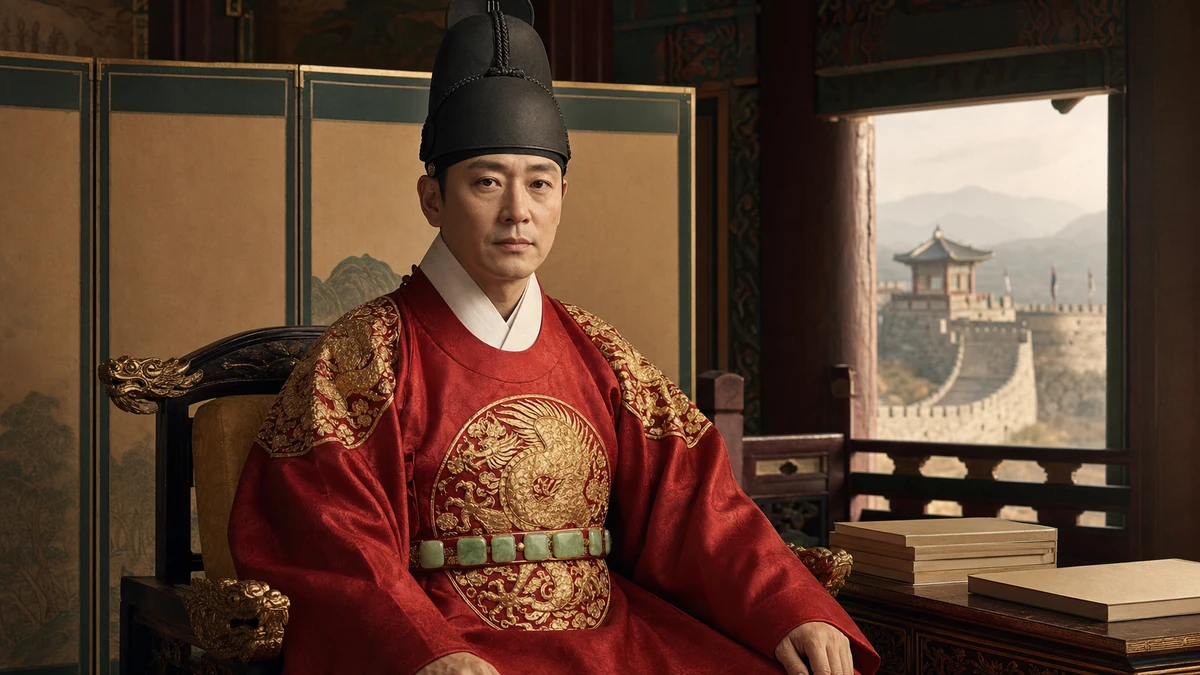
Image to help understand the article
A reformer forged by palace tragedy
For many Americans, Korean history begins with modern flashpoints: the Korean War, the rise of Samsung and Hyundai, or the global success of K-pop, Korean film and streaming dramas. But to understand how South Korea tells its own story about leadership, reform and national resilience, it helps to go back much further — to the late 18th century and to King Jeongjo, one of the most studied monarchs of the Joseon dynasty.
Jeongjo, who was born in 1752 and became the 22nd king of Joseon in 1776, is remembered in Korea not simply as a king but as a ruler who tried to revive a strained political order through learning, administrative discipline and carefully calibrated reform. Joseon, the Korean kingdom that ruled for more than five centuries before the modern era, was built on Confucian political ideals: scholarship, hierarchy, moral conduct and bureaucratic governance. In that world, the king was not just a sovereign in the European sense. He was expected to serve as a moral exemplar, a guardian of order and, in some respects, a teacher to the realm.
Jeongjo’s path to the throne was marked by one of the most traumatic episodes in Korean royal history: the death of his father, Crown Prince Sado. Sado had fallen into conflict with Jeongjo’s grandfather, King Yeongjo, amid court tensions, personal instability and factional fighting. In 1762, Yeongjo ordered Sado confined in a rice chest, where he died after eight days. The image is so haunting that it remains one of the defining scenes in Korean historical memory. For Jeongjo, still a child at the time, it was not just a family catastrophe. It became the central political fact of his life.
That trauma shaped how he was viewed and how he ruled. He had to survive in a palace culture where succession was never merely personal, and where the downfall of one royal could become the weapon used against another. The Korean article’s central argument is that Jeongjo’s later achievements cannot be separated from this early experience. He grew up under threat, under scrutiny and under the burden of proving both his legitimacy and his capacity. In American terms, it is as if a future president had come of age after a family scandal so explosive that it nearly destroyed his claim to public office before he could even take it.
That background helps explain why Jeongjo still attracts such sustained attention in Korea. He fits a familiar pattern in national storytelling: the leader shaped by private grief who turns personal survival into public ambition. But unlike a purely romanticized hero, Jeongjo’s reputation rests on concrete governing choices — whom he promoted, how he handled factional conflict, how he used scholarship as political authority and how he tried to strengthen the state without triggering outright institutional collapse.
The making of a scholar-king
If Jeongjo’s childhood was defined by danger, it was also defined by relentless education. The Korean summary describes a training regimen that was not ceremonial but exhaustive. As a young royal, he studied the core texts of Confucian learning, beginning with introductory primers and moving into the canonical works that structured East Asian political thought. He also studied history, maintained regular tutorial sessions and, by his late teens, was engaged in multiple rounds of formal lessons each day.
This matters because in Joseon political culture, learning was not an ornament. It was one of the chief currencies of legitimacy. The king’s ability to read, interpret and discuss classical texts was tied directly to his claim to rule well. Court lectures and study sessions were not unlike a permanent graduate seminar fused with state business. Officials debated principles of governance through classical language, and a ruler who could command those discussions could project more than intellect — he could project moral and political control.
Jeongjo seems to have embraced that model with unusual intensity. According to the summary, he was not only widely read in the Four Books and Five Classics of Confucianism but also in Chinese histories, Korean historical texts, Korean-language fiction and even medical writings. He practiced archery as well, building a reputation for martial competence alongside literary discipline. In later years, records would portray him as a ruler able to lecture officials directly in royal seminars, a powerful image in a society where scholarship and statecraft were inseparable.
For Americans, the closest analogy may be the recurring fascination with presidents who cultivate the image of being both intellectually serious and operationally hands-on. Think of the way American political culture admires leaders who read deeply, quote history fluently and treat ideas as governing tools rather than branding accessories. The comparison is imperfect, because Jeongjo was a hereditary monarch, not an elected official. Still, the parallel helps illuminate why Koreans often view him less as a distant dynastic figure and more as a model of disciplined, knowledge-based leadership.
His intellectual identity also carried strategic value. Jeongjo had to navigate a court split by factions, including powerful conservative blocs that could view his very existence as politically destabilizing because of his father’s fate. Becoming an unmistakably capable scholar-ruler was not just a personal preference. It was a survival strategy. He could not erase the politics surrounding his father’s death, but he could make himself harder to dismiss as unfit.
How Jeongjo turned survival into statecraft
When Yeongjo aged and Jeongjo began taking on governing responsibilities before formally ascending the throne, he entered a political environment defined by organized factions and entrenched interests. The Korean account notes that resistance emerged when the elderly king tried to transfer more practical authority to the crown prince. Jeongjo’s enemies understood the stakes clearly: once he gained real administrative power, their own room to maneuver could shrink.
That is one reason Jeongjo’s accession in 1776 matters beyond palace ceremony. On the day he took the throne, he made a pointed declaration that he was the son of Crown Prince Sado. This was politically loaded. It directly confronted efforts by some opponents to weaponize his father’s disgrace against him. Yet he stopped short of an immediate all-out reckoning that could have plunged the court into fresh instability. Instead, he asserted legitimacy while managing the balance of power carefully.
That combination — symbolic boldness paired with tactical restraint — is a hallmark of his reign. Jeongjo was not a revolutionary in the modern sense. He did not try to blow up the governing order. He worked within monarchy and hierarchy while trying to make them function better and bend more reliably toward royal authority rather than factional paralysis.
His personnel choices reflected that pragmatism. After an early period in which a close ally accumulated too much influence, Jeongjo re-centered authority in himself. He then elevated officials from groups that had been excluded from power while also making use of people from factions not naturally considered his base. In other words, he did not govern through one narrow camp alone. He sought to recruit talent across lines and place competing political elements beneath the crown.
That is a familiar reform problem in many countries, including the United States: how does a leader weaken entrenched gatekeepers without creating a new inner circle so dominant that it simply reproduces the same problem in another form? Jeongjo’s response appears to have been a continuing attempt to widen the pool of service while strengthening the center. It did not eliminate factional politics, but it gave him greater room to govern.
The Korean summary also points to structural measures. Jeongjo created a royal guard unit, reinforcing the military basis of the throne. He sponsored the republication of important writings and legal materials. He treated learning itself as infrastructure for governance. And in economic policy, he moved to curb long-standing merchant privileges by abolishing certain exclusive rights long enjoyed by officially licensed shop merchants, except for a limited core group. The significance of that move lies not in modern free-market ideology but in the effort to loosen monopolistic protections and improve commercial circulation inside the kingdom’s existing framework.
Seen together, these moves suggest why Jeongjo is so often framed in Korea as a reform monarch rather than simply a tragic prince who survived. He tried to make the state more governable, more merit-based and more directly responsive to the crown. His legacy rests on process and institutional adjustment as much as on personal drama.
Suwon Hwaseong and the politics of building
The title of the Korean story links Jeongjo not only to reform politics but also to Suwon Hwaseong, the fortress complex in the city of Suwon that has become one of the most visible physical symbols of his reign. For readers outside Korea, Hwaseong is more than an old wall or tourist site. It represents a larger point about how premodern rulers used urban planning, military design and monumental architecture to signal political intention.
In Jeongjo’s case, Hwaseong is closely associated with his effort to shape a new center of authority and memorialize his father, while also demonstrating administrative competence. In modern Korea, the site stands as a tangible bridge between scholarship, engineering, ritual memory and governance. It is the kind of place where political meaning is built into stone.
Americans are not strangers to this idea. Washington, D.C., for example, is not just a functional capital. Its avenues, memorials and monumental spaces were designed to stage national values and institutional permanence. The same is true, in a different register, of presidential libraries, Civil War monuments or even the symbolic politics that surround rebuilding major civic sites after tragedy. Architecture often serves as argument. It tells a public what power wants to say about itself.
Hwaseong performs a similar function in Korean historical imagination. It embodies Jeongjo’s attempt to fuse filial piety, administrative rationality and political re-centering. Filial piety — the Confucian duty of honoring one’s parents and ancestors — can sound abstract to American readers, but in Joseon it was a core moral and political principle, not a private sentiment alone. For a king whose father had died in disgrace, public acts of remembrance carried enormous emotional and ideological weight. They were also politically risky. To honor Sado too aggressively could alarm opponents; to remain silent could hollow out Jeongjo’s own legitimacy and personal mission.
That balancing act helps explain why Jeongjo has proven durable as a subject in Korean books, television dramas and public history. He offers a story with all the ingredients modern audiences recognize: family trauma, palace intrigue, intellectual rigor, state reform and a monumental urban legacy that can still be visited. Yet reducing him to a costume-drama protagonist misses the more interesting point. His continuing appeal comes from the way those elements connect to an enduring Korean question: what does strong but ethical leadership look like in a system vulnerable to faction, privilege and inherited grievance?
Why this matters in the United States
For American readers, Jeongjo’s story may seem remote at first glance. It comes from an 18th-century Confucian monarchy, not a contemporary democracy. But the way Korea remembers him matters in the United States for several reasons — cultural, commercial and diplomatic.
First, Korean history is no longer a niche subject in America. The Korean Wave, or Hallyu, has transformed what used to be specialized cultural knowledge into mainstream consumer awareness. American audiences who found Korea through BTS, “Parasite,” Netflix dramas or Korean beauty brands are increasingly encountering deeper layers of Korean identity, including historical narratives. Period dramas set in the Joseon era have become a gateway for international viewers, and those shows often draw on royal figures such as Jeongjo and Sado. The result is that historical memory has become part of Korea’s global cultural export, much the way British monarchy stories have long traveled through Hollywood, PBS and streaming platforms.
Second, there is a business angle. U.S. entertainment companies, streaming distributors, publishers, museums, universities and travel firms all operate in an environment where Korean content has become commercially significant. The more global audiences engage Korea not just as a pop-culture trend but as a civilization with a rich, internally debated past, the more value there is in serious, accessible storytelling about figures like Jeongjo. This is similar to how American consumers embraced “Hamilton” not merely as a musical but as a reframing of early U.S. history for a mass audience. Historical branding can drive tourism, licensing, education and prestige, and South Korea has become increasingly adept at that ecosystem.
Third, the U.S.-Korea alliance has matured beyond security alone. The relationship now includes semiconductors, batteries, defense production, higher education and culture. In that setting, understanding how South Koreans think about historical leadership is not trivial. Political memory shapes the language nations use about reform, fairness, institutions and national purpose. Jeongjo’s reputation as a ruler who tried to elevate talent across factional lines, curb privilege and strengthen the state through learning resonates in a country that still prizes education and often measures leadership against ideals of competence and integrity.
There is also a useful American comparison in the politics of historical narrative. In the United States, public battles over the Founders, Reconstruction, the New Deal or civil rights are never really about the past alone. They are arguments about legitimacy now: whose story is central, which institutions deserve trust and what kind of leadership should be celebrated. Korea’s engagement with Jeongjo works similarly. He is not remembered only as a man who lived. He is used, debated and revisited as an example of what reform from the top can achieve — and where it can fall short.
For American fans of Korean culture, then, Jeongjo is a reminder that the Korean Wave is not just about catchy songs and addictive shows. It increasingly asks foreign audiences to understand the historical grammar beneath modern Korean storytelling. For American companies, that means Korean content is richest when it is contextualized rather than flattened into exotic spectacle. For the bilateral relationship, it means cultural literacy is becoming a practical asset, not a decorative one.
What Jeongjo’s legacy says about Korea now
The larger lesson in Jeongjo’s story is not that one extraordinary king solved the problems of his age. It is that Korea continues to value him as a ruler who understood that legitimacy had to be earned repeatedly — through study, through discipline, through appointments, through symbolic acts and through institutional design. That is a modern lesson wrapped in premodern clothing.
His reign is often discussed as part of a late-Joseon revival because it combined personal authority with attempts at administrative repair. He strengthened royal power, but he also sought to improve the machinery around it. He used scholarship not as retreat but as governance. He tried to broaden the ranks of useful officials rather than leave politics to one dominant faction. He paid attention to commerce and the military. And he cultivated a public image in which the ruler should also be a moral educator.
None of that made him a democrat, and American readers should resist the temptation to turn every admired historical figure into a precursor of modern liberal politics. Jeongjo ruled within monarchy, hierarchy and inherited status. Still, the persistence of his appeal tells us something important about South Korea’s historical imagination. Koreans often return to figures who represent competence under pressure, reform without chaos and emotional depth paired with administrative seriousness. Jeongjo fits that pattern unusually well.
That may be why his story travels effectively today. In an era when many democracies, including the United States, are struggling with elite distrust, institutional fatigue and culture-war versions of history, Jeongjo offers a different but recognizable political drama: a leader hemmed in by faction, trying to reassert the center through merit, learning and symbolic authority. He is not an American model, but he is legible to American concerns.
For that reason, Jeongjo should be seen not as a museum piece but as part of a broader trend in how Korea presents itself to the world. The country’s global image is no longer confined to cutting-edge tech and entertainment. It increasingly includes historical depth — kings, scholars, cities, archives and contested memories that help explain why modern Korea sees itself as both deeply traditional and relentlessly adaptive.
If Americans want to understand Korea as a full-spectrum cultural and strategic partner, not just a source of hit music and smartphones, figures like Jeongjo deserve attention. His life was born in palace tragedy, tested by factional politics and remembered through reform. That combination is exactly why he remains so relevant: not because he belongs safely to the past, but because Korea continues to use him to think about power, legitimacy and renewal in the present.
Comments
Post a Comment