Why ‘Veteran’ Still Lands: The Korean Box Office Smash That Turned Class Rage Into Crowd-Pleasing Action
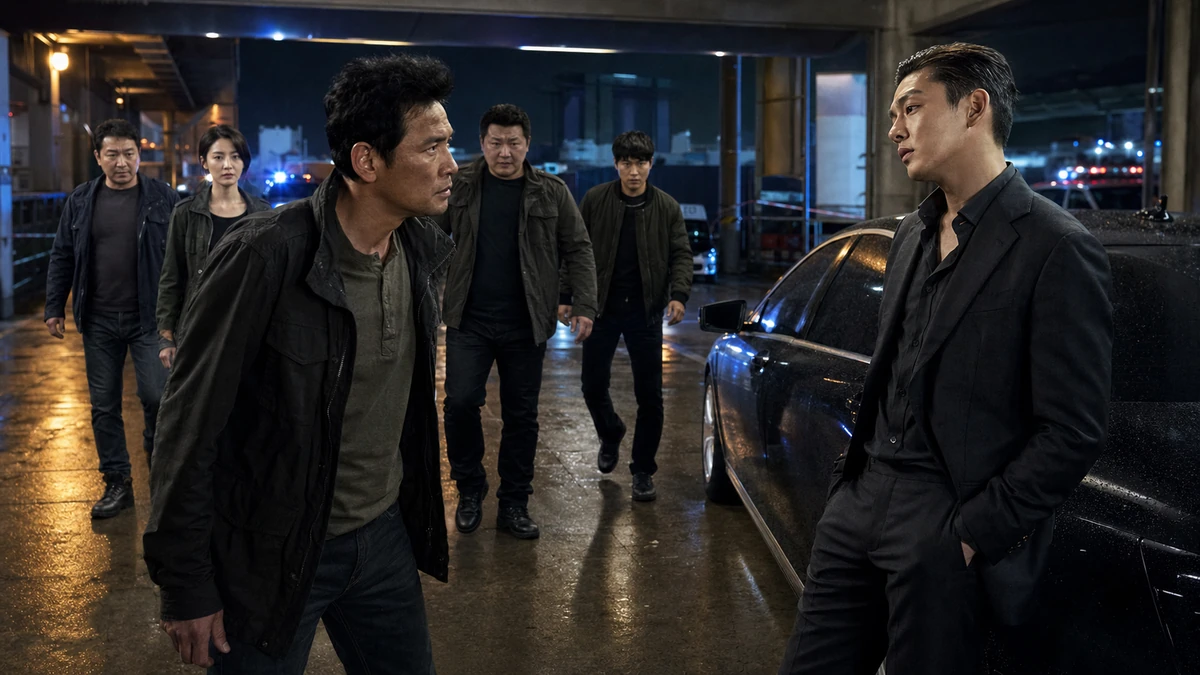
Image to help understand the article
A Korean blockbuster with a familiar American hook
Long before South Korean film and television became routine parts of American streaming habits, director Ryoo Seung-wan’s 2015 hit “Veteran” showed how Korean popular cinema could package a very local grievance inside a globally legible crowd-pleaser. On its surface, the movie is easy to grasp for any American viewer who has ever enjoyed a hard-charging cop thriller: a relentless detective, Seo Do-cheol, goes after a rich and protected heir whose money and family name seem to place him above the law. The setup recalls the broad pleasure of American populist crime movies, where audiences are invited to cheer when an investigator cuts through bureaucracy, intimidation and elite arrogance to expose abuse.
But “Veteran” is not simply Korea’s version of a Hollywood cops-and-robbers story. Its real charge comes from the social system it targets. The villain, Jo Tae-oh, is not just wealthy. He is a “third-generation chaebol heir,” a phrase that carries specific weight in South Korea. “Chaebol” refers to the large, family-controlled conglomerates that have dominated the country’s postwar economic rise. For American readers, the closest comparison is not any one company but a mix of Wall Street dynasty, legacy corporate empire and celebrity capitalism — except with even more concentrated family control over sprawling business networks. Jo’s status means he is protected not only by personal wealth but by the institutional force of a corporate family machine.
That is what gives “Veteran” its staying power. The film delivers chase scenes, wisecracks and star charisma, but its real subject is whether power can buy impunity. The answer matters far beyond Seoul. For American audiences used to debates about billionaire influence, labor exploitation, corporate settlements and the unequal ways justice is administered, “Veteran” plays less like an exotic import than like a sharply Korean variation on a familiar democratic anxiety: What happens when a society believes the rules are tougher on workers than on the rich?
The movie became one of South Korea’s celebrated “10 million audience” films, a benchmark that signals not niche acclaim but true mass appeal. In a country of roughly 50 million people, crossing that threshold means a movie has become a mainstream cultural event. That popularity is itself part of the story. “Veteran” was not merely a critics’ favorite or a politically admired work. It was a hit with ordinary moviegoers, suggesting that its anger at privilege and corporate insulation resonated across age groups and social classes, even as it entertained them.
What the movie is really about
The plot centers on Seo, a veteran detective in the Seoul Metropolitan Police Agency’s Major Crimes Division, played by Hwang Jung-min with a bruising, restless energy. He is the kind of movie cop American audiences recognize instantly: intuitive, stubborn, physically fearless and constitutionally unable to let obvious wrongdoing slide. But unlike the more solitary antiheroes of some U.S. crime dramas, Seo works inside a lively ensemble. His team includes a seasoned supervisor, an undercover specialist, a physically imposing field detective and a younger team member whose presence helps establish the group as a functioning unit rather than a one-man crusade.
The film opens by showing that team in action during a case involving used-car fraud, a sequence that does more than provide excitement. It teaches the audience how these detectives operate: improvisationally, physically and with a strong sense of team rhythm. That early stretch is also a tonal promise. Ryoo wants viewers to understand that “Veteran” will move quickly, explain itself clearly and balance social criticism with humor. The movie is not interested in dense procedural complexity for its own sake. It wants to make the lines of conflict legible and emotionally satisfying.
The story turns when Seo is invited into the orbit of the wealthy and meets Jo Tae-oh, played by Yoo Ah-in. Jo is a corporate executive and the youngest son of a powerful conglomerate chairman. Seo’s instinct tells him something is wrong before he can prove anything, and the film leans into that old detective-fiction pleasure: the investigator sensing rot hidden beneath polished surfaces. Soon after, a truck driver named Bae Cheol-woong, who has been trying to resolve unpaid wages, is reported to have fallen down an emergency stairwell in what authorities frame as a suicide attempt.
That incident changes the moral temperature of the film. Seo has a prior connection to Bae through another investigation, so the case becomes more than abstract police work. He now sees what appears to be a familiar pattern in unequal societies: a vulnerable laborer seeks redress from a powerful company, suffers catastrophic harm, and then finds his story managed by people with money, legal resources and influence. The issue is not just violence. It is the system that can rename violence, soften it, bury it or settle it quietly.
Jo’s right-hand man and other company figures function as the machinery of denial. Surveillance footage is unavailable. Explanations appear convenient. The incident is steered toward a conclusion that protects the powerful. In narrative terms, that makes Jo more than a flamboyant villain. He becomes the face of a broader institutional barrier that Seo must fight through. “Veteran” understands that class anger becomes more potent on screen when the audience feels the hero is battling not only one bad man but an entire architecture built to absorb scandal and neutralize accountability.
The Korean context American viewers need
To understand why “Veteran” struck such a nerve in South Korea, it helps to unpack the cultural and economic meaning of the term “chaebol.” In modern Korean history, family-run conglomerates played a central role in the nation’s rapid industrialization and rise as an export powerhouse. Names like Samsung, Hyundai, LG and SK are not merely businesses; they are institutions woven into national life. They have provided jobs, technology, infrastructure and prestige. But they have also drawn public scrutiny over hereditary succession, political influence, labor practices and the perception that elite families face softer consequences than ordinary citizens.
That is the emotional backdrop for Jo Tae-oh. He is introduced as a “third-generation” heir, which in Korean shorthand suggests inherited entitlement rather than earned authority. In the American imagination, the closest parallel might be the CEO’s son parachuted into power with a boardroom title and a permanent shield of deference, but that still understates the Korean implications. A chaebol heir is not just a privileged executive. He stands at the intersection of family dynasty, corporate hierarchy and public resentment over how concentrated power reproduces itself.
The labor angle matters just as much. Bae’s conflict over unpaid wages is not incidental. It places the film’s melodrama in a social reality familiar to many workers: delayed pay, subcontracting vulnerability and the humiliating imbalance between those who do the work and those who control the contracts. When the film suggests that a worker’s suffering can be dismissed with money or reframed through public-relations management, it taps a deep Korean concern about whether economic modernization has distributed dignity as fairly as it distributed growth.
There is also a language of insult embedded in the story that can be easy for foreign audiences to miss if it is not explained. Jo’s treatment of people beneath him is not simply rude in an individual sense; it reflects a hierarchical worldview in which social rank appears to justify cruelty. Korean audiences would recognize that dynamic instantly, especially in workplaces where status, age, title and family background can shape everyday interactions. “Veteran” turns that social structure into narrative fuel. Seo’s pursuit becomes satisfying not only because he is solving a case but because he is refusing the hierarchy itself.
Even the film’s mix of humor and outrage fits a recognizable pattern in Korean commercial cinema. Ryoo avoids making the movie feel like a lecture. Instead, he allows comedy, ensemble banter and exaggerated villainy to keep the story accessible. That tonal agility is one reason the movie reached a mass audience. It can be enjoyed as a kinetic action film while also inviting viewers to think about how institutions protect the connected. In other words, it is political without becoming solemn, which is often the sweet spot for popular entertainment with social bite.
Why it became a mass hit, not just a message movie
One reason “Veteran” became such a phenomenon is that it solves a problem many socially conscious films cannot: how to make structural injustice feel immediate, visual and fun to watch without trivializing it. Ryoo’s answer is clarity. The hero is unmistakable. The victim’s vulnerability is understandable. The villain’s privilege is visible. The obstruction is systemic but not confusing. American filmmakers have long understood the power of that formula, from classic corruption thrillers to more modern David-versus-Goliath dramas. “Veteran” applies it with unusual efficiency.
Hwang Jung-min and Yoo Ah-in are central to that equation. Hwang’s Seo is a man of motion — the kind of screen presence who seems to think with his whole body. He listens, pushes, runs, crashes through rooms and keeps digging even when the case becomes inconvenient for others. Yoo, by contrast, plays Jo with a performance built on entitlement and volatility. The contrast is the point. One man works through sweat, instinct and collective effort. The other moves through a world softened by inheritance, handlers and institutional buffers. Their conflict feels archetypal because the movie stages it as a clash between labor and leisure, effort and entitlement, accountability and insulation.
The supporting cast also contributes to the film’s broad appeal. Seo’s team gives the movie warmth and comic rhythm, keeping it from hardening into grim social realism. Their presence matters because audiences often absorb criticism more readily when it arrives inside a functioning group dynamic rather than through abstract moral speeches. The detectives joke, coordinate, improvise and frustrate one another the way memorable teams do in mainstream entertainment. That camaraderie broadens the movie’s audience beyond viewers specifically seeking a class critique.
Then there is the question of genre. “Veteran” is an action movie, but not in the sleek, detached sense of some franchise filmmaking. Its action scenes are tied to character and social tension. Seo is not superhuman. His physicality underscores the labor of investigation itself. He has to force progress with his body because official processes alone are not enough when the suspect can weaponize status. That gives the action a narrative purpose beyond spectacle: each collision represents an effort to move a blocked system one step closer to truth.
The film’s music choices, which range from pop to opera to classical pieces, reinforce that tonal nimbleness. Rather than locking itself into one mood, “Veteran” shifts registers to emphasize irony, swagger, tension and release. It feels like a popular movie in the fullest sense — eager to entertain, unafraid of broad effects, but controlled enough to keep its thematic target in focus. That combination helps explain why the movie crossed from issue-driven relevance into genuine event status.
What it means in the United States
For American audiences, “Veteran” lands at the intersection of several familiar conversations: inherited corporate power, labor precarity, public distrust of elite accountability and the marketability of anti-elite entertainment. None of those themes are uniquely Korean. If anything, the movie’s continuing relevance in the United States reflects how easily its core conflict maps onto American concerns. U.S. viewers do not need to know every detail of Korean corporate history to understand the emotional charge of a worker being crushed while a wealthy insider expects to walk away untouched.
That helps explain why Korean storytelling has found such a large foothold in the American market over the past decade. U.S. audiences have embraced Korean works not only because they feel fresh, but because they often dramatize inequalities Americans already recognize, sometimes with more bluntness than Hollywood is willing to use. “Parasite” connected in the United States because class anxiety is not foreign here. “Squid Game” broke through because debt, humiliation and spectacle are hardly unfamiliar to an American public. “Veteran,” though earlier than those breakout moments, belongs to the same broader current: Korean popular culture translating social frustration into gripping, accessible narrative form.
There is also an industry angle. American distributors, streamers and studios have learned that Korean content travels well when it combines local specificity with universal stakes. A film like “Veteran” demonstrates why. The word “chaebol” may require explanation, but the underlying issue — dynastic privilege shielding misconduct — does not. That is exactly the kind of story U.S. entertainment companies know how to market: a sharp antagonist, a righteous investigator, a working-class victim and a system rigged in favor of the powerful. The more American audiences become comfortable with subtitles and with Korean cultural reference points, the easier it becomes for movies like this to circulate as mainstream options rather than specialty imports.
The film also speaks to U.S.-Korea ties in a softer but meaningful way. South Korea is one of America’s most important allies in Asia, yet for many Americans their most vivid connection to the country increasingly comes through culture rather than diplomacy. K-pop, Korean dramas, films, food and beauty brands have become part of everyday consumer life in the United States. That means cultural products now shape how Americans understand Korean society — its aspirations, anxieties and internal debates. “Veteran” offers a view of South Korea not as a glossy export success story alone, but as a democracy wrestling with concentrated power and uneven justice, themes that make the country feel more legible and relatable to U.S. audiences.
Comparable cases in the United States are not hard to find at the thematic level, even if the corporate structures differ. Americans have seen repeated public battles over labor abuses, powerful families, executive misconduct and settlements that appear to treat harm as a cost of doing business. The point is not that “Veteran” maps perfectly onto any one U.S. scandal. It is that its outrage feels immediately intelligible in an era when Americans across the political spectrum often suspect that wealth and access produce a different kind of justice. In that sense, the movie functions almost like a trans-Pacific mirror.
A trend, not just a one-day story
Seen from 2025, “Veteran” matters less as a snapshot of one hit movie from 2015 than as an early and durable example of a larger trend: Korean mainstream entertainment turning social resentment into exportable genre storytelling. This is one reason the film deserves renewed attention. It anticipated the way global audiences, including Americans, would increasingly reward Korean works that refuse to separate entertainment from structural critique. Not every successful Korean movie is about inequality, of course, but many of the most internationally resonant ones understand that audiences crave stories that identify systems of power clearly and dramatize them emotionally.
What changed in the years after “Veteran” is not simply that more people discovered Korean cinema. It is that the American market became more receptive to stories rooted in Korean conditions but speaking to global frustrations. Streaming accelerated that shift. So did the erosion of old assumptions about what kinds of international content U.S. viewers would tolerate. The success of Korean media in the United States has made context more valuable, not less. Viewers want explanation — what a chaebol is, why labor conflict matters in Korea, why a phrase or gesture carries class meaning — but they are no longer deterred by that need for explanation.
That creates a useful frame for “Veteran.” Rather than asking whether the film still works, the better question is what it reveals about the formula Korean entertainment has refined so effectively. First, identify a pressure point in society. Second, embody it in vivid characters rather than abstract systems. Third, keep the pacing muscular enough that audiences never feel they are doing homework. Finally, trust that local details will deepen rather than limit global interest. This is not just a Korean formula, but South Korea has executed it with notable consistency.
For American observers of the culture business, that trend has consequences. U.S. studios and streamers are competing in a world where Korean creators have proved they can turn national specifics into international event viewing. That puts pressure on American companies to either partner more deeply with Korean talent and firms or become better at making their own socially grounded popular entertainment. It also means U.S. critics and journalists need to cover Korean media not as novelty but as a core part of the global mainstream.
What to watch next is not only whether older Korean hits continue to find new audiences abroad, but how future films handle the same tensions “Veteran” captured so cleanly: labor versus capital, institutions versus individuals, and the public appetite for seeing elites challenged on screen. Those themes are unlikely to disappear in either Korea or the United States. If anything, they have become more central to how mass audiences process politics through entertainment.
Why “Veteran” endures
The simplest reason “Veteran” lasts is that it understands something basic about popular storytelling: audiences will follow a movie a long way if they know exactly who is abusing power and why it matters. The film never loses sight of the human stakes behind its action. A worker is harmed. A family suffers. A detective refuses to look away. A wealthy man assumes the system exists to soften consequences for people like him. That is straightforward, but not simplistic. It is the kind of clarity that lets a movie speak to broad audiences without giving up its political nerve.
Its endurance also has to do with timing. Looking back, “Veteran” now reads as part of the foundation for the later global boom in Korean screen culture. It showed that a movie deeply embedded in Korean realities could reach large audiences by being specific, funny, angry and expertly constructed all at once. It did not require foreign viewers to know everything in advance; it simply gave them enough emotional and narrative footing to understand why the fight mattered.
For American readers and viewers, that may be the most important takeaway. “Veteran” is not valuable because it offers a neatly exportable lesson about Korea. It is valuable because it shows how another democracy stages its own arguments about inequality, inherited privilege and justice — and how recognizable those arguments can feel from across the Pacific. The movie’s setting is Seoul, its social vocabulary is Korean, and its villain emerges from the logic of the chaebol system. Yet its deeper question is universal: when institutions bend toward power, who still has the will to push back?
That question has not lost relevance in South Korea, and it has certainly not lost relevance in the United States. In that sense, “Veteran” remains more than a box office success from a decade ago. It is a durable piece of populist cinema, a sharply entertaining expression of class anger, and an early marker of why Korean storytelling has become so important to American cultural life. Its punches land because they are aimed at a structure audiences everywhere already suspect is there.
Comments
Post a Comment