Image to help understand the article
Three days of talks end without a joint statement
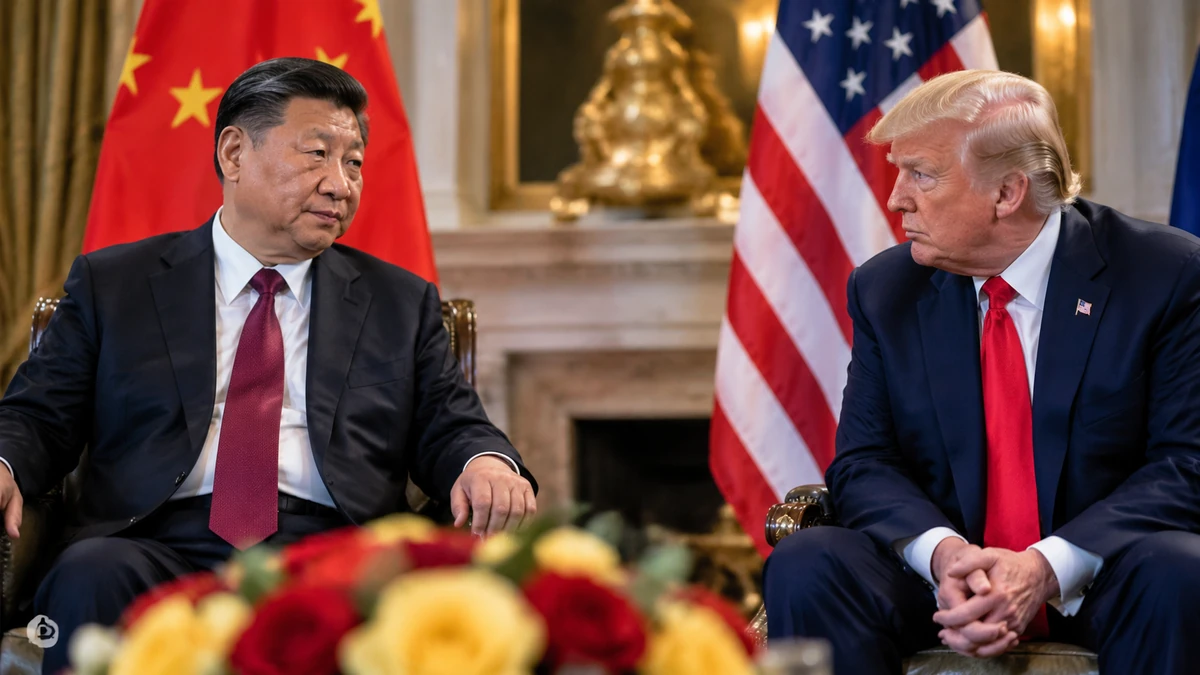
WASHINGTON — President Donald Trump and Chinese President Xi Jinping concluded three days of meetings in Washington on Thursday without issuing a joint agreement, despite both leaders describing the talks in positive terms.
Trump and first lady Melania Trump met with Xi and his wife for tea on the final day. The two couples then visited the National Archives near the White House, formally ending the summit.
Xi invited the Trumps to visit China and proposed meeting again around the Asia-Pacific Economic Cooperation summit in Shenzhen in November and the Group of 20 summit in Miami in December. Trump said on social media that he expected to meet Xi at both events.
U.S. Trade Representative Jamieson Greer said progress had been made in negotiations held alongside the summit and that details would be released Sunday. The expected measures include a two-month extension of the countries’ trade truce and other agreements reached by senior officials.
Xi skips the United Nations gathering in New York
Xi returned to China directly after meeting Trump rather than traveling to New York, where the U.N. General Assembly was underway. The decision contrasted with Xi’s 2015 visit, when he combined a Washington meeting with then-President Barack Obama and an appearance at the United Nations.
Jeffrey Prescott, a senior fellow at the Carnegie Endowment for International Peace who served as U.S. ambassador to U.N. agencies in Rome under President Joe Biden, said it was difficult to imagine “a more devastating image” for the United Nations. Other experts offered a different interpretation, saying Xi may have wanted to avoid diluting the importance of his White House meetings by combining them with a broader U.N. itinerary.
The episode highlighted questions about the United Nations’ influence as rivalry among the United States, China and Russia has limited action by the Security Council. The three countries hold veto power, and the council has struggled to play a significant role this year in conflicts involving Iran, Gaza and Ukraine.
China has supported Russia’s war effort through economic and political assistance and remains Iran’s largest trading partner despite Trump’s demand that countries stop trading with Tehran. The United Nations has also faced limits in efforts to establish an international system for governing artificial intelligence: The United States opposes global AI regulation, while China has resisted measures that could constrain its own development.
American technology and finance leaders fill state dinner
Trump and Xi delivered remarks Wednesday at a state dinner in the White House East Room. Trump said the countries had made “tremendous progress” that was “very positive” for both sides. Xi said the relationship should pursue strategic stability through respect, fairness and reciprocity.
Xi invoked U.S.-Chinese cooperation against Japan during World War II and the “pingpong diplomacy” that helped thaw relations in the 1970s. He said the two powers should demonstrate responsibility and seek a new way for major countries to manage their relationship.
The guest list reflected the importance of technology and finance to U.S.-China relations. Attendees included Nvidia CEO Jensen Huang, Meta CEO Mark Zuckerberg, AMD CEO Lisa Su, Apple CEO Tim Cook, OpenAI CEO Sam Altman, Google CEO Sundar Pichai, Microsoft CEO Satya Nadella, Amazon founder Jeff Bezos and Tesla and SpaceX CEO Elon Musk.
Financial executives included JPMorgan Chase CEO Jamie Dimon, BlackRock CEO Larry Fink, Blackstone CEO Stephen Schwarzman, Goldman Sachs CEO David Solomon and Citi CEO Jane Fraser. Jeff Yass, a co-founder of Susquehanna International Group and a major investor in TikTok parent ByteDance, also attended. The White House identified him as “Jeff Yass, TikTok” rather than by his company affiliation.
No Chinese business leaders attended. Xi was accompanied instead by senior Communist Party and government officials, including Cai Qi, Foreign Minister Wang Yi, Commerce Minister Wang Wentao and China’s ambassador to the United States, Xie Feng. The U.S. delegation included Vice President JD Vance, Secretary of State Marco Rubio, Treasury Secretary Scott Bessent, Defense Secretary Pete Hegseth, Commerce Secretary Howard Lutnick and Greer.
Washington and Beijing reassess their U.N. roles
China has increased its financial support for the United Nations and sought greater influence within the organization since Xi came to power. The United States, after cutting U.N. funding and withdrawing from dozens of affiliated bodies, notified Congress last month that it planned to pay $850 million of roughly $5 billion in overdue contributions.
Bangladeshi Foreign Minister Khalilur Rahman defended the institution despite its shortcomings. “The United Nations has survived not because it is perfect, but because it is irreplaceable,” he said. “We cannot even imagine a situation without the United Nations.”
Comments
Post a Comment