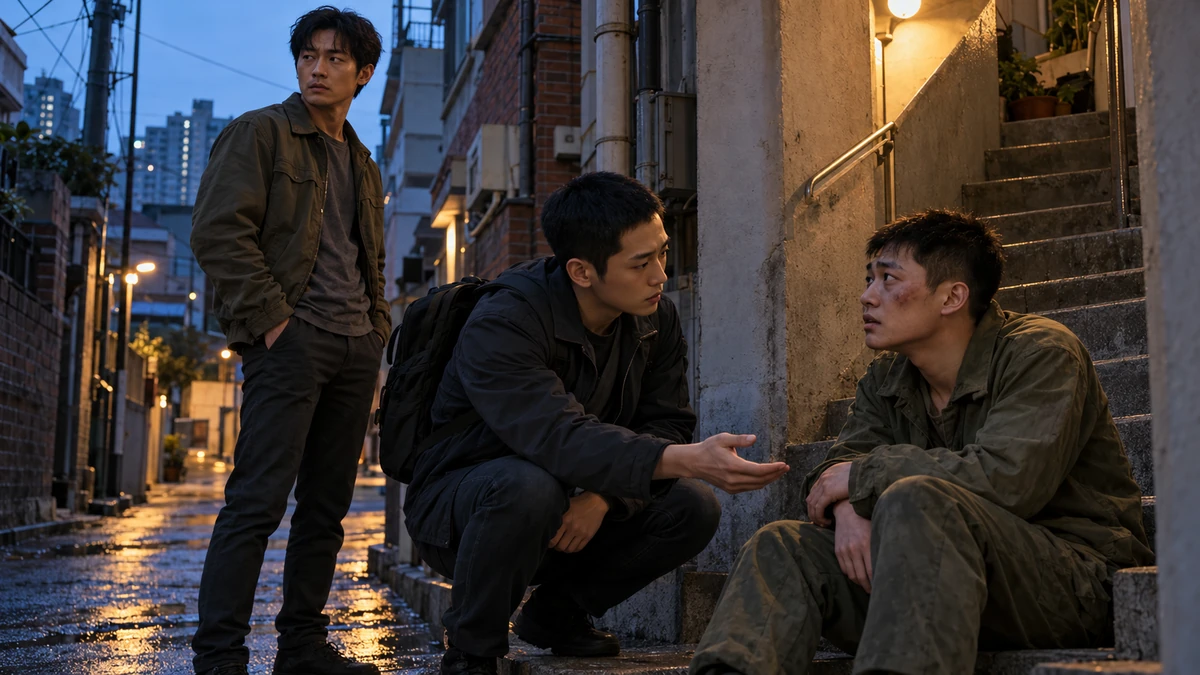
Image to help understand the article
A military pursuit drama with a darker mission
Netflix’s South Korean series “D.P.” follows soldiers assigned to track down military deserters, using their investigations to examine bullying, brutality and institutional failure within the country’s armed forces.
The title stands for “Deserter Pursuit,” a military term generally referring to teams, often within the military police, tasked with apprehending service members who have left without authorization. The drama debuted its first season on Aug. 27, 2021, and returned for a second on July 28, 2023. Its two seasons contain 12 episodes in total.
Set initially in 2014, the series begins when newly enlisted Pvt. An Jun-ho is assigned to a D.P. unit. Partnered with Cpl. Han Ho-yeol, he searches for deserters and gradually confronts the painful circumstances that drove them to flee. The second season continues directly from the first while widening the story’s focus to senior officers and the military hierarchy.
Han Jun-hee directed the series and co-wrote it with Kim Bo-tong, whose webtoon “D.P. Dog’s Day” inspired the adaptation. JTBC Studio produced the drama, which blends elements of crime, action and adventure with a serious examination of military life.
From webtoon to live-action series
Kim based the original story on experiences from his own mandatory military service. Lezhin Entertainment announced in June 2020 that Lezhin Studio and Homemade Film would jointly produce a six-episode adaptation, and filming began that summer. A second season was announced on Dec. 14, 2021.
Han said he had wanted to adapt the work for five or six years before taking on the project. For the television version, An was changed from a corporal in the webtoon to a private just beginning military life. The director said the lower rank was intended to help viewers identify with An and see him as a friend entering an unfamiliar system.
Han Ho-yeol, meanwhile, was created for the Netflix series and does not appear in the original webtoon. Koo Kyo-hwan, who plays the character, described portraying a role without a source-material counterpart as difficult but interesting. He also sought advice from his road manager, who had served in a D.P. unit.
Jung Hae-in stars as An, with Koo as his more experienced partner. Kim Sung-kyun plays Sgt. Park Beom-gu, and Son Suk-ku portrays Capt. Lim Ji-seop. Cho Hyun-chul appears as fellow soldier Cho Suk-bong, while Shin Seung-ho plays senior soldier Hwang Jang-soo. Park Se-joon, Hyun Bong-sik and Hong Kyung also have supporting roles.
Jung trained in boxing for three months before production so he could perform his own action scenes. Kim praised the ensemble, saying he had never imagined such casting and felt each actor fit the role as though it had been written specifically for them.
Abuse, discrimination and institutional responsibility
The first season moves beyond the mechanics of catching deserters to show how soldiers perceived as weak can be pushed to the bottom of a rigid hierarchy and subjected to abuse by superiors and peers.
The second season examines similar problems more often through the perspective of high-ranking officers. Its story addresses corruption and discrimination against LGBTQ people while asking how much responsibility an institution bears when a soldier becomes violent after suffering abuse from fellow service members.
The show also generated a dispute over a scene in Episode 5. After leaving the military, Hwang works at a 7-Eleven store and attempts to remove expired milk from a shelf. The store owner scolds him and orders him to put it back. 7-Eleven said the scene could damage the reputation of its brand and franchise owners and that it was considering legal options. The company said it had cooperated with the filming but had not expected the scene to be so negative.
Netflix success and critical response
After its release, the first season reached No. 1 on Netflix’s South Korean Top 10 chart. On Rotten Tomatoes, all five listed critic reviews for Season 1 were positive, producing an average score of 8.8 out of 10. All six reviews listed for Season 2 were also positive, with a 7.9 average.
William Schwartz of HanCinema praised Jung’s performance in an introspective, cinematic role far removed from the romantic dramas for which he was known. South China Morning Post critic Pierce Conran awarded the show 4.5 out of 5 stars, commending its cinematography and the chemistry between Jung and Koo while noting how unresolved problems from the past can persist into the present.
Review Geek’s Greg Wheeler gave the series 4.3 out of 5, praising its direct treatment of bullying, mental health and South Korea’s mandatory military service. NME’s Hidzir Junaini gave it 3 out of 5, applauding its compassionate handling of tragic material, performances, cinematography and pacing but criticizing the characterization of its three central figures and arguing that later developments shift the grounded drama toward melodramatic action-thriller territory.
Major awards in South Korea
“D.P.” won best drama at the 2022 Baeksang Arts Awards, one of South Korea’s most prominent entertainment honors. Koo received the award for best new actor, and Cho won best supporting actor.
At the inaugural Blue Dragon Series Awards in 2022, the show won best drama, Koo was named best new actor and Jung received the TIRTIR Popular Star Award. Jung also won the award for top male performance in the streaming category at the 2022 APAN Star Awards.
The series later received a film award in the series category at the 2023 Bucheon International Fantastic Film Festival. Kim Sung-kyun won an excellence award for male acting at the 2023 Korea Drama Awards.
Comments
Post a Comment