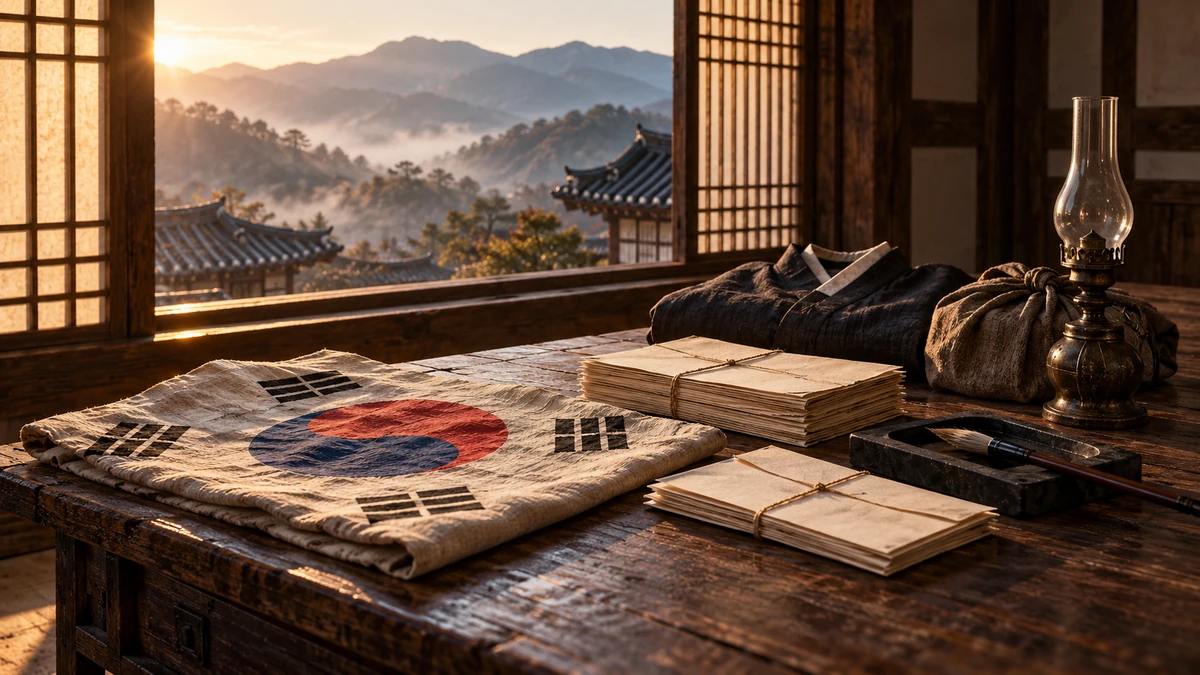
Image to help understand the article
A young commander in Korea’s resistance
Korean independence activist Pyeon Gang-ryeol spent more than two decades moving between armed resistance, underground organizing and efforts to unite rival groups fighting Japanese rule. He joined a volunteer militia as a teenager, later organized the Uiseongdan armed group in Manchuria and played a decisive role in the formation of Jeonguibu, a coalition of independence organizations in southern Manchuria.
Pyeon was born Feb. 28, 1892, in Yeonbaek County in Hwanghae province, the third son of Pyeon Sang-hun. He studied classical Chinese texts and was remembered as exceptionally strong, courageous and uncompromising. Accounts of his youth say he resolved to resist Japan after learning of the coerced 1905 treaty that stripped Korea of its diplomatic sovereignty.
In 1907, with his parents’ permission, Pyeon joined the volunteer force commanded by independence fighter Yi Gang-nyeon. Such militias, known in Korean as “righteous armies,” fought Japanese troops and authorities as Korea’s sovereignty eroded. Yi appointed Pyeon to lead advance operations and recruit fighters, and Pyeon took part in battles across the Gyeongsang and Chungcheong regions.
In 1908, he led troops along Korea’s east coast and through Gangneung to Yangju, north of Seoul, for an attempted advance on the capital. The assembled resistance forces were defeated in a major Japanese attack, and Pyeon suffered several gunshot wounds. He returned to the main force near Mount Taebaek before going home the following spring at the urging of his older brother.
Underground activism and repeated imprisonment
Pyeon attended Soongsil School, a Christian institution in Pyongyang, in 1910 while conducting clandestine activities. The next year, he was implicated in the so-called Case of the 105, a sweeping prosecution of Korean activists, and served three years at Seodaemun Prison.
After his release, he recruited supporters in southeastern Korea and joined the Gwangbokdan independence organization established by Park Sang-jin and others. At Yangjin Uisuk, a school previously operated by his father, Pyeon taught students about Korean independence. He also worked with prominent activists including Ahn Chang-ho and Yang Gi-tak in the secret organization Shinminhoe, which limited contact among members to reduce the risk of exposing the wider network.
During the March First Movement of 1919, a mass campaign demanding Korean independence, Pyeon organized in Hwanghae province and led demonstrations in Yeonbaek County. He sent his younger brother, Pyeon Deok-ryeol, to Shanghai to contact Korea’s provisional government. Working with regional representatives, he also pursued military fundraising, distributed anti-Japanese documents and prepared support for independence fighters seeking to enter Korea.
Pyeon was later imprisoned for a year at Haeju Prison over activities connected to the Guwolsan Jubidan organization. After his release, he worked with other activists on plans to destroy Japanese facilities in Korea, then traveled to Manchuria to establish contact with independence groups there.
Armed struggle and support for Korean communities
Pyeon concluded that education and public awareness campaigns alone would not restore Korean sovereignty. In 1923, he and fellow activists including Yang Gi-tak and Nam Jeong founded Uiseongdan in Huide County, Manchuria. Pyeon was elected leader of the armed anti-Japanese group, which was reported to have about 250 members and its own training organization.
Uiseongdan attacked Japanese institutions and trains carrying military supplies and fought Japanese forces directly. Pyeon and five members carried out an attack on Japanese troops in Changchun. In Fengtian, he and seven members engaged Japanese military police in a prolonged street battle. Another account says seven Uiseongdan members attacked the Japanese Consulate in Changchun, fought roughly 200 soldiers and police officers for about seven hours and returned safely.
Korean accounts said about 60 Japanese soldiers and police officers were killed or wounded in that battle. Japanese records listed 17 deaths and classified the remaining casualties as injuries. Uiseongdan also attacked a South Manchuria Railway hospital reserved for Japanese military personnel in Changchun and Japanese facilities in Jilin.
The organization’s work extended beyond combat. Korean migrants in Manchuria often lacked farmland and agricultural tools and faced exploitation or attacks while farming rented land. Uiseongdan helped organize those communities, establish self-governing and financial institutions, raise funds and operate schools aimed at reducing illiteracy. It also worked to protect farmers who lacked access to medical supplies.
Uiseongdan members continued armed operations inside and outside Korea. Park Il-hun was shot four times during a June 1923 attack on a Japanese police outpost in Uiju but succeeded in destroying the facility. He later died in another clash after suffering a total of nine gunshot wounds. Kim Myeong-je was killed fighting a Japanese garrison after being discovered during a mission to receive weapons in Changchun. Pyeon held a memorial service for him in Jilin in February 1924. Kim Hong-jin and Kim Chang-jin were killed in a June 1924 battle at a Japanese police outpost in Yeongdeok. Japanese authorities wrote that their marksmanship suggested substantial military training.
An effort to unite independence groups
Pyeon believed that divisions among Manchuria’s armed organizations weakened the independence movement and placed additional burdens on Korean communities. He contacted groups including Seorogunjeongseo, Tonguibu, Gugukdan and the Jilin Residents’ Association. He also discussed unifying independence forces in Manchuria and the Russian Far East with commanders and organizers including Kim Gyu-sik, Kim Jwa-jin and Ji Cheong-cheon.
In July 1924, Pyeon led a preparatory committee in Jilin that brought representatives of several organizations together to discuss consolidation. He later took part in similar talks in Harbin. Those efforts were instrumental in the 1925 establishment of Jeonguibu, a unified independence organization in southern Manchuria.
Japanese police arrested Pyeon in Harbin in 1925 as he worked with Ahn Chang-ho, Yang Gi-tak and others to bring Manchurian organizations together. After he was transferred to Korea, colonial authorities offered him a provincial governor’s post if he abandoned the independence movement. He refused, saying he would not become a servant of Japan.
In his final statement at an Oct. 20, 1925, trial, Pyeon said he would fight Japanese rule until his death and seek a future in which a Korean served as governor-general in Japan. Despite defense lawyers’ efforts to reduce his punishment, he was sentenced to seven years in prison.
Death and legacy
Pyeon developed spinal inflammation while imprisoned at Sinuiju Prison. He died Jan. 16, 1929, at Andong Red Cross Hospital. Although he had repeatedly been jailed over efforts to raise money for the independence struggle, he died without personal wealth. A labor union in Andong County, whose 400 to 500 members were Korean, organized a funeral attended by its members.
South Korea’s government posthumously awarded Pyeon the Order of Merit for National Foundation, Presidential Medal, in 1962. A memorial honoring him stands in Namsan Park in Gimcheon, and another was established at the Ganghwa Peace Observatory by Koreans displaced from their homes in the North.
Pyeon’s independence work encompassed volunteer militia warfare, patriotic education, underground organizing, armed attacks and attempts to consolidate competing resistance groups. Historical assessments emphasize that repeated imprisonment, torture and illness did not end his commitment to Korean independence and freedom.
Comments
Post a Comment