Image to help understand the article
South Korean President Lee Jae Myung visited two rural counties in North Gyeongsang province on Oct. 31 to assess a government basic income pilot program, promising to expand the initiative while emphasizing the importance of keeping spending within local communities.
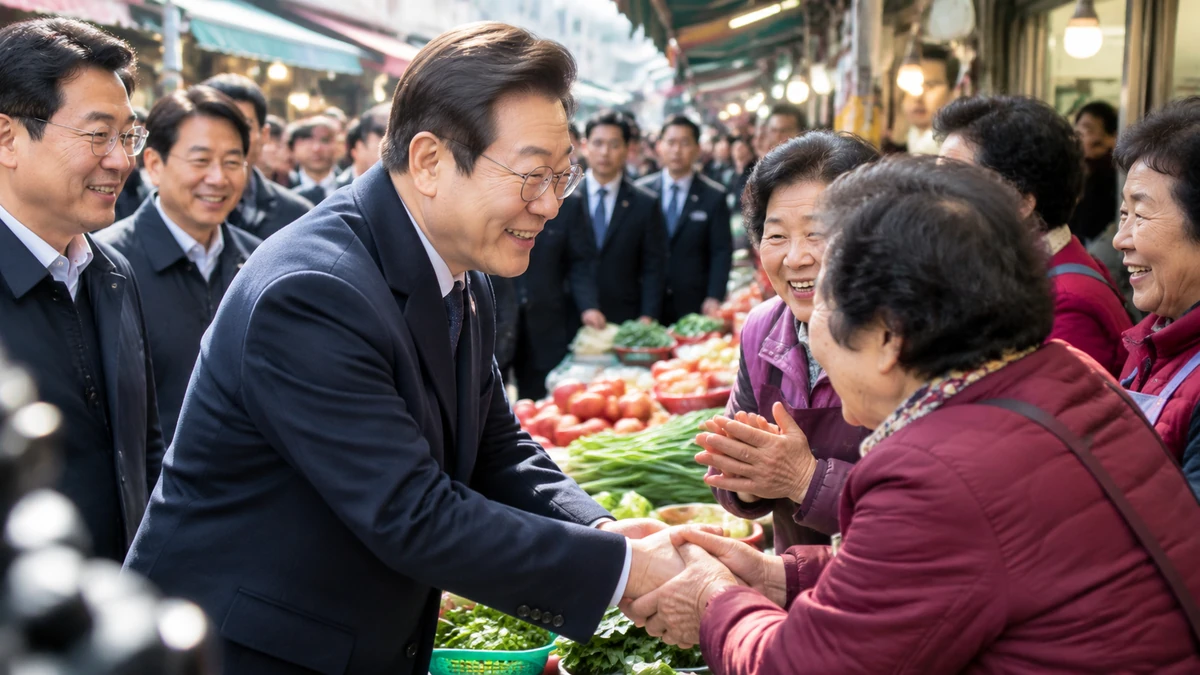
Lee made unannounced stops in Cheongsong and Yeongyang counties, where he visited traditional markets, small businesses and community facilities and spoke with residents about the program's economic effects. The initiative provides residents in selected rural areas with locally restricted spending vouchers intended to support household finances, encourage local consumption and address population decline.
Business owners report stronger local spending
During a walk through the traditional market district in Jinbo-myeon, Cheongsong, Lee visited restaurants, butcher shops, supermarkets, pharmacies, laundromats, hair salons and clothing stores. Business owners told him that sales had increased since the basic income program began.
One young entrepreneur said the financial support had made running a business in a rural area more viable. Lee acknowledged the challenges of starting a business outside a major urban center and praised the owner's determination.
Cheongsong County Gov. Yoon Kyung-hee said the county's population had increased by 1,500 within two to three months of implementing the program, adding that he expected the increase could eventually reach 3,000. Yeongyang County Gov. Oh Do-chang separately said the county had recorded population growth for the first time in half a century, attributing the change to the basic income support.
Spending restrictions are central to the policy
At a community meeting in Yeongyang, Lee explained why recipients cannot spend their vouchers freely across all locations. The restrictions are designed to ensure that money circulates within residents' own communities rather than concentrating in larger town centers.
Lee acknowledged that the rules could frustrate residents but argued that the inconvenience was necessary to achieve the program's objectives. He said allowing unrestricted use of the payment cards would reduce the policy's effectiveness. He also resisted a proposal to combine the spending areas of Cheongsong and Yeongyang, maintaining that clearly defined local boundaries were important.
The discussion highlighted a central feature of the Korean initiative: Unlike unrestricted cash payments, the support is structured to direct purchasing power toward neighborhood businesses and smaller rural communities.
Lee seeks long-term funding and political stability
Lee said the program needed greater institutional stability because its future could be affected by political disputes and changing government decisions. He argued that demonstrating its effectiveness through consistent implementation was essential to securing long-term support.
He described the initiative as a potentially important investment in balanced regional development, preventing rural depopulation and improving quality of life. Lee also called on county officials to help establish the program locally and urged residents to consider how the additional purchasing power could contribute to broader community development.
At a lunch meeting with residents and small-business owners, participants raised concerns about the financial burden on local governments. Lee pledged to pay greater attention to funding arrangements to make the program more sustainable.
He also proposed using shared revenues from renewable energy projects as a possible funding source in Yeongyang, which already has a major wind power complex. Community-owned solar projects and investment opportunities for residents were among the ideas discussed.
Mobile market highlights challenges facing remote communities
Before the community meeting, Lee visited Yeongyang's Masil Market, a mobile retail service designed for residents who have limited access to nearby stores. Two vehicles carry more than 150 types of essential goods, including food, to village meeting halls and other accessible locations.
The operator also delivers items ordered by residents. Its representative joked that local customers considered the service faster than Coupang, South Korea's major e-commerce platform, prompting laughter from Lee and other officials.
Lee also recalled visiting Yeongyang as a child with his father for treatment of an ear infection, noting that the area is near his hometown of Andong and is also connected to his mother's family. He described the county's mountainous geography and relative isolation as challenges that make the basic income program a potential new opportunity for local residents.
The visit ended with a stop at Yeongyang's traditional market, where Lee continued speaking with residents. The president had announced the trip himself on X earlier that morning rather than releasing an advance schedule.
Comments
Post a Comment