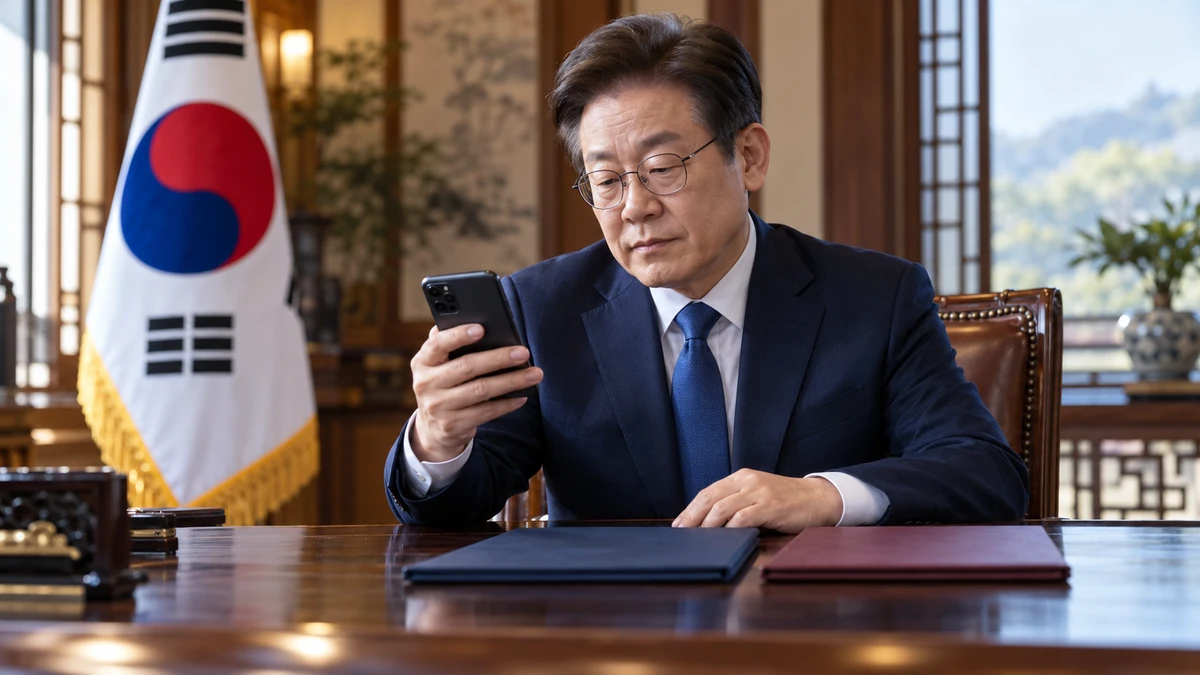
Image to help understand the article
Lee defends personnel choice amid party criticism
South Korean President Lee Jae Myung said prosecutors’ offices must be institutionally overhauled without allowing political figures to interfere in personnel decisions, individual investigations or prosecutions.
In a series of posts on X, formerly Twitter, Lee warned that no one should use prosecutorial reform as a pretext to pursue personal interests or control appointments and specific cases. He said public officials must distinguish between public responsibilities and private interests.
“Prosecutorial reform is being carried out for the people, not to create a political legacy for particular individuals,” Lee wrote. He also criticized attempts to claim sole credit for the overhaul by dismissing other officials’ contributions as useless or obstructive.
His comments were widely interpreted as a response to criticism from hard-line reform advocates within the governing camp over the nomination of Kim Ji-yong, a former prosecutor, to lead the planned Major Crimes Investigation Agency. The presidential office has said it sees no problem with Kim’s selection, while prominent critics, including Gyeonggi Gov. Choo Mi-ae of Lee’s Democratic Party, have objected.
Government says investigation and prosecution are being separated
Lee rejected allegations that his administration had deliberately delayed the restructuring. He shared a video by Gangwon Gov. Woo Sang-ho, a former senior presidential political affairs official who coordinated with the Democratic Party on the reforms.
Lee said the government moved quickly under an agreement with the party to fully separate investigative and prosecutorial powers. He added that the plan went further than many earlier proposals by placing the two functions under different ministries.
Woo said the timetable — including legislation establishing the Public Prosecution Office and the Major Crimes Investigation Agency, as well as revisions to the Criminal Procedure Act — had been agreed upon with Democratic Party leader Chung Chung-rae. His comments challenged claims that the government had resisted the party’s demands.
Writer and political commentator Rhyu Si-min had accused Lee of misleading the public over whether both bodies would remain within the Justice Ministry and whether prosecutors would retain any investigative authority. Lee’s posts appeared to answer that criticism directly.
Two agencies would divide major investigative duties
Under the government’s plan, the Major Crimes Investigation Agency would investigate corruption and financial crimes, while the Public Prosecution Office would handle indictments and courtroom prosecutions. The investigative agency would operate under the Ministry of the Interior and Safety, while the prosecution body would remain under the Justice Ministry.
Lee said many reform advocates, including members of the Rebuilding Korea Party, had originally supported putting both organizations under the Justice Ministry and allowing prosecutors to conduct supplementary investigations. The government, he said, went further by assigning the agencies to separate ministries and accepting demands to remove supplementary investigative powers from prosecutors.
Lee argued that the institutional separation of investigations and prosecutions — the central goal of the overhaul — had therefore been completed to the point that even follow-up investigations by prosecutors would be prohibited.
President cautions against political extremes
Lee also used three social media posts within roughly a day to warn against what he described as irresponsible extremism on both the political left and right.
He said radical demands and unsupported agitation can reflect a desire to monopolize credit for reform rather than serve the public. Lee referred to such figures as the “mugeuk faction,” a label suggesting unrestrained extremists, but did not identify specific people or statements.
Lee shared a clip of the late former President Roh Moo-hyun warning about extremism and said similar movements had appeared during the French Revolution, Roh’s presidency and the present day. Reform, Lee wrote, should be a goal in itself — not a way to attract attention, demonstrate ideological purity or attack others.
Comments
Post a Comment