Image to help understand the article
A national blockbuster on a high-speed train
Yeon Sang-ho’s “Train to Busan” opened in South Korea on July 20, 2016, and became the country’s first film that year to surpass 10 million admissions, a benchmark widely used by the Korean film industry to measure blockbuster success. According to the Korean Film Council’s box office database, the movie had drawn 11,531,866 admissions by Sept. 4, 2016.
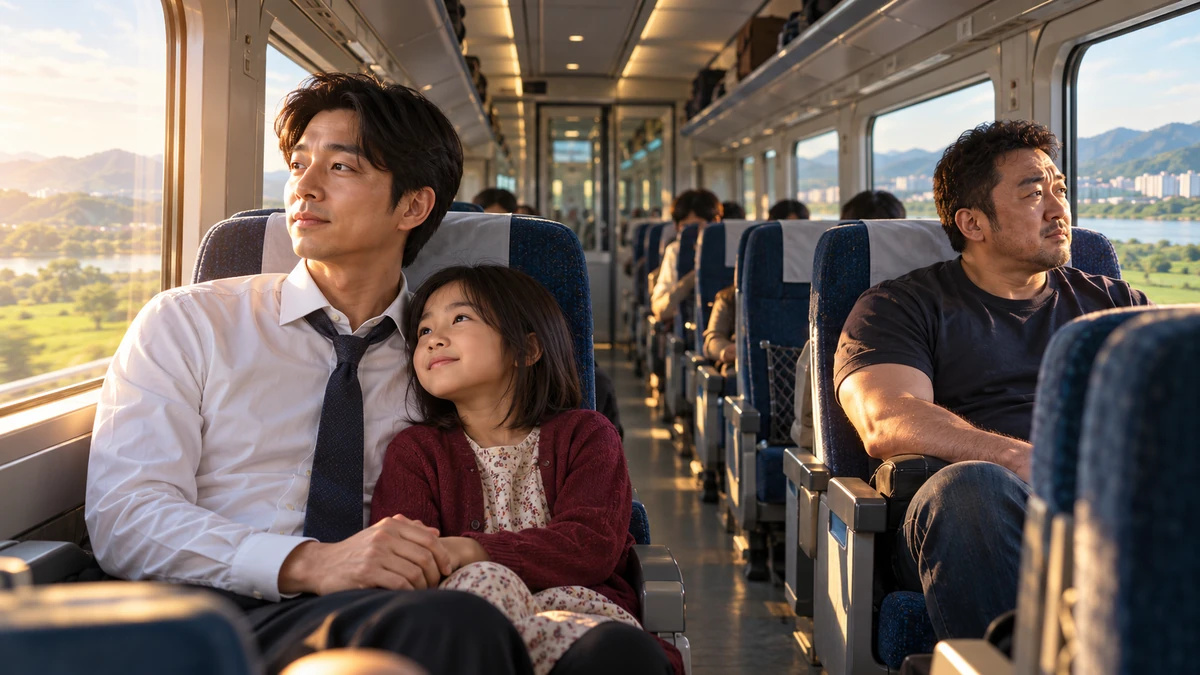
The 118-minute action thriller follows passengers aboard a KTX high-speed train from Seoul to the southern port city of Busan as a rapidly spreading infection turns people into zombies. Rated in South Korea for viewers 15 and older, the film was produced by RedPeter Film and distributed by Next Entertainment World, or NEW. Yeon and Park Joo-suk are credited as screenwriters.
A father-daughter journey becomes a fight for survival
Gong Yoo stars as Seo Seok-woo, a fund manager separated from his wife and emotionally distant from his young daughter, Su-an, played by Kim Su-an. Hoping to fulfill her birthday wish, he boards a train with her to visit her mother in Busan.
Other passengers include the pregnant Seong-kyeong, played by Jung Yu-mi, and her husband, Sang-hwa, played by Ma Dong-seok; a high school baseball team; students portrayed by Choi Woo-shik and Ahn So-hee; a homeless man played by Choi Gwi-hwa; and a businessman portrayed by Kim Eui-sung. Ye Soo-jung and Park Myung-shin play elderly sisters, while Jung Suk-yong appears as the train’s engineer. Shim Eun-kyung makes a special appearance as a runaway teenager.
Moments before departure, an infected young woman slips aboard and attacks a train attendant, setting off chaos inside the cars. As passengers learn that the emergency is unfolding nationwide, they focus on reaching Busan, described as the only city where authorities have successfully contained the initial outbreak.
An attempted evacuation at Daejeon station collapses when the passengers encounter infected people in military uniforms. Back aboard, the survivors face not only zombies but distrust among themselves. A corporate executive locks doors against those he believes may be infected, dividing the train and forcing several characters into increasingly desperate attempts to move between cars. When a derailment later blocks the tracks at Dongdaegu station, the engineer announces plans to prepare another train on a separate line.
Festival debut, rerelease and franchise
“Train to Busan” premiered before its Korean theatrical release, screening in the noncompetitive Midnight Screenings section at the Cannes Film Festival on May 13, 2016. It returned to Korean theaters on July 1, 2020.
The film also found a large television audience. When South Korean broadcaster MBC aired it as a special presentation during the Chuseok harvest holiday on Oct. 6, 2017, it recorded a 12.9% rating and was the only holiday movie shown that day to reach double digits.
Yeon’s animated film “Seoul Station” serves as a prequel, while the sequel “Peninsula” opened in South Korea on July 15, 2020.
An English-language remake connection
The film’s international reach prompted plans for an English-language remake. Variety reported in December 2016 that French studio Gaumont was developing the project. Reports in September 2018 said James Wan would produce the remake, with Gary Dauberman writing the screenplay, linking the Korean hit to two established figures in Hollywood horror filmmaking.
Award recognition at home and abroad
At the 2016 Sitges International Fantastic Film Festival in Spain, Yeon won best director and Jung Hwang-su received the visual effects award. In South Korea, Kim Eui-sung collected multiple supporting actor honors, including awards from the Buil Film Awards, the Korean Association of Film Critics Awards and the Baeksang Arts Awards.
The film also received recognition for its screenplay, special effects and makeup. Yeon won the rookie director award in the film category at the 2017 Baeksang Arts Awards, while Ma Dong-seok was named best supporting actor at South Korea’s Film Awards of the Year.
Comments
Post a Comment