Image to help understand the article
Amkor Technology Korea broke ground Oct. 19 on a major expansion of its semiconductor packaging operations in Gwangju, pledging to invest 3 trillion won and create about 2,000 jobs as demand rises for chips used in artificial intelligence and high-performance computing.
The company said it accelerated the timeline and added 2 trillion won to its original investment plan. Spending is scheduled from 2026 through 2031, while the employment target has doubled from about 1,000 positions.
Four Advanced Packaging Plants Planned
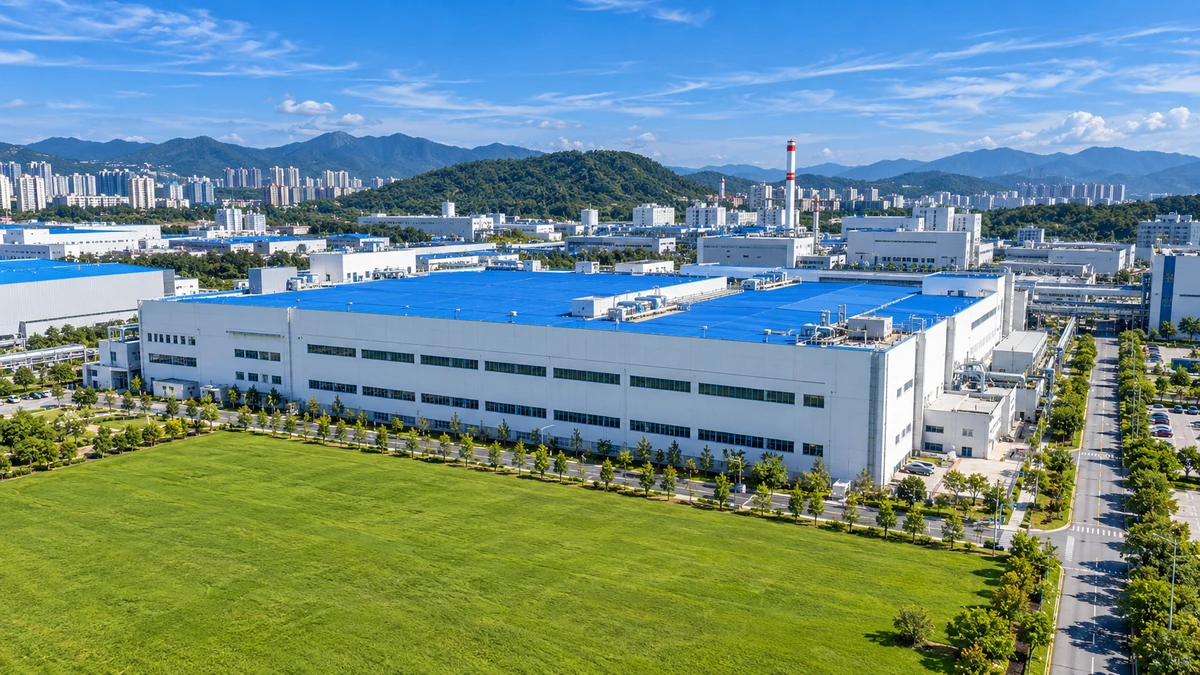
Amkor plans to build four packaging and testing facilities in stages on unused land at its existing K4 complex in Gwangju, a regional city in southwestern South Korea. Two buildings are scheduled for completion in the second half of 2027 and two more in the first half of 2028. Each is expected to begin mass production as soon as construction is completed.
The plants will produce advanced packaging products for AI and high-performance computing, or HPC, including technology used in AI data centers and supercomputers. Advanced packaging combines or stacks different chips to improve computing performance and energy efficiency. The technology has become increasingly important as manufacturers encounter physical limits in making semiconductor circuitry smaller.
Growth in AI, high-bandwidth memory and data-intensive computing is increasing demand for this stage of chip production. Known as back-end manufacturing, it includes packaging completed chips and testing them before they are placed in electronic products.
Wastewater Agreement Clears Expansion Hurdle
Resolving wastewater capacity constraints was a turning point in the expansion. Amkor requested support for processing an additional 5,500 metric tons of wastewater per day, but Gwangju's first sewage treatment plant had reached its daily capacity of 600,000 tons. A second plant, with capacity for 120,000 tons a day, was operating at 92%.
Regional authorities and Jangseong County agreed to connect the project with public wastewater treatment facilities serving the Advanced District 3 development and the Nano Industrial Complex. The local governments reached an additional agreement two days after Amkor's request, securing a treatment plan. The proposed investment subsequently increased from 1.009 trillion won to about 3 trillion won.
Amkor chose to expand in South Korea after the site competed with the company's overseas production bases for the investment. The project is expected to accelerate work on electricity, water and transportation infrastructure needed for a broader semiconductor development strategy in the country's southwest.
First Project to Break Ground Under Regional Chip Plan
Amkor announced its Gwangju investment plan June 30 as part of a national presentation on advanced industrial development in southwestern South Korea. It is the first company to begin construction among the semiconductor projects unveiled under that initiative, which calls for 896 trillion won in overall investment.
The company's earlier plan envisioned spending more than 500 billion won in the first phase and beginning production at the end of 2027. It initially proposed three new AI chip packaging and testing lines, along with expanded cooperation with South Korean suppliers.
Separately, Samsung Electronics plans to invest 425 trillion won in the broader Honam region, which includes Gwangju and the surrounding Jeolla provinces, for two memory chip fabrication plants and a national AI computing center. SK Hynix plans to invest about 470 trillion won in two memory plants and a 1-gigawatt AI data center. The companies are targeting initial mass production in 2030.
If those front-end fabrication plants are connected with Amkor's packaging and testing operations, the region could develop a supply chain covering production through final assembly and inspection. Whether the companies will directly exchange production volume will depend on future business plans and contracts.
U.S. Chip Company Deepens Korea Footprint
Amkor Technology, headquartered in the United States, operates more than 20 facilities across eight countries and recorded about 9 trillion won in revenue last year. Its South Korean subsidiary generates more than 5 trillion won in annual revenue and employs about 8,400 people across sites in Gwangju, Songdo and Bupyeong.
The Gwangju operation, established in an advanced industrial complex in the 1990s, has grown into one of Amkor's main production bases and one of the city's largest industrial workplaces. Executives from Amkor's U.S. headquarters attended the groundbreaking alongside South Korean government officials and representatives of global customers including TSMC and Nvidia.
Lee Min-woo, a senior official at South Korea's Ministry of Trade, Industry and Energy, called the groundbreaking the first sign that the southwest semiconductor investment plan was moving into construction. He said the government would work with ministries and local authorities to support the project and address obstacles throughout the investment process.
Comments
Post a Comment