Image to help understand the article
A landmark film about the May 18 movement
Released April 5, 1996, Jang Sun-woo’s “A Petal” confronts the lasting trauma of South Korea’s May 18 Gwangju Democratization Movement through the story of a girl who experienced the violence at age 15. Based on a work by Choe Yun, the 101-minute drama was written by Jang and Shim Kwang-jin and produced by Miracin Korea.
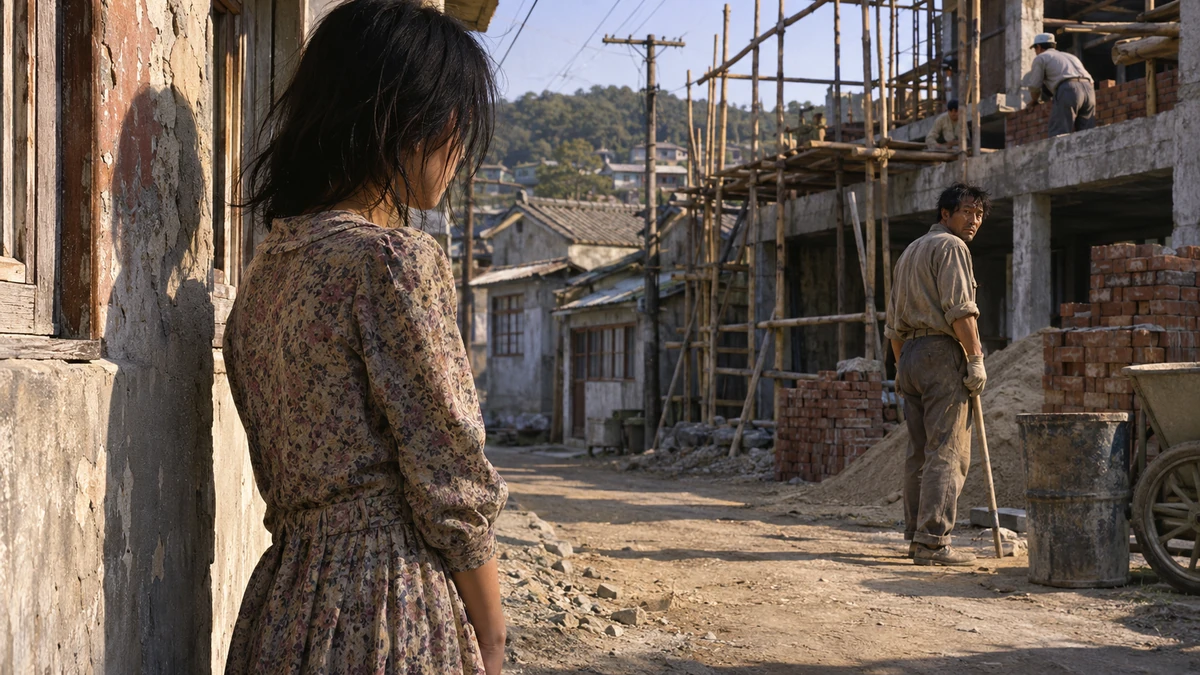
The story follows a group known as “We” as they search for the younger sister of a friend who died under suspicious circumstances. A construction worker named Jang encounters the girl on the street. After she follows him and calls him her older brother — a Korean term that can convey trust and familiarity beyond a literal sibling relationship — he subjects her to physical and sexual violence. As he witnesses her nightmares and fragmented speech, however, he gradually begins to recognize the grief she carries.
A demanding debut performance
Lee Jung-hyun plays the girl, while Moon Sung-keun portrays Jang. The cast also includes Lee Young-ran as the girl’s mother, along with Yoo Soon-chul, Ahn Suk-hwan, Oh Ji-hye, Park Kwang-jung, Park Choong-seon and Huh Joon-ho. Seol Kyung-gu, Park Chul-min, Choo Sang-mi and Na Chang-jin appear as members of “We.”
Lee was 15 and inexperienced as an actor when filming began. She later recalled that the director halted her first shoot and threw down the script because of her performance. After returning to her lodging and crying, she decided that if she could not act like the traumatized character, she would have to live like her. Lee said she wandered neighborhoods for three or four hours before filming, sometimes prompting residents who believed she was genuinely distressed to take her in, wash her and give her food. Looking back, she described the lack of separation between her daily life and the role as a naive approach.
Recreating violence and memory
Cinematographer Yoo Young-gil, lighting director Kim Dong-ho, composer Won Il and editor Kim Yang-il helped shape the film’s stark presentation. Its large crowd sequences in Gwangju attracted attention during production. The advance of tanks and violence by airborne troops are recreated in black and white, accompanied by mournful traditional Korean music.
Jang’s transformation supplies the film’s broader argument about historical memory. He abuses the girl while she remains with him, then loses control after she disappears. As he learns the source of her breakdown and encounters Gwangju indirectly through fellow workers, his ignorance gives way to an understanding of her suffering. The character can be read as a symbol of the indifference and mistreatment directed at victims by people removed from the events.
Recognition at home and abroad
“A Petal” received the Ecumenical Jury Prize and a special mention for Jang at the 1996 Mannheim-Heidelberg International Film Festival. Jang also received a special mention for the KNF Award at the 1997 International Film Festival Rotterdam. The film won a jury prize for best Asian feature at the 1998 Bangkok International Film Festival and recorded best film honors at the Asia-Pacific Film Festival in 1996 and 1997. Moon won best actor at the 41st Asia-Pacific Film Festival.
In South Korea, Moon received best actor at the 17th Blue Dragon Film Awards. Lee won best new actress at both the Blue Dragon Film Awards and the 34th Grand Bell Awards, as well as newcomer honors from the Korean Association of Film Critics and the Cine21 Film Awards.
Scholar Kim Kyung-hyun later examined “A Petal” alongside “A Single Spark” in his 2004 book, “The Remasculinization of Korean Cinema.” The chapter, titled “Post-Trauma and Historical Remembrance in A Single Spark and A Petal,” placed the film within a wider discussion of how Korean cinema represents collective trauma and remembers history.
Comments
Post a Comment