Image to help understand the article
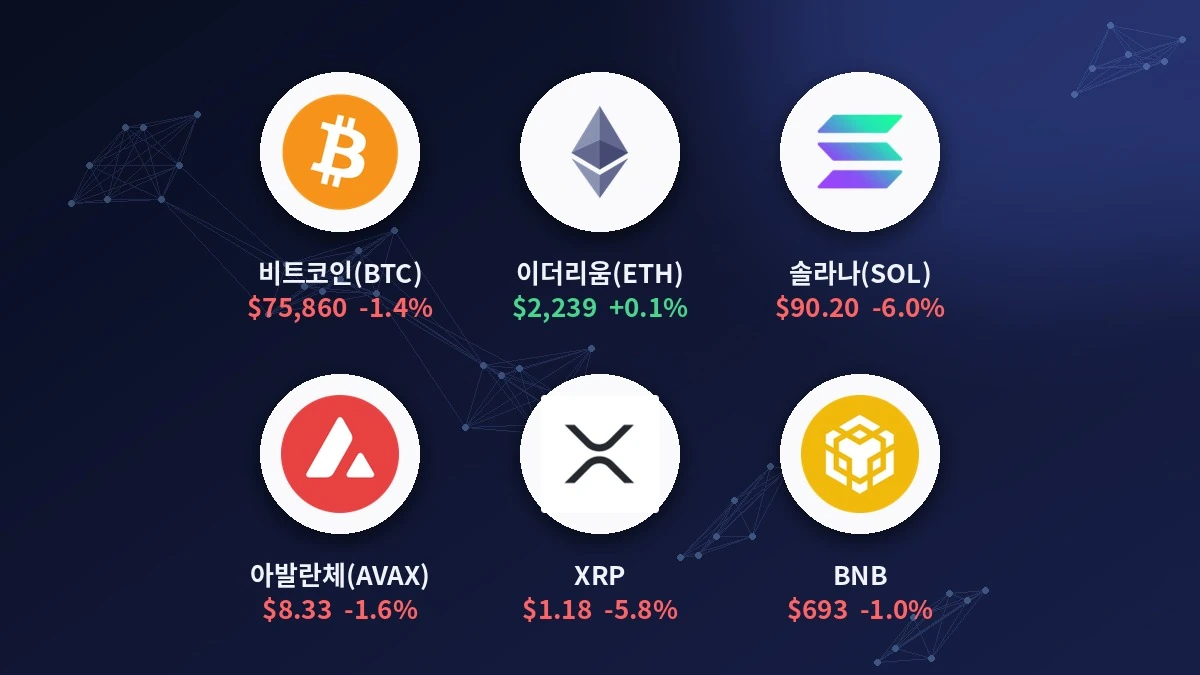
Bitcoin traded at $75,860 on Nov. 7, down 1.4% over seven days, as cryptocurrency markets faced renewed selling pressure and substantial withdrawals from U.S. spot exchange-traded funds. Ethereum held relatively steady at $2,239, gaining 0.1% over the week, according to CoinGecko data recorded at 9:30 a.m. Korea time.
The total cryptocurrency market capitalization fell 2.5% in 24 hours to $2.57 trillion. Bitcoin accounted for 59.2% of the market, with a capitalization of approximately $1.53 trillion. Solana dropped 6% over seven days to $90.20, while XRP declined 5.8% to $1.18.
U.S. Spot Crypto ETFs Face Significant Withdrawals
U.S. spot Bitcoin ETFs experienced substantial and uneven capital flows during the first week of November. Data from Farside Investors showed that $115.6 million left the funds on Nov. 3. BlackRock's IBIT recorded $95 million in outflows, while Bitwise's BITB attracted $21.9 million and Fidelity's FBTC received $6.8 million.
The direction briefly reversed on Nov. 4, when Bitcoin ETFs recorded a combined net inflow of $74.6 million. Fidelity's FBTC attracted $236.7 million, offsetting $201.2 million in withdrawals from BlackRock's IBIT. The recovery did not last. On Nov. 5, the funds recorded $430.2 million in net outflows, including $199.9 million from FBTC and $105 million from IBIT. Separate data from TFTC put Bitcoin ETF withdrawals at $398.6 million on Nov. 2.
Ethereum investment products also experienced persistent selling. SoSoValue reported $140 million in net outflows from spot Ethereum ETFs on Nov. 2, with BlackRock's ETHA accounting for approximately $138 million, or 98.6% of the total. Farside Investors recorded another $85.3 million in withdrawals on Nov. 3, marking seven consecutive trading sessions of net outflows. BlackRock's Ethereum Trust lost $74.4 million, while Grayscale's Ethereum Mini Trust saw $10.9 million withdrawn.
Ethereum ETFs briefly returned to positive territory on Nov. 4, attracting $53.02 million and ending a five-session withdrawal streak, according to SoSoValue. However, the 11 products collectively lost $99.97 million on Nov. 5. BlackRock's ETHA accounted for $75.2 million of those withdrawals, while ETHB lost $21.99 million. Solana and Avalanche spot ETFs also recorded net outflows of $1.18 million and approximately $841,000, respectively.
U.S. Economic Signals and Stock Market Volatility Pressure Bitcoin
Bitcoin's price movements reflected broader uncertainty in U.S. financial markets. Initial jobless claims came in at 189,000, below the forecast of 196,000 and the lowest level since mid-July 2026. On Nov. 5, Bitcoin briefly climbed above $80,500 before falling below $80,000. It was trading around $79,356 at one point, up approximately 1.3% over 24 hours.
Broader market volatility subsequently weighed on digital assets. Following gains by Democrats in the U.S. midterm elections, concerns about a slowdown in artificial intelligence-related economic activity coincided with sharp declines in major stock indexes. The Nasdaq Composite fell 5.5%, while the S&P 500 dropped approximately 4.4%. Bitcoin also retreated.
On Nov. 6, the Nasdaq recovered 1.1% and the S&P 500 gained 0.3%, while the Dow Jones Industrial Average slipped 0.45%. Bitcoin remained relatively range-bound between approximately $75,750 and $76,000.
Employment figures provided another important signal for monetary policy expectations. October job growth reached 165,000, substantially exceeding the forecast of 65,000. Meanwhile, market-implied odds of a Federal Reserve interest rate increase in December rose to 77%, compared with approximately 70% during the Nov. 5 market sell-off. Expectations surrounding U.S. monetary policy remain an important factor for investors assessing riskier assets such as cryptocurrencies.
Binance Details $6.3 Billion Wallet Attack Linked to North Korea
Security concerns added another layer of uncertainty after Binance disclosed a major wallet compromise involving approximately $6.3 billion in cryptocurrency outflows. The exchange said the activity began at 8:05 p.m. UTC on Oct. 29 and was contained by 12:10 a.m. UTC the following day.
Binance reported that approximately $2.85 billion had subsequently been frozen or recovered and that company funds covered approximately 98% of the affected tokens. Its chief security officer said North Korea-linked hackers had infected an engineer's computer with malware through a fake job interview process. The attackers then exploited Ethereum's EIP-7702 functionality to gain control of hot wallets, which are connected to the internet and used for transactions.
The FBI identified North Korea as being behind the attack. The incident highlights the security risks facing cryptocurrency exchanges and the importance of protecting employees and operational wallet infrastructure, even as blockchain technology expands into mainstream financial services.
Samsung Wallet and Schroders Expand Their Solana Connections
Despite market weakness, major companies continued developing blockchain-based financial services. Samsung Wallet introduced stablecoin accounts on Nov. 5, allowing eligible Galaxy users in the United States to purchase, hold and transfer USDC on the Solana blockchain. The potential device reach was approximately 82 million Galaxy devices in the U.S. market.
Custody services will be provided by licensed digital asset custodian Bastion, with Coinbase serving as a subcustodian through its Coinbase Prime Vault infrastructure. The initiative gives eligible American Galaxy users access to a stablecoin through a familiar mobile wallet environment.
Asset manager Schroders also announced a Solana-based investment initiative in partnership with Centrifuge. Its Schroder International Selection Fund Emerging Markets Bond strategy was brought onto the blockchain. Schroders manages approximately $1.1 trillion in assets, although the amount allocated to this particular on-chain strategy was not disclosed.
These developments illustrate how established financial institutions and technology companies are continuing to explore blockchain infrastructure even as cryptocurrency prices and investment flows fluctuate.
Solana Developers Warn of Critical Linux Vulnerability
Solana's ecosystem also faced a significant infrastructure security warning. Solana-focused development firm Anza and the Solana Foundation alerted mainnet beta validators on Nov. 1-2 to a critical Linux kernel vulnerability identified as CVE-2026-98432, carrying a CVSS severity score of 9.8 out of 10.
The flaw is a use-after-free vulnerability in the IPv4 TCP connection establishment process. It has existed since Linux kernel version 4.4, released in 2016, and affects Ubuntu 22.04, 24.04, 26.04 and 26.10. Until patches become available, the organizations advised validators to block IPv4 option packets through nftables and disable Multipath TCP (MPTCP) and TCP request socket migration functionality.
Separately, blockchain analytics firm Glassnode reported that Bitcoin finished the week ending Nov. 1 down approximately 2%, before trading near $78,000 on Monday. A decline on Thursday had pushed the cryptocurrency decisively below $80,000. During the same period, U.S. spot Bitcoin ETF flows shifted from $247.3 million in net outflows to $46.7 million in net inflows. ETF-related trading volume increased 21.6% to $13.1 billion, while Bitcoin's market value to realized value (MVRV) ratio rose to 1.43.
The latest figures point to a cryptocurrency market balancing institutional adoption and expanding blockchain applications against ETF withdrawals, macroeconomic uncertainty and persistent cybersecurity risks. All prices and market statistics reflect the CoinGecko snapshot taken Nov. 7 at 9:30 a.m. Korea time. Cryptocurrency investments remain highly volatile and carry the risk of losing principal.
Comments
Post a Comment