Image to help understand the article
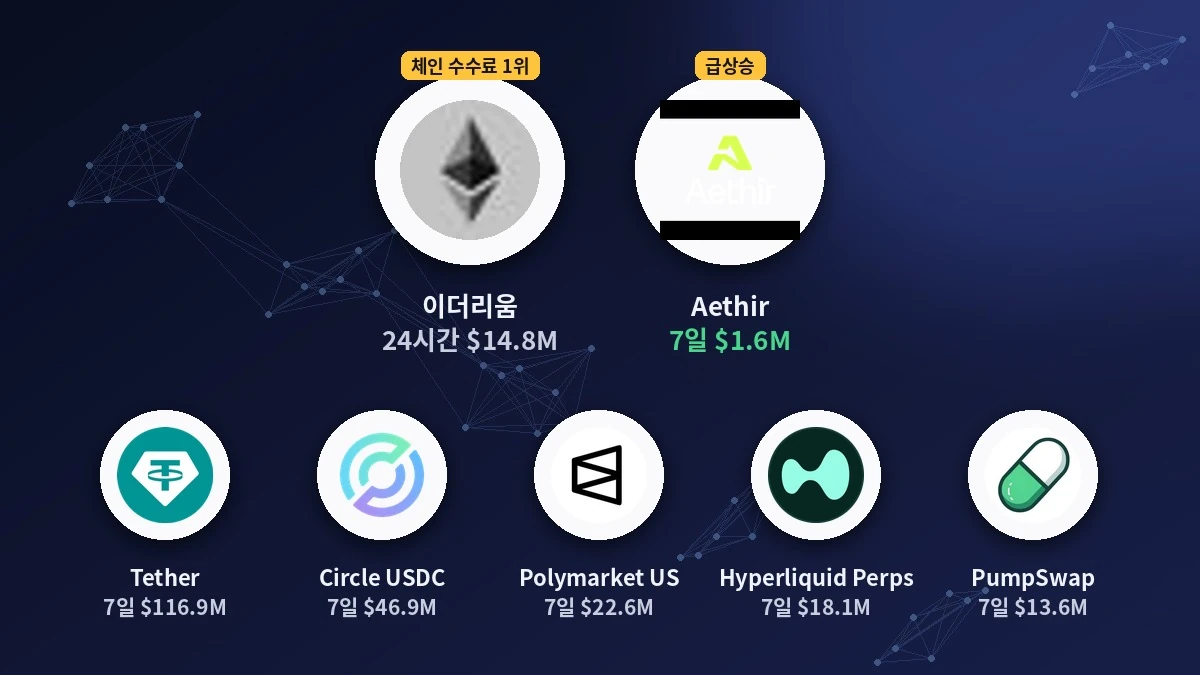
Ethereum generated the highest blockchain transaction fees over the past 30 days, while Aethir emerged as the fastest-growing major project in a weekly ranking compiled by DeFiLlama on Nov. 13. The data showed broad declines among the largest fee-generating protocols, alongside sharp increases in activity across developer tools, token launchpads and decentralized finance applications.
Stablecoin issuers dominate weekly fee rankings
Tether ranked first among the 10 largest fee generators, collecting $116.9 million over seven days. Circle's USDC followed with $46.9 million. Both recorded a 1% decline from the previous week.
Fees fell at nine of the 10 projects in the ranking. Lido experienced the steepest drop, with weekly fees falling 48% to $10.2 million from $19.8 million. Hyperliquid Perps declined 16%, PumpSwap fell 21%, pump.fun dropped 19% and Aave V3 decreased 14%.
Morpho Blue was the only project among the top 10 to post an increase. The lending protocol's fees rose 13% to $8.1 million from $7.2 million.
The figures distinguish between fees and revenue. Fees represent the total amount users pay, while revenue is the portion retained by a protocol and its token holders. Tether and Circle recorded equal fee and revenue figures. Polymarket US collected $22.6 million in fees but reported no revenue for the seven-day period. Lido generated $621,000 in revenue from its $10.2 million in fees.
Aethir and token launchpads lead emerging projects
Among projects generating at least $200,000 in weekly fees and recording growth of more than 50%, Aethir ranked first by fee volume. Classified under developer tools, the project generated $1.6 million on Arbitrum, compared with zero in the preceding seven days, making it a new entrant in the category.
Token launchpads also recorded substantial gains. Montra, operating on the Elysium blockchain, increased weekly fees from $53,000 to $1.3 million, a 25.2-fold rise. Another Elysium launchpad, Ascend Launchpad, climbed 13.7-fold to $537,000. Bags, operating on Solana and Robinhood Chain, increased fees 6.3-fold to $264,000.
Other notable increases included Tron-based lending protocol JustLend V1, whose fees rose 3.4-fold to $1 million, and AI agent project Central City, which reached $1 million across Base and Arc, up 3.2-fold.
Peapods Finance recorded the largest proportional increase. The yield-farming project, operating on Berachain and Arbitrum, saw fees jump from just $21 to $340,000, a reported increase of 16,087.2 times. Ethereum-based stablecoin wrapper Saturn also entered the ranking, recording $303,000 after reporting negative fees of $22,896 in the previous period.
Trading application Ave.ai increased fees 41-fold to $323,000, while Base-based Farm project Venice rose fourfold to $623,000.
Ethereum leads blockchain fee activity, while TON shows the strongest recent concentration
Excluding off-chain fees recorded by stablecoin issuers, Ethereum ranked first among the eight leading blockchain networks, with $14.8 million in fees over 24 hours and $431 million over 30 days. Solana followed with $9.1 million and $349.3 million, respectively. Hyperliquid ranked third, generating $5.9 million in daily fees and $185.2 million over 30 days.
TON recorded the strongest recent concentration of activity. Its 24-hour fees of $1.4 million were 1.5 times its average daily fees over the preceding 30 days, which totaled $28.8 million for the month.
Ethereum, Hyperliquid, Base and Polygon each recorded a concentration ratio of 1.0. Robinhood Chain stood at 0.6, Solana at 0.8 and BNB Chain at 0.9.
Robinhood Chain generated $64.2 million in 30-day fees, exceeding Base's $62 million. However, its daily figure of $1.3 million remained below Base's $2.1 million, suggesting that recent activity was less concentrated on Robinhood Chain.
High DeFi yields require a different interpretation
DeFiLlama's data also highlighted liquidity pools holding more than $10 million in deposits. Ethereum's Uniswap V3 USDC-WETH pool posted the highest annual percentage yield, or APY, at 52.70%. Its 30-day average yield was 17%, with $80.5 million in deposits.
The Midas RWA USDC pool offered a 32.05% APY, although its 30-day average was considerably lower at 5.37%.
APY represents the return offered to depositors, not the fees earned by a protocol. The distinction matters when comparing DeFi projects because a high advertised yield does not necessarily indicate strong protocol revenue.
The weekly figures are snapshots of activity rather than guarantees of financial performance. Rapid fee growth, particularly among newer projects, does not establish security or long-term sustainability. The figures summarize publicly available DeFiLlama data and are not investment recommendations.
Comments
Post a Comment